Highlights: In judicial practice, there is significant debate over whether operating a vaping business without a license constitutes the crime of illegal business operations. Classification should depend on the specific type of conduct involved.
In judicial practice, there is significant debate regarding whether operating e-cigarettes without a license can be classified as illegal business operations—
Distinguishing Types of Unlicensed E-Cigarette Operations
Between August 2017 and October 2020, Xie and others procured e-cigarette pods from Guangzhou, Shenzhen, and other locations for sale without obtaining a tobacco monopoly license. They were later caught by law enforcement, who seized a total of 11,430 units of the relevant brand's heat-not-burn pods.Upon inspection, the seized pods were confirmed to be genuine IQOS cigarettes; the local tobacco monopoly bureau assessed the total value of the seized pods at 2.754 million RMB. It was also discovered that Xie and others were selling e-liquid vaporizing e-cigarettes.In recent years, e-cigarettes have gained popularity worldwide, and the number of cases involving unlicensed e-cigarette operations has surged, leading to significant debate about whether such actions can be classified as illegal business operations.On November 10, 2021, the State Council issued Order No. 750, announcing the revised "Regulations on the Implementation of the Tobacco Monopoly Law" (hereinafter referred to as the "Regulations"), which added provisions stating that "new tobacco products such as e-cigarettes shall be implemented in accordance with the relevant provisions of this regulation for cigarettes."On March 11, 2022, the National Tobacco Monopoly Bureau issued the "E-Cigarette Management Measures" (effective from May 1, 2022) (hereinafter referred to as the "Measures"). Prior to the revision of the Regulations, there was already controversy regarding the classification of unlicensed e-cigarette operations, and even after the revision, disputes continue to pose challenges in judicial practice.The aforementioned case involves two types of e-cigarettes: heat-not-burn e-cigarettes and e-liquid vaporizing e-cigarettes.There are differing opinions on how to classify similar cases: one view holds that both heat-not-burn e-cigarettes and e-liquid vaporizing e-cigarettes should not be classified as illegal business operations, arguing that e-cigarettes differ from traditional cigarettes and that prior to the revision of the Regulations, e-cigarettes were not included in the category of monopolized products; thus, the relevant documents from the National Tobacco Monopoly Bureau are merely departmental normative documents. Therefore, they should not be classified as illegal business operations.Another view argues that heat-not-burn e-cigarettes are inherently tobacco products, and operating such e-cigarettes without a license constitutes illegal business operations; prior to the revision of the Regulations, unlicensed operation of e-liquid vaporizing e-cigarettes did not constitute illegal business operations, but after the revision, it does.I believe that clarifying the following three issues will help resolve such problems:Clarifying the types of e-cigarettes.
E-cigarettes are mainly divided into two categories: heat-not-burn (with solid pods) and e-liquid vaporizing (with liquid pods).Heat-not-burn e-cigarettes consist of pods and devices, with the pods wrapped in cigarette paper containing thin slices of tobacco and a filter tip, resembling traditional cigarettes. The core material of heat-not-burn e-cigarette pods is thin slices of tobacco, which come from tobacco leaves and are made from a combination of tobacco leaf scraps, stems, and by-products.E-liquid vaporizing e-cigarettes are electronic devices that vaporize e-liquids for inhalation, consisting of pods and devices, with the pods containing vaporizing substances that can be fully or partially vaporized into aerosols by electronic devices, generally in liquid form, primarily composed of nicotine and various flavor additives.The main difference between heat-not-burn and e-liquid vaporizing e-cigarettes is that the former's core material is tobacco slices, while the latter's core material is nicotine (extracted from tobacco leaves).
The tobacco slices, cigarette paper, and filter tips in heat-not-burn e-cigarette pods are essentially the same as those in regular cigarettes, differing mainly in the method of consumption; the latter is consumed through combustion, while the former is consumed through heating without combustion.For this reason, the true meaning of e-cigarettes in the tobacco professional field does not include heat-not-burn products, which are regarded as ordinary tobacco products.
The "Regulations" and relevant documents from the National Tobacco Monopoly Bureau do not include heat-not-burn products as e-cigarettes.
E-liquid vaporizing e-cigarettes differ significantly from regular cigarettes in both composition and appearance.
Clarifying the distinction between heat-not-burn and e-liquid vaporizing e-cigarettes is a prerequisite for accurate classification.Clarifying "national regulations."
Illegal business operations are administrative offenses, and whether unlicensed e-cigarette operations can be classified as illegal business operations depends on the existence of prior administrative regulatory basis, specifically reflected in Article 225 of the Criminal Law's "violating national regulations."
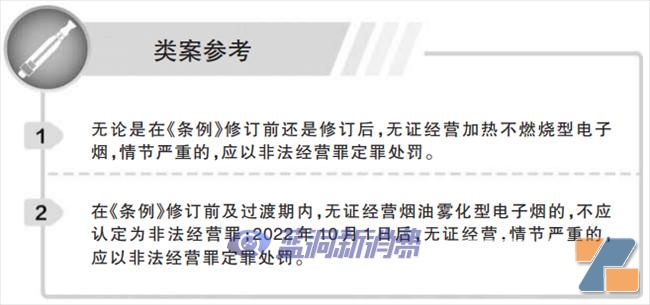
Article 2 of the Tobacco Monopoly Law of 1991 states: "The tobacco monopoly products referred to in this law are cigarettes, cigars, cut tobacco, re-dried tobacco leaves, tobacco leaves, cigarette paper, filter tips, tobacco bundles, and tobacco-specific machinery." Article 3 of the Regulations (revised in 1997 and 2021) states: "The cut tobacco in tobacco monopoly products refers to products made from tobacco leaves, re-dried tobacco leaves, and tobacco slices processed into strands, crumbs, or granules." These two documents are both regulations and State Council orders, falling under the category of "national regulations" in criminal law, which is undisputed. According to these normative documents, heat-not-burn e-cigarettes clearly fall under the category of tobacco monopoly products. Therefore, whether before or after the revision of the Regulations, heat-not-burn e-cigarettes are considered tobacco monopoly products, and unlicensed operations, if serious, constitute illegal business operations.As for e-liquid vaporizing e-cigarettes, prior to the revision of the Regulations, they were not classified as monopolized products, nor were there any other "national regulations" categorizing them as restricted items for sale. Thus, unlicensed operation of e-liquid vaporizing e-cigarettes prior to the revision of the Regulations does not constitute illegal business operations.After the revision of the Regulations in 2021, it was clearly stated that "new tobacco products such as e-cigarettes shall be implemented in accordance with the relevant provisions of this regulation for cigarettes." The term "implemented" is a legal presumption, not a discretionary execution, meaning it must be executed. In other words, after the implementation of the revised Regulations, unlicensed operation of e-liquid vaporizing e-cigarettes, if serious, can constitute illegal business operations.Some may argue that this could lead to the "pocketing" of illegal business operations. However, this concern is unnecessary; on one hand, the core regulatory target of illegal business operations is monopolized products, with tobacco being the primary monopolized product; on the other hand, the main components of e-liquid vaporizing e-cigarettes, such as nicotine and various flavor additives, are harmful to human health and can attract youth through various flavors and packaging, justifying their inclusion as regulated monopolized products.The focus of limiting the "pocketing" of illegal business operations is on Article 225, Section 4 of the Criminal Law and other types of restricted sale items; cigarettes (whether traditional or electronic) have always been the core regulatory target of illegal business operations.Clarifying the understanding of illegality.
Administrative offenses' prohibition errors (errors in understanding illegality) can negate responsibility and affect the determination of intent. For heat-not-burn e-cigarettes, the pods, whether in appearance or content, do not fundamentally differ from regular cigarettes, which would not lead to a general misunderstanding. Therefore, unlicensed operation of such e-cigarettes, if serious, can be classified as illegal business operations without obstacles.For e-liquid vaporizing e-cigarettes, their appearance bears almost no resemblance to traditional cigarettes; from the perspective of the pods' composition, they do not contain tobacco leaves or cut tobacco, making it difficult for the average person to recognize them as cigarettes. Therefore, prior to the revision of the Regulations, unlicensed operation should not be classified as illegal business operations, and after the revision, a transition period should be established for public awareness and education.The Regulations were revised on November 10, 2021, and the accompanying Measures were issued on March 11, 2022, with a notice from the National Tobacco Monopoly Bureau to provincial bureaus on September 28, 2022, requiring that as of October 1, 2022, market entities engaged in the production and operation of e-cigarettes must obtain a tobacco monopoly license. The period from November 10, 2021, to October 1, 2022, serves as a transition period, during which unlicensed operation of e-liquid vaporizing e-cigarettes should not be classified as illegal business operations.In the aforementioned case, Xie and others were unlicensed sellers of heat-not-burn e-cigarettes, which should be classified as illegal business operations even if it occurred before the revision of the Regulations; their sale of e-liquid vaporizing e-cigarettes occurred before the revision and should not be counted as illegal business operations.
(The authors are the director of the Legal Policy Research Office of the Nanjing People's Procuratorate in Jiangsu Province and the deputy chief judge of the Second Criminal Division of the Henan Provincial High People's Court.)