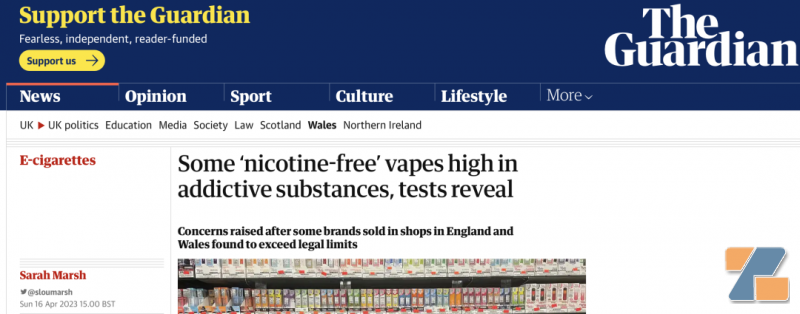
Key points: According to The Guardian on April 16, testing agency Inter Scientific examined 52 e-cigarette brands sold in stores across England and Wales and released the findings.
FLOW-wrap: break-word !important;"> According to the British" Guardian "local time on April 16, the testing agency Inter Scientific targeted the testing agency for products sold in stores in England and Wales52 e-cigarette brands were tested and found that 73% of the e-cigarette oil content exceeded the 2ml regulatory limit, and more than 40% were injected with at least 5ml of cigarette oil; At the same time, Inter Scientific also said that it had detected nicotine in eight products that claimed to contain no nicotine.Some nicotine concentrations are close to the 2% regulatory limit, and one of them even has a nicotine concentration more than 50% higher than the regulatory limit. In the report, the Guardian quoted Inter Scientific data as saying that the test covered 52 brands sold in stores in Newcastle, Birmingham, Hertfordshire, Staffordshire, Dudley, Liverpool and Wales. It mentioned that Dr Gorilla King Blackcurrant Grape Slush claimed to contain no nicotine, but actually contained 19.7mg/ml; public information shows that the Dr Gorilla King trademark belongs to China company Shenzhen Formote Technology Co., Ltd.; Another product called Vape With a Bang Havana Tobacco has a nicotine concentration of 29.35mg/ml, and it is temporarily impossible to confirm which manufacturer it came from. It is worth noting that the data released by Inter Scientific and the Guardian report did not mention other well-known people from Chinae-cigarette brands。 This contrasts with previous reports in the Guardian. The Guardian once played a key role in setting off the" controversy over excessive oil levels."For example, in its report, it questioned that ELFBAR's advertisements were suspected of targeting minors, and issued a message that" Chinae-cigarettesRegulatory regulations have banned fruit flavors but exported them to the UK." It is reasonable to speculate that if the test involves a well-known China brand, the Guardian should expose it.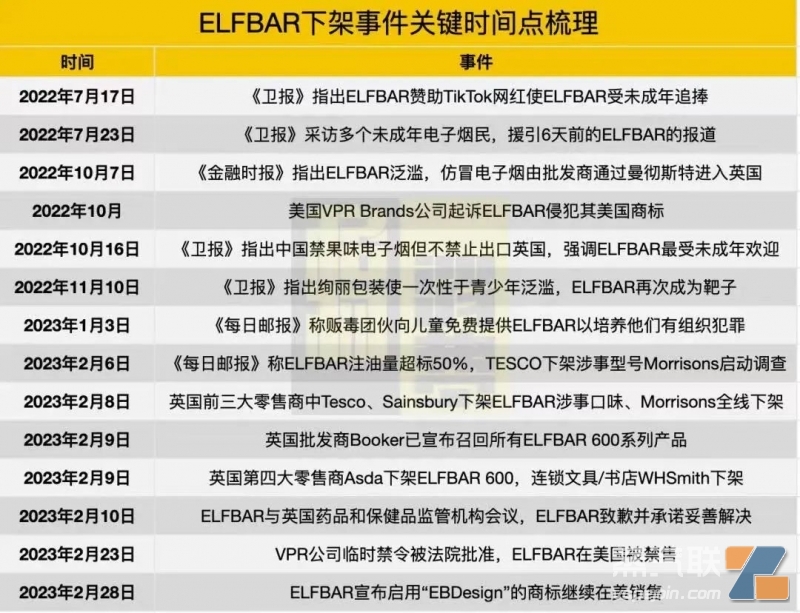 On the one hand, the reason may be related to the small brand they choose. It is understood that the products of major manufacturers will generally be filed with relevant records, but reports say that none of the e-cigarettes tested this time have been filed with the drug and health product regulatory agencies; on the other hand, since the previous incident started with ELFBAR and gradually spread to brands such as Lost Mary and SKE, most well-known brands with higher sales volume conducted a round of self-inspection, so they may not have been found to exceed the standard in this test. What needs to be added is that the testing organization Inter Scientific is not a simple third-party testing organization. It had previously cooperated with Trading Standards to help it investigate and deal with related illegal products. In the second half of last year alone, more than 1.4 tons of illegal products were seized in northeastern England. In other words, it can be regarded as the official" royal testing agency "of the UK. Currently, the UKe-cigarette marketIt is entering a new stage. On the one hand, the UK announced a plan to distribute free e-cigarettes to 1 million people to help quit e-cigarettes; on the other hand, during the same period, the British regulatory authorities announced that the Ministry of Health would allocate £ 3 million to establish an "illegal e-cigarette" law enforcement team. Investigate and crack down on illegal sales through trial purchases and other means.