HNB Home · Heated Tobacco and Vaping Industry NewsChinese
Home›Vaping News›Inside the U.S. Public Hearing on Tobacco Product Manufacturing Practice (TPMP)
Vaping News · tobacco
Inside the U.S. Public Hearing on Tobacco Product Manufacturing Practice (TPMP)
H cink2023-04-14Views 205Source 未知
Key point: On April 12, 2023, the U.S. FDA held a public online hearing on its TPMP (Tobacco Product Manufacturing Practice), scheduled from 9:30 AM to 5:00 PM...
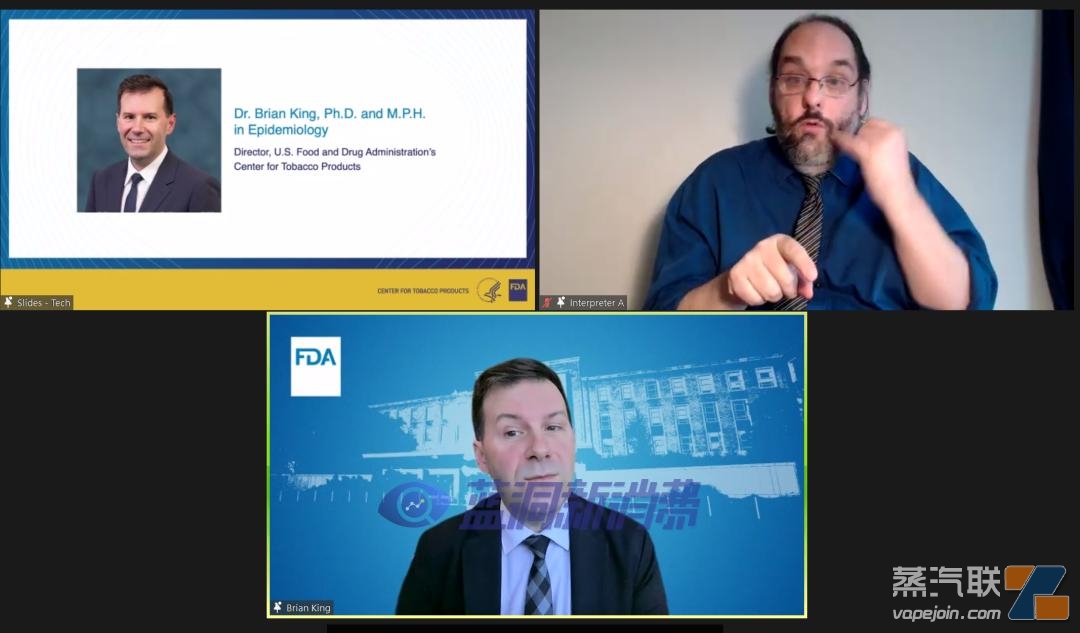
On April 12, 2023, the U.S. FDA held a public hearing on its Tobacco Product Manufacturing Practice (TPMP) via a polling network. The hearing was scheduled from 9:30 AM to 5:00 PM but actually ended after just over 3 hours! A representative from our company spoke, and I briefly recorded the opinions of the attendees as follows. Our company was surprisingly the only Chinese company to speak at the meeting and one of the few to raise technical issues.The meeting was chaired by Necola Staples, who briefly introduced the background and today's topic. CTP Director Brian King delivered a speech highlighting his achievements since taking office and the importance of TPMP. Then, CTP Senior Regulatory Advisor Matthew Brenner introduced the scope of TPMP, and Emil Wang discussed the effective date of TPMP. After that, the attendees began to speak, with each person limited to 5 minutes.
The first speaker, James O’Reilly, was a deaf-mute woman who later also served as a sign language interpreter. She reviewed the FDA's PMTA and is a staunch supporter of both PMTA and TPMP regulations!
Our company representative, Mr. Shi Huiyu, was the third to speak. We proposed that the FDA revise the standards for drinking water related to tobacco products in section 1120.34. Currently, the acceptable standard for TPMP is the EPA's U.S. primary drinking water quality standards, which differ significantly from China's national drinking water standards or Shenzhen's drinking water quality standards. If TPMP requires compliance with U.S. federal EPA standards for monitoring and testing drinking water, the process is complex and costly, which is disadvantageous for Chinese companies. Therefore, we suggest revising the standard so that the drinking water used in e-cigarette production complies with the national standards of the country of the reporting entity.Dr. Gaby Kafie shared his beautiful and long story about himself and his family with premium cigars. He loves handmade cigars and prepared a 60-page article just to express one point: cigars are harmless and do not require special regulation under TPMP. Fortunately, the FDA only gave him 5 minutes; otherwise, the entire hearing would have been filled with his storytelling!Jason Hodge, a 25-year veteran smoker, completely quit smoking after using e-cigarettes for 6 months. He stated that there is currently no direct evidence that e-cigarettes cause death compared to traditional tobacco. Moreover, e-cigarette companies have spontaneously formed an industry system over the past decade to ensure the healthy development of the entire industry, and there is no need for special regulation through TPMP. He emphasized that the FDA must not ignore the voices of e-cigarette users and the benefits that e-cigarettes bring to them when formulating any policies related to e-cigarettes. He is considered a staunch supporter of our industry. Mr. Jason Hodge's speech lacked much technical content and was mainly an emotional outburst!Joshua Habursky, a cigar industry practitioner, stated that TPMP would impose tremendous pressure on the cigar industry, especially on small family manufacturers in underdeveloped countries. The FDA needs to familiarize itself with the characteristics of different tobacco industries before formulating policies and cannot generalize. He pointed out that a cigar factory with only 30 employees would face enormous investment and management costs if required to use HAVC to manage the environment according to TPMP! A product with a production history of hundreds of years does not need a new regulation to manage it!Ms. Meredith Berkman, from an anti-tobacco organization, emphasized the harm of tobacco to the community, especially to teenagers, and specifically mentioned the need for strict regulation of e-cigarette products from China. She strongly urged for accelerated enforcement of ENDS, and that PMTA must be comprehensively and promptly implemented because all tobacco is harmful, especially disposable e-cigarettes from Chinese companies! The harm to teenagers is particularly significant!Maham Akbar strongly supports the FDA's current TPMP policy, especially emphasizing that packaging-related requirements must be strictly enforced. No improvement suggestions were made, purely in agreement.Connor Fuchs stated that even if TPMP is strictly enforced, it does not mean that the health risks posed by tobacco products to the public will be completely reduced. The FDA must pay special attention to wording when implementing TPMP, ensuring that the public does not perceive that as long as tobacco companies strictly comply with TPMP, their products are harmless. He also mentioned that the current implementation timeline is still too lenient and should be changed to 1 year for large enterprises and 5 years for small and micro enterprises. Additionally, the FDA must ensure that policies are implemented immediately after they take effect and not delayed.Mark Anton, CEO of a small e-cigarette manufacturer, asked the FDA whether it would give those companies that do not comply with TPMP a chance to correct their issues. He also stated that the existing TPMP seems to shift the responsibilities that the FDA should assume onto the companies. For example, the TPMP requires companies to identify all foreseeable and unforeseeable risks throughout the production to transportation process, making companies the primary risk identification entity rather than the FDA, which poses significant obstacles for companies in their production activities.Patrick Murphy, a deputy director of a research organization, stated that TPMP needs to clarify some information, such as how product design development and changes are conducted, as well as verification and confirmation activities. These aspects are not very clear in the existing regulations, and the current definition of TPMP does not apply to all types of tobacco products, requiring detailed explanations for different product categories.Michelle Page, a researcher, stated that her research shows that e-liquid is not only unstable in nicotine content under normal temperature and visible light storage conditions but also generates other harmful substances. In contrast, storage conditions at 4 degrees Celsius in the dark can ensure more stable e-liquid composition. Her research indicates that almost all e-liquids will undergo significant compositional changes after 2 years under normal temperature and visible light conditions, with some even generating more toxic substances than formaldehyde after just 3 months. Therefore, she recommends that the FDA emphasize product storage conditions in the TPMP storage section and strictly require product storage times.Samy Hamdouche, a small business practitioner in smokeless tobacco, stated that the current TPMP is extremely unfriendly to small businesses. For example, the heavy documentation work makes it impossible for small businesses to compete equally with large enterprises. Meanwhile, the existing large enterprises primarily manufacture traditional tobacco products that are highly harmful, while small businesses focus more on innovative harm-reduction tobacco products. Strict enforcement of TPMP on small businesses will stifle innovation in harm-reduction tobacco products.Ron Tully, a consulting industry professional, stated that TPMP did not adequately consider the significant differences in manufacturer sizes when it was formulated. The entire TPMP seems to favor large enterprises, as many companies already have similar management systems to ensure product quality, while small businesses need to make disproportionately large investments to comply with TPMP regulations, making it impossible for them to compete with large enterprises.Dr. Pamela Ling, a university professor, supports the FDA's implementation of TPMP for strict regulation, especially emphasizing that section 1120.90 regarding nicotine information must be accurately and strictly labeled (e.g., concentration), and section 1120.102 storage sections need to be strengthened to clarify product shelf life and expiration dates, while warning consumers not to use products beyond their expiration dates.Pamela Granger, a staunch anti-tobacco volunteer, expressed hope to completely eliminate all tobacco products from the market by 2035 and is pleased that the FDA is regulating tobacco products, including e-cigarettes, consistently.Delorse Orlando, a retail store owner with 5 stores, stated that no one is willing to use the few e-cigarette products that have passed PMTA. The FDA has completely ignored scientific evidence and factual situations in the implementation of PMTA and the TPMP draft, only considering political factors.The above is a brief summary of most speakers' opinions, and everyone is welcome to add any omissions. The FDA stated that after the online comments conclude, it will open the Tobacco Science Committee's internal comments on TPMP to the public on May 18.This hearing featured a comprehensive background of speakers from various tobacco industries, as well as research, production, retail, and customer sectors along the entire industry chain. From the speeches, it is evident that the overall attitude towards PMTA and TPMP is more supportive than opposed.Unfortunately, our company was the only Chinese company to participate in the hearing, and there was no participation from Chinese e-cigarette companies in the FDA's publicly released opinion solicitation draft. It is important to note that TPMP is a significant event that will determine the direction of the e-cigarette industry. This 180-day period is the only open window to raise objections; if missed, even if one wishes to object later, it will be of no use! An objection raised by one company may not attract the FDA's attention, but if the entire industry strongly opposes, the FDA will certainly make adjustments. I would like to call again for industry elites to study TPMP as soon as possible during the remaining less than 150 days of the comment solicitation period, identify clauses that are not applicable to their companies, and feel free to discuss with us to contribute to the e-cigarette industry!