
Interview with Tianzhu Biotech: Can Zero-Ding X be a qualified nicotine substitute?
Recently, Ge Wu has reported multiple times on the zero-nicotine market, where most products aim to create a new type of vaping product, attempting to penetrate the market among non-smokers and become part of the new consumption wave.
Although zero-nicotine products can somewhat satisfy the addiction needs of smokers through flavor and the act of inhaling and exhaling, many practitioners are cautious about the current zero-nicotine products' ability to alleviate cravings and encourage repurchase. So, is there a substance that can partially replace nicotine?
We learned that the supply chain brand Tianzhu Biotech has officially entered the herbal vaping market with its newly developed Zero-Ding X? technology. The person in charge claims that Zero-Ding X? can serve as a nicotine substitute and be added to zero-nicotine vaping liquids. Therefore, Ge Wu contacted Mr. Yang, the general manager of Tianzhu Biotech, to learn more about Zero-Ding X?.
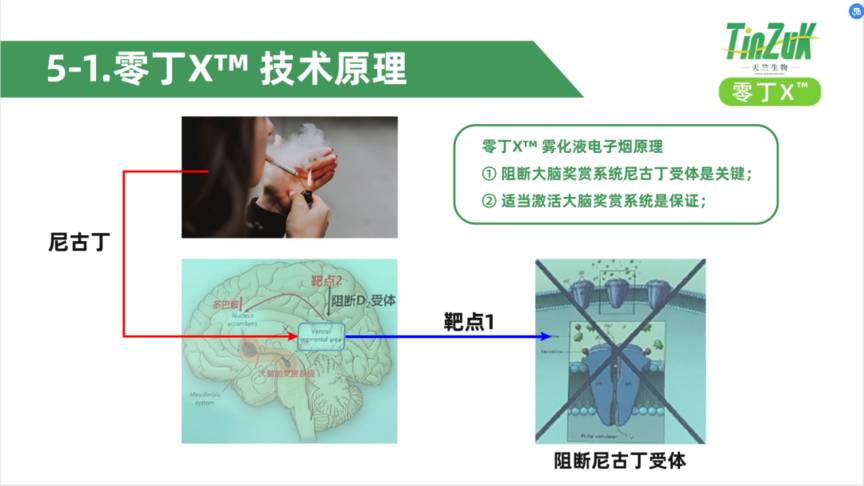
Mr. Yang believes that to understand Zero-Ding X?, one must start with the mechanism of nicotine addiction.
Previously, Ge Wu explained in the report "Why No Repurchase for Herbal Vaping? A Detailed Analysis of the Underlying Logic of Addiction Consumption" that the formation of addiction is related to dopamine rewards in the brain, which includes nicotine, the act of inhalation, and flavor. Regarding nicotine, its addiction is linked to nicotine receptors.
The operation of nicotine receptors in the human brain occurs when nicotine, the main component in tobacco, is inhaled and binds to specific receptors in the brain, prompting the pleasure center to release dopamine, creating a "reward effect."
Therefore, Mr. Yang believes that quitting smoking needs to meet two targets: one is to block the brain's reward nicotine receptors, and the other is to appropriately activate the brain's reward system, where blocking is key, and activation is a guarantee. The problem is that blocking nicotine receptors can cause withdrawal reactions, while activating the brain's reward system requires another addictive substance or element.
We can observe this theory from smoking cessation products.
The earliest nicotine receptor-blocking drugs could achieve smoking cessation goals after a treatment course, but smokers would experience prolonged withdrawal reactions. Later developed nicotine products, such as nicotine patches, nicotine gum, and e-cigarettes, while removing many harmful substances from smoking, still allow nicotine receptors to operate continuously, making it impossible to fundamentally quit nicotine.
Subsequently, smoking cessation medications developed by British pharmaceutical company GlaxoSmithKline, such as bupropion, and American pharmaceutical company Pfizer's varenicline, while meeting both targets, are prescription drugs that are expensive and difficult to promote. Previously, it was reported that these two drugs carry risks of causing depression and have certain side effects.
So, what should a nicotine substitute achieve?
Mr. Yang believes that it must first provide smokers with a certain throat hit. Previously, some practitioners experienced herbal vaping and felt that there was "no strength, no throat hit," which is one of the main reasons zero-nicotine products are not favored by practitioners.
Tianzhu Biotech has developed Zero-Ding X? and registered relevant patents and trademarks. Its main components are artemisinin, tetrandrine, and cactus alkaloids, which can simulate the throat hit brought by nicotine.
However, Dr. Wang Jing from Borton mentioned in the "Ge Wu Face to Face" program that currently, herbal vaping generally provides throat hit by increasing cooling sensations, and the alternatives to nicotine in herbal extracts also carry risks. Thus, it is evident that Tianzhu Biotech has taken some risk-averse measures regarding the composition of its products.
Additionally, Tianzhu Biotech has paid special attention to safety and compliance issues with Zero-Ding X?. One aspect is that all flavor formulas of Zero-Ding X? have undergone independent MSDS (Material Safety Data Sheet) testing, and it emphasizes that the solvents used in Zero-Ding X? comply with the 122 whitelist categories for e-cigarettes.
"Brands are now transitioning to zero-nicotine, and related regulations will definitely come in the future, so Tianzhu Biotech is also strictly demanding itself in advance," Mr. Yang stated.
It is worth mentioning that simply providing a throat hit does not satisfy the craving for nicotine; blocking nicotine will still lead to a certain degree of withdrawal reaction. In this regard, Mr. Yang stated that Zero-Ding X? can also appropriately activate the brain's reward system to ensure dopamine secretion.
"Data from the collaborative experiments with Shantou University reflect that Zero-Ding X? can increase the discharge activity of dopaminergic neurons to a certain extent, promoting dopamine secretion and alleviating withdrawal reactions. We are applying for a patent for this, so related details cannot be disclosed," Mr. Yang stated.
In Tianzhu Biotech's planning, the transition from e-cigarettes to herbal vaping is only in its initial stage, and in the future, it can also expand into broader fields such as ultrasonic vaping and CBD.


