
Vape news: what overseas energy sticks reveal about herbal vaping - was its rise inevitable?
Recently, the herbal vaping industry has captured the attention of the entire e-vaping industry, with mixed opinions emerging. Today, we will discuss the potential rise of herbal vaping.
Back in December 2019, we published an article titled "E-cigarettes, E-coffee... Is Everything 'Electronic' Feasible?" In that article, we mentioned the coffee energy sticks:
"Coffee energy sticks have long been criticized for being 'ineffective' and have gradually fallen out of favor. The later products also failed to enter the mainstream with a better experience, but the commercial space for 'vaping' has been further expanded."
It is important to clarify that substances like caffeine, which are addictive, are also regulated by the state. According to relevant laws, the National Medical Products Administration is responsible for supervising the production, operation, use, and import/export of caffeine nationwide. We are merely explaining the product and do not advocate for the use of caffeine, firmly supporting state regulation.
Overseas, the sales of these nicotine-free products have been quite good. From 2018 to 2019, the annual revenue of a US caffeine energy stick manufacturer increased by 462%, with rapid growth in international market sales.
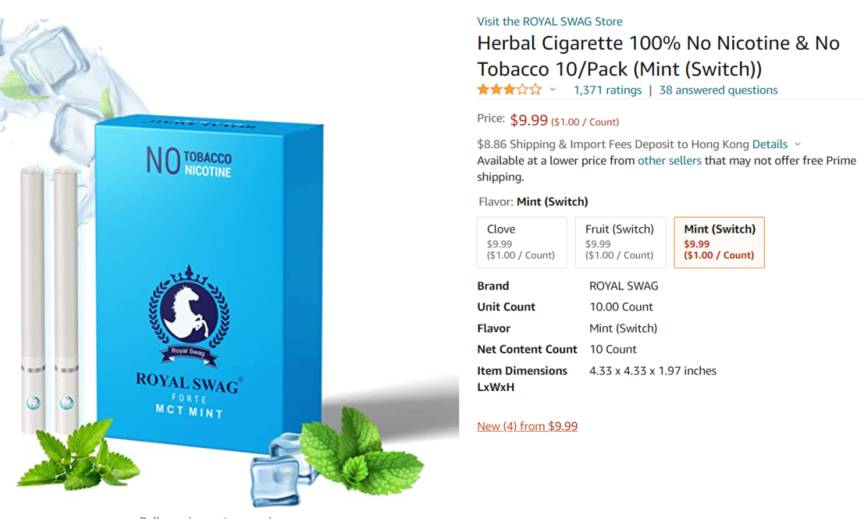
Fast forward to the present, and we see that the popularity of these energy sticks in overseas markets remains high. For example, a mint-flavored energy stick has generated thousands of discussions and reviews on an overseas shopping platform.
The initial energy sticks and the current herbal vaping products are not fundamentally different in terms of usage. However, in 2021, herbal vaping emerged from the e-cigarette industry and established itself in the new consumption field, with market prospects far surpassing those of energy sticks.
Inhalable consumer products
The foundation of herbal vaping is very solid.
To truly understand the infinite possibilities contained in the herbal vaping track, we must focus on the new consumption field—compared to e-cigarettes, which are nicotine intake tools, herbal vaping, as an inhalable consumer product, has unprecedented market space.
What are inhalable consumer products? We can explain this using the inhalable energy sticks that became popular online a few years ago. Inhalable energy sticks deliver substances like caffeine through the respiratory tract to provide a stimulating effect.
The reason herbal vaping can become a completely different new consumer product from e-cigarettes is that it does not contain nicotine.
Products that do not contain nicotine and are not systems for delivering nicotine are not subject to the restrictions of new e-cigarette regulations. Thus, herbal vaping is destined to have a broader market space. Moreover, for consumers, herbal vaping products, due to their lack of nicotine, will not have the consumption recognition barriers associated with being a smoker, making the audience much wider.
Additionally, herbal vaping products have a technological advantage due to the years of technological accumulation in the e-cigarette industry. It is important to note that the essential difference between herbal vaping products and e-cigarettes is whether they contain nicotine and whether they have the function of delivering nicotine. Once nicotine is removed, e-cigarettes and herbal vaping products essentially operate on the same principles and inhalation methods.
The supply chain barriers between the e-cigarette industry and the herbal vaping industry are not high. The domestic herbal vaping industry inherently possesses the technological reserves and production line equipment accumulated over years in the e-cigarette industry, making the industry transition threshold relatively low.
For e-cigarette supply chain giants that have been deeply involved in the industry for many years, the domestic herbal vaping market can be seen as a new track that is within reach compared to the distant overseas e-cigarette market. Collaborating in this field has almost become a consensus in the e-cigarette industry—especially as regulations are about to be implemented.
Currently, transitioning to the herbal vaping field has become a new choice for many brands and manufacturers, similar to going overseas.
Indeed, from the current actions in the supply chain, major manufacturers have already begun to intensively research various products and technologies that are more suitable for the herbal vaping field. This track is not about to become popular; it has already started to attract a crowd.
Taste addiction
Herbal vaping will become a new consumption trend
When discussing herbal vaping as a new consumption trend, we must mention a concept: taste addiction.
Taste addiction is different from nicotine addiction; the underlying logic of taste addiction stems from human preferences for flavors like sweetness and coolness. This explains why a considerable number of light smokers choose to use e-cigarettes—compared to traditional cigarettes, e-cigarettes offer a richer variety of flavors, especially those based on sweetness and coolness.
In the draft of the new national standard, 122 additives that are allowed to be added to e-cigarettes have already been specified, and most of the cooling agents and sweeteners commonly used in current e-cigarette liquids are not included among these 122 additives. According to supply chain sources, the pleasantness of the taste of cartridges produced according to the new national standard has significantly decreased.
We previously published an article titled "Is the Taste of New Standard Cartridges Bad? Actually, It's Long-Term Beneficial," which mentioned a concept: "Let harm reduction be harm reduction, and let pleasure for the palate be pleasure for the palate." The new regulations on e-cigarette additives are essentially preventing those who are merely taste-addicted from being "forced" to consume nicotine.
Since herbal vaping is not affected by the relevant management measures for e-cigarettes, it is not subject to these restrictions. As a result, the flavor profiles of herbal vaping are more diverse compared to e-cigarettes, better meeting the needs of taste-addicted individuals.
In addition to having stronger universality in terms of flavor, the nature of herbal vaping determines that it can be promoted through various fast-moving consumer goods channels. This way, herbal vaping products have a clear distinction from e-cigarettes in trading venues, and the consumer groups they face are also broader. Over time, consumers will form a different consumption perception of herbal vaping compared to e-cigarettes.
Therefore, for a long time to come, herbal vaping will complete market education during the channel promotion process. We will continue to pay attention to the development of the herbal vaping industry and welcome everyone to follow us.


