Wotofo Profile Single-Coil Mesh Atomizer Review: Pros and Cons Analysis
What do you think about mesh atomizers? They are widely known for producing clear vapor, but they can be tricky to wick and often result in a burnt taste. These are common comments heard among experienced users. If there were a mesh atomizer that retains the advantages of clarity while significantly improving the difficulty of setup, would you be willing to try it? The Profile RDA is exactly that, designed by Wotofo in collaboration with #MrJustRight1 (Joel Robinson).
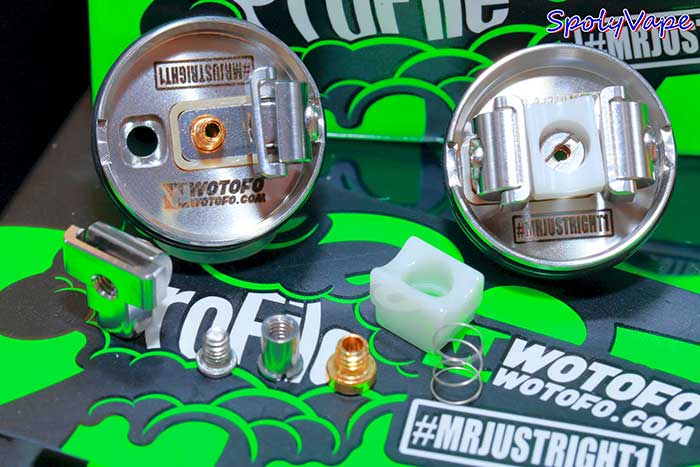
The Profile RDA features a spring-loaded ceramic block on the base. When cotton is inserted, the ceramic block ensures that the cotton fully contacts the mesh due to the opposing forces of the cotton's volume and the spring's elasticity. Additionally, the oil fill screw located in the center of the ceramic block allows for quick direct filling of e-liquid into the cotton beneath the mesh through the grooves and holes in the ceramic block. This simple little component resolves the biggest pain point of mesh atomizers, but users of bottom-feeding (BF) devices should still be cautious not to pack the cotton too tightly against the ceramic block, or else most of the e-liquid will be sucked back when releasing the bottom-fill bottle, requiring more frequent squeezing of the bottle. Compared to standard coils, the e-liquid begins to saturate from a slightly higher position in the cotton, and the shorter liquid path also provides excellent assistance.
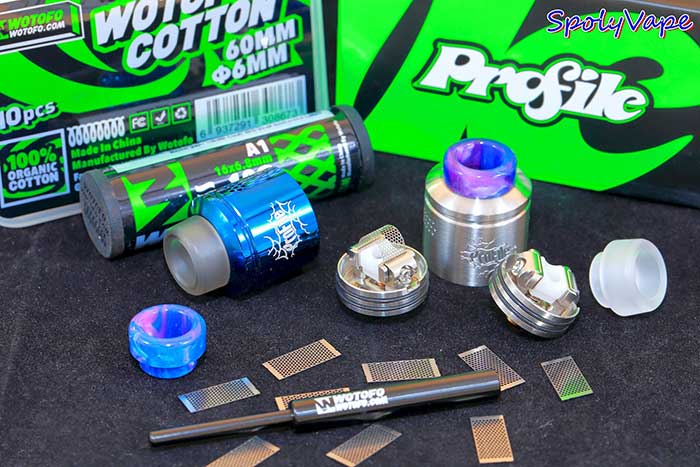
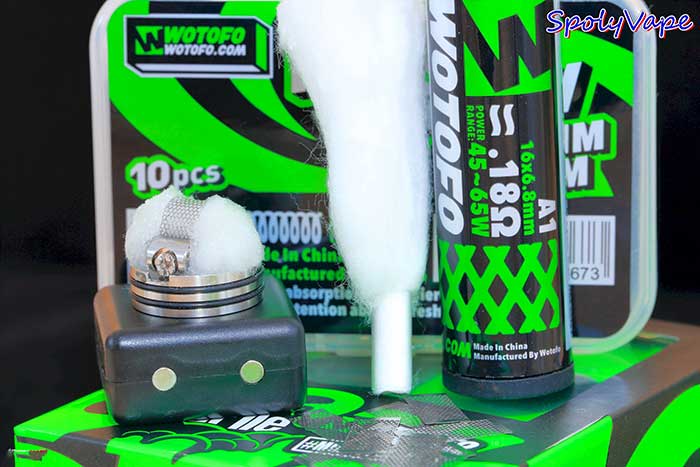
For those who prefer convenience, Wotofo has also launched a 6mm agleted organic cotton specifically for mesh, which, combined with the included mesh/coils and a simple coiling tool, allows you to easily shape the mesh and insert it into the locking holes, tightening the clamps after cutting the cotton. This gives you the feel of assembling your own pre-made coil.
After solving the oil delivery and setup issues, there also needs to be a corresponding airflow and vaporization solution. The outer cover features three rows of paired side airflow holes totaling 20 holes, and the top cap has three stepped baffles allowing players to freely choose airflow volume and direction. Additionally, the Profile RDA, with its compact dimensions of 24*31mm, has a thick outer cover and top cap that prevent high temperatures from burning your hands.
Wotofo positions the Profile RDA as a storyteller for various types of e-liquids, from multi-layered to single-flavor, which is also the origin of its name. The horizontal clamps and oil delivery structure allow for easy switching between mesh and standard coils, and the planned airflow control enhances its clarity significantly. Even without the mesh, it remains an impressive balanced atomizer. Wotofo is ready, but are you prepared to analyze your favorite e-liquids with the Profile?
Similar to the recently popular Recurve RDA, the Profile's packaging features a lively street graffiti style, and the contents include: the main body, dual-spec 810 drip tips, dual-spec screwdrivers, a coiling tool, two pieces of 0.18Ω A1 mesh and wire, mesh-specific agleted cotton, screws, O-rings, and a manual; the main body can be disassembled into: drip tip, top cap, outer cover, and base.
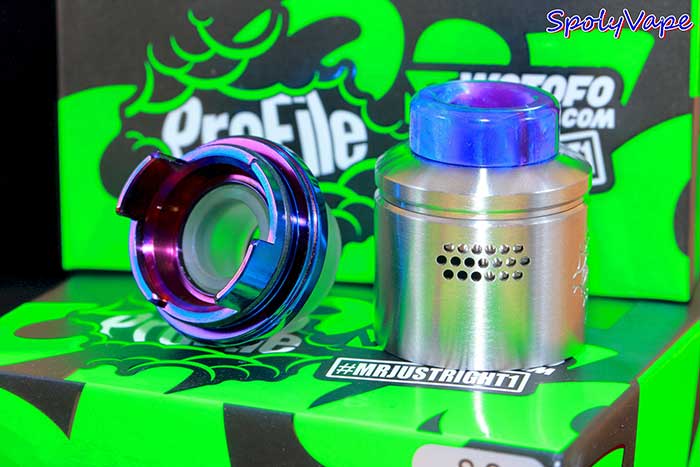
The included two 810 drip tips have slight height differences, and both have a slightly wider top and narrower bottom angle, but both feel great in thickness and touch, and do not feel hot during continuous firing. Personally, I prefer the taller PEI drip tip. By the way, the steel-colored PEI drip tip is translucent, while the blue version is somewhat dark.
The airflow adjustment section consists of paired rows of airflow holes on the outer cover, combined with the stepped design of the top cap, allowing for individual control of the upper airflow for a more direct flavor, while also allowing for the lower two rows of airflow holes to be opened for a more refined draw resistance.
The Profile's outer cover is significantly thicker than that of standard atomizers, providing excellent temperature insulation, and it also has a protrusion at the bottom to fit the base's limiting slot, which I find to be a very convenient design, making assembly and disassembly very easy.
Thanks to Wotofo for providing me with my favorite blue version, the bright blue base with white lettering is just pleasing to the eye.
Now, let's talk about the biggest and most common issue with mesh: wicking. Due to the larger heating area, mesh requires more cotton to support oil delivery and ensure there are no gaps between them. However, after saturating with e-liquid, the cotton can still change its contact area due to gravity or volume changes, leading to the unforgettable burnt cotton taste.
As seen in the above image, the Profile has a white ceramic block set in the center of the base, which is spring-loaded to create a movable structure. In other words, when I place cotton beneath the mesh, the upward force from the spring and the downward force from the cotton and e-liquid due to gravity will conflict, allowing the ceramic block to securely hold the cotton and maintain its contact with the mesh.
Before setting up the mesh, you can easily press out a nice arc using the thicker end of the included coiling tool, shape it, and insert it into the vertical locking holes. After securing the screws, you can remove the coiling tool. If using the dedicated agleted cotton, you can gently press the part fixed by the silicone sleeve down onto the ceramic block to quickly insert the cotton, but it's recommended to slightly roll the 6mm agleted cotton beforehand; otherwise, it may be too fluffy and difficult to insert. If using standard cotton, I would recommend holding the ceramic block with my fingertip and carefully pulling the cotton with tweezers without excessively compressing it.
Since I initially used it as a pure dripping atomizer, I intentionally increased the amount of cotton at both ends to maintain oil capacity. When paired with a BF device, it can reduce the amount needed; one piece of agleted cotton can last about 1-2 uses. After using up the included mesh and agleted cotton, you can also purchase Wotofo's dedicated retail packs for the Profile, which come in packs of 10.
Let's briefly discuss the differences between mesh, standard wire, and fused wire in terms of clarity. In terms of vapor production, mesh and fused wire are not significantly different, and both outperform standard wire. This allows the former two to easily produce a large vapor volume that brings out the flavor of the e-liquid itself. However, fused wire is limited by its structure, making it more prone to carbon buildup, slower heating, and poor heat dissipation. Mesh, due to its simple flat structure, can achieve a more uniform vaporization effect and better express multi-layered aromas at different temperatures. However, it also has the challenge of ensuring complete and effective contact between the cotton and the mesh, which tests the user's skills. Moreover, experiencing the burnt cotton taste after a deep inhale is a memory that is hard to forget. This is why I was so impressed when I received the Profile RDA; by solving the fundamental issues, users can enjoy a rich and voluminous vapor experience more easily and effortlessly.
Thanks to the large locking holes, the Profile is also compatible with standard coils. I still prefer using my favorite N80 26ga+40ga*3 braided wire for testing both dual and single coils. Under standard single coil conditions, it is an impressive balanced atomizer, but don't forget to switch to a narrow 810 or 510 drip tip for a better experience, and ensure the legs of the coil are angled slightly.
The dual coil setup is a more imaginative attempt. Since the Profile's locking plates have space for the legs on both sides, I initially lazily inserted each dual coil into one side of the locking plate. While quick, the airflow holes were perpendicular to the coils, resulting in subpar airflow and heat dissipation. After putting some thought into shaping the legs, I finally felt the direct oil assistance starting from the cotton legs in the compact chamber, which was very pleasant.
To summarize the features of the Wotofo Profile RDA:
- Air resistance ranges from 1 to 11, falling within levels 3 to 8.
- Clarity is balanced (fused wire) and dense (mesh).
- The adaptive height spring and ceramic block effectively solve the two major issues of cotton wicking and oil delivery for mesh, while also increasing oil delivery efficiency for standard coils, making it a multi-benefit design.
- The included coiling tool, fixed-size mesh, and dedicated agleted cotton serve as an innovative guide for mesh-type RDAs, resembling a more DIY-friendly pre-made coil.
- Specially thick outer cover and top cap provide excellent heat insulation.
- Stepped airflow adjustment offers great control over airflow range and volume.
- The balance of drip tip height, airflow volume, airflow position, and vapor production, combined with various clever designs, makes it the best mesh-type RDA I have used so far.
There are also some designs that are difficult to define:
- Due to the sufficient thickness of the outer cover and the relatively small airflow holes, it is somewhat difficult to discern the current airflow volume, which is a minor regret built on the advantages of heat insulation and draw resistance.
- BF users should still be cautious about the cotton amount above and on both sides of the ceramic block; if too tightly packed, it will suck the e-liquid back into the bottle when releasing it, requiring frequent refills. Perhaps increasing the curvature of the ceramic block or adding lateral oil paths would provide a better and more convenient experience.
- I actually considered during the dual coil testing that if a limiting slot were set on the other side of the outer cover and the screws were lengthened, the Profile would more easily accommodate dual coils, and with the appropriately small outer cover and the movable ceramic block's excellent oil delivery assistance, it would significantly enhance playability.