
Are E-Cigarettes Really That Harmful? Read This First to Clear Up Common Misunderstandings
recently as315At the party, CCTV exposed the chaos in the e-cigarette industry, pointing out that the liquid of e-cigarettes contains formaldehyde, which will endanger the health of smokers. Long-term smoking of e-cigarettes will also lead to dependence on nicotine.

?
Once the program was broadcast, it aroused widespread discussion, and some even said that e-cigarettes were more toxic than cigarettes. But is the harm of e-cigarettes really that serious?
About Formaldehyde
The main raw materials of e-cigarettes are propylene glycol, glycerol (glycerin), essence, and a small amount of nicotine. Propylene glycol and glycerol here are the main sources of formaldehyde in e-cigarettes. These two substances will undergo a cracking reaction at high temperatures to produce formaldehyde. The high temperature here is400℃。That is to say,When the e-cigarette heats more than400At ℃, formaldehyde will begin to be released, and ordinary e-cigarettes usually do not heat more than300-400℃, above this temperature, cotton may be burnt.
?

?
Although e-cigarettes with heavy smoke may reach this temperature, they will also burn the mouth... Formaldehyde is widely found in our nature, and even contains trace amounts of formaldehyde in human bodies. Everyone should treat formaldehyde more rationally, instead of talking about "aldehyde" color change.
?
There has been a saying that "inhaling formaldehyde will lead to cancer." There are indeed relevant studies that show that long-term exposure to high concentrations of formaldehyde will increase the incidence of nasopharyngeal carcinoma, but there is no scientific proof that formaldehyde is the direct cause of leukemia or nasopharyngeal carcinoma. The culprit.while the United StatesFDAResearch with the Swedish Ministry of Health showed that tar is the culprit of cancer, and tar is not added to e-cigarettes.
About Nicotine
In addition, e-cigarettes can make users rely on nicotine, which is also one of the reasons why the public hates e-cigarettes. Long-term consumption of large amounts of nicotine can cause damage to the human body, but everything has two sides. Statistics show that nicotine can play a certain role in preventing Parkinson's disease and Alzheimer's disease (Alzheimer's disease).
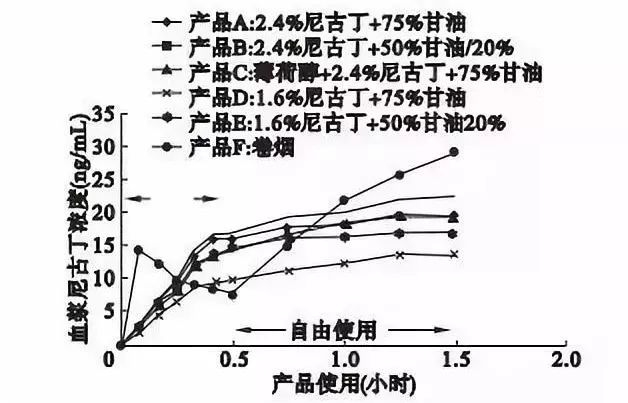
Due to the different mechanisms of action between e-cigarettes and traditional cigarettes, the nicotine transport rates in traditional tobacco and e-cigarettes are very different. The bioavailability of nicotine in e-cigarette aerosols limits the amount of nicotine that can be absorbed by the blood and reach the brain's nicotine receptors. That is to say,Much of the nicotine in e-cigarettes is not actually absorbed by the body, but is directly metabolized out of the body.。The human body can metabolize nicotine, so trace amounts of nicotine will do little harm to the human body.
?
written in the end
As the saying goes,"Putting aside the dose and talking about toxicity is just a hooligan." The experimental results at the party are not false. E-cigarettes do contain formaldehyde and nicotine, but they are both extremely small amounts. Moreover, the experimental methods used at the party are to focus on highlighting the experimental results, which is very different from our daily habit of using e-cigarettes.
#p#Pagination Title #e#?
We do not advocate that "e-cigarettes are harmless" or "e-cigarettes can maintain health", but in the face of traditional cigarettes, their harm is much less. After all, CCTV only said when mentioning its harm"Very small amounts of harmful substances"。If you are someone who has never been exposed to cigarettes, e-cigarettes may indeed make you addicted to nicotine; but if you are a cigarette smoker and can't quit cigarettes for a while, e-cigarettes are undoubtedly a healthier choice.
this315The party is by no means the end of the e-cigarette industry, but a new starting point for this industry. We also hope that the popularity and attention brought to the e-cigarette industry this time will promote the industry's self-discipline and promote the emergence of relevant regulatory systems to make this industry more standardized.


