
No Secondhand Smoke From Vaping? CDC Scientists Release New Evidence
Introduction: the level of NNAL, a tobacco-specific nitrosamine metabolite, in the urine of e-cigarette users is extremely low—only 2.2% of that found in cigarette smokers. According to a newly published paper by researchers from the U.S. Centers for Dise
Editor’s note: The level of the tobacco-specific nitrosamine (TSNA) metabolite NNAL in the urine of e-cigarette users is extremely low—only 2.2% of that found in cigarette smokers.
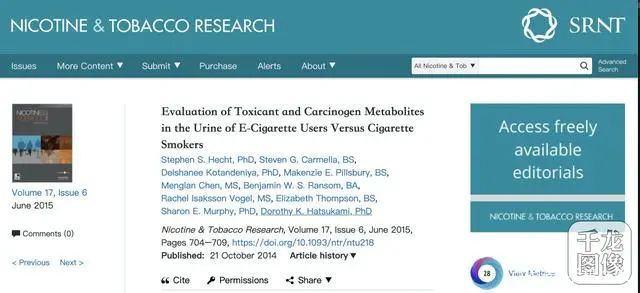
Screenshot of the latest paper published by CDC researchers. Published by Qianlong.com
Qianlong.com reports that a newly published paper by researchers at the U.S. Centers for Disease Control and Prevention (CDC) shows that the level of NNAL, a metabolite of tobacco-specific nitrosamines (TSNAs), in the urine of e-cigarette users is extremely low—only 2.2% of that found in cigarette smokers, and 0.6% of that found in smokeless tobacco users (such as snuff and chewing tobacco users). The findings again suggest that the risks of e-cigarettes are far lower than those of traditional tobacco, and that e-cigarettes do not present the same secondhand smoke issue associated with traditional tobacco. More than 70 carcinogens have been identified in traditional tobacco and secondhand smoke. Among them, tobacco-specific nitrosamines (TSNAs) are the most important carcinogens in tobacco and in smoke generated by combustion, posing major health risks to both smokers and people exposed to secondhand smoke. TSNAs include NNK, NNN, NAB, and NAT. The World Health Organization (WHO) has identified NNK and NNN as the main factors responsible for the carcinogenicity of cigarette smoke. This study lasted seven years. Beginning in 2013, it collected epidemiological data related to tobacco use behavior, including methods of use, attitudes, habits, and health effects, in order to assess the impact of relevant tobacco regulatory policies of the U.S. Food and Drug Administration (FDA). This paper is the first-phase result of that study, primarily monitoring urinary NNAL concentrations in participants from Wave 1 (W1) of the PATH study conducted between September 12, 2013 and December 15, 2014. NNAL is a metabolite produced when the human body processes nitrosamines (TSNAs), and it is excreted through urine. People inhale nitrosamines (TSNAs) through tobacco product use or secondhand smoke exposure, and the metabolite NNAL is then excreted in urine. The study found that the average urinary NNAL concentration was 993.3 ng/g creatinine in smokeless tobacco users, 285.4 ng/g creatinine in cigarette smokers, and 6.3 ng/g creatinine in e-cigarette users. In other words, the amount of NNAL in the urine of e-cigarette users was only 2.2% of that in cigarette smokers and 0.6% of that in smokeless tobacco users.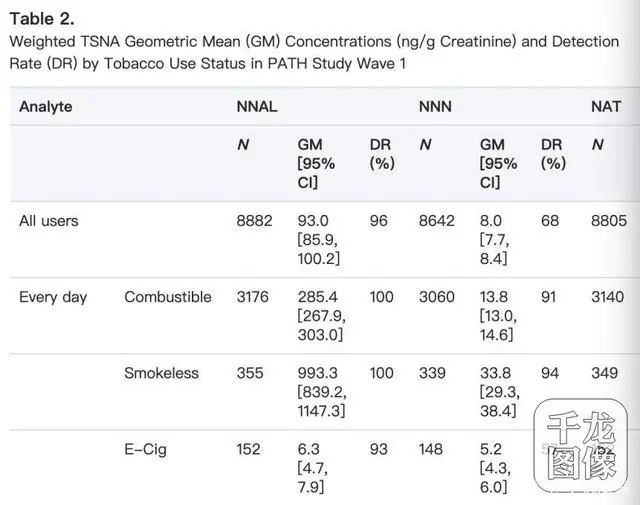
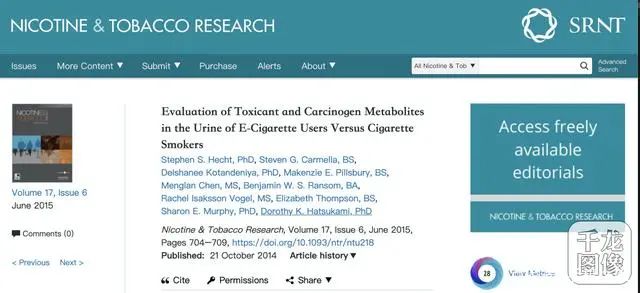
Screenshot of a paper published by CDC researchers in 2014. Published by Qianlong.com
VOCs (volatile organic compounds) are a general term for organic compounds that are volatile under certain conditions. Harmful substances familiar in daily life, such as benzene, toluene, and formaldehyde, all fall within the category of VOCs. TSNAs (nitrosamines) and VOCs (volatile organic compounds) are the two most important carcinogenic harmful substances in secondhand smoke from traditional tobacco. The above CDC studies suggest that e-cigarettes do not present a secondhand smoke problem comparable to that of traditional tobacco. This also shows once again that equating e-cigarettes with traditional tobacco, or even using the harms of traditional tobacco secondhand smoke as evidence to include e-cigarettes in indoor smoking bans, lacks scientific basis and is absurd.

