China National Radio: Some Vaping Products May Reduce Harm, Regulation Should Avoid a One-Size-Fits-
Although e-cigarettes are by no means harmless, some products have a significantly reduced harm compared to traditional cigarettes.
Experimental results show that the vapor emitted by e-cigarettes contains 9 to 450 times fewer toxic substances than regular cigarettes, and lacks harmful substances such as hydrogen cyanide, carbon monoxide, tar, lead, carbon dioxide, arsenic, acrolein, and mercury.
It can be said that the risks associated with e-cigarettes are much lower compared to regular tobacco.
—— China National Radio "E-cigarette Regulation Should Avoid a One-Size-Fits-All Approach"
▲ China National Radio "E-cigarette Regulation Should Avoid a One-Size-Fits-All Approach"
On March 22, to strengthen the regulation of e-cigarettes and other new tobacco products, the Ministry of Industry and Information Technology and the State Tobacco Monopoly Administration drafted the "Decision on Amending the Implementation Regulations of the Tobacco Monopoly Law of the People's Republic of China (Draft for Comments)". It was decided that "e-cigarettes and other new tobacco products will be regulated according to the relevant provisions for cigarettes in this regulation."
As soon as the news broke, the topic of "e-cigarettes will be regulated like cigarettes" surged to the top of Weibo's trending list. Many industry insiders believe that inclusion in tobacco monopoly means a reshaping of multiple links in the e-cigarette industry chain, and whether e-cigarettes and other new tobacco products can be regulated according to the provisions for cigarettes has become a focal point of discussion.
The Beijing Smoking Control Association stated that the chaos surrounding e-cigarettes should be regulated more strictly, but suggested that they should not be included in tobacco monopoly regulation, but rather be overseen by health departments, food and drug regulatory agencies, or market supervision administrations. Zhang Jianshu, president of the Beijing Smoking Control Association, believes that only heated, non-combustion types of e-cigarettes belong to tobacco; other main types are not tobacco products. If all e-cigarettes are included in tobacco monopoly, it would provide further expansion opportunities for the tobacco industry, which has already caused serious harm to public health.
In fact, from an industry development perspective, the development of e-cigarettes stems from tobacco companies' continuous attempts to reduce the harmfulness of tobacco. Major tobacco companies are constantly trying to reduce the harmfulness of tobacco, and as the potential for reducing tar diminishes, e-cigarettes have become a new direction for promoting harm reduction in the industry. It is precisely because of this advantage that e-cigarettes have gained popularity and favor among smokers worldwide.
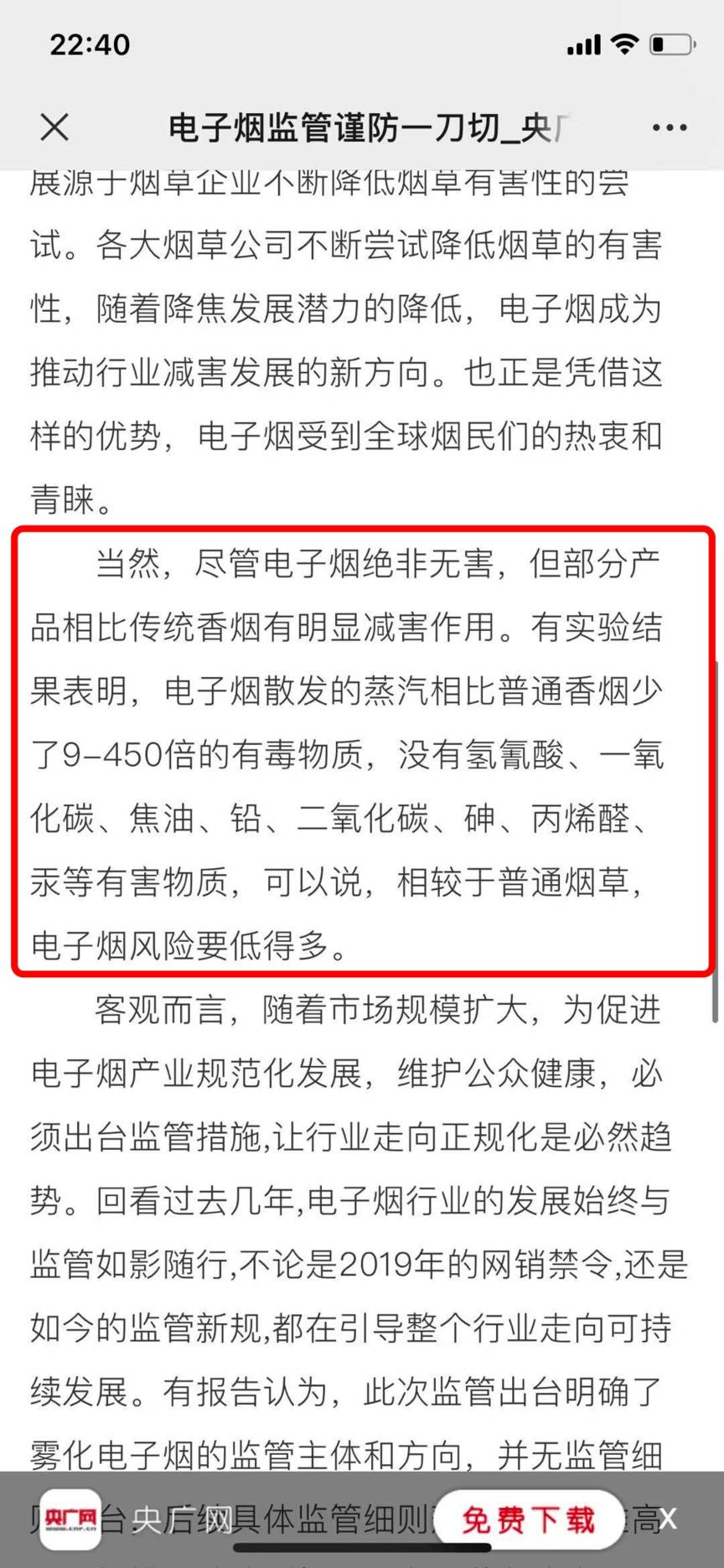
Of course, although e-cigarettes are by no means harmless, some products have a significantly reduced harm compared to traditional cigarettes. Experimental results show that the vapor emitted by e-cigarettes contains 9 to 450 times fewer toxic substances than regular cigarettes, and lacks harmful substances such as hydrogen cyanide, carbon monoxide, tar, lead, carbon dioxide, arsenic, acrolein, and mercury. It can be said that the risks associated with e-cigarettes are much lower compared to regular tobacco.
Objectively speaking, as the market expands, regulatory measures must be introduced to promote the standardized development of the e-cigarette industry and protect public health. It is an inevitable trend for the industry to move towards normalization. Looking back over the past few years, the development of the e-cigarette industry has always been accompanied by regulation, whether it is the online sales ban in 2019 or the current new regulatory rules, all of which guide the entire industry towards sustainable development. Reports suggest that this regulatory introduction clarifies the regulatory subjects and directions for vaporized e-cigarettes, and without specific regulatory details being introduced, the effective raising of industry thresholds will benefit leading enterprises in the industry chain.
Ultimately, for the e-cigarette industry, while implementing reasonable regulation, it is also necessary to recognize the development patterns of the e-cigarette industry, consider the characteristics of different products, objectively understand the risks and benefits of e-cigarettes, and adopt refined regulatory rules to find a balance between industry development and regulation, avoiding a one-size-fits-all approach, which will help the e-cigarette industry to develop steadily and sustainably.