
How to Pick Stocks in a Volatile Market? U.S. Tobacco Stocks Remain Strong
On Tuesday, the U.S. stock market fell sharply, with disappointing earnings reports from companies like Microsoft and Caterpillar, and a decline in the U.S. December durable goods orders index, raising concerns among investors about a slowdown in U.S. economic growth.
CNBC financial columnist Lawrence Lewitinn wrote today that the recent stock market rhythm has been difficult to grasp, shifting from a one-sided upward trend to a volatile market. In a period of market consolidation, the consumer sector typically performs well, and the tobacco sector is particularly worth investors' attention. Large tobacco companies have strong fundamentals and stable dividends, and in the context of continuously declining U.S. Treasury yields, the value of tobacco stocks is further highlighted, with the tobacco sector likely to produce continuously rising long-term stocks.
Lewitinn noted that this year, the U.S. stock market has struggled to maintain last year's strong upward momentum. After several days of decline, it finally welcomed the European version of QE, but after a brief rebound, the bulls were hit hard again on Tuesday. The Dow opened down nearly 300 points, raising doubts about whether last week's rebound was merely a counter-trend rally in a downtrend.
He pointed out that although the market organized a rebound at an important technical support level last week, the strength of the rebound was weak and could still be seen as a weak rebound in the process of decline.
This week will see the peak of this earnings season, with disappointing earnings reports from major Dow stocks like Intel, Caterpillar, and Microsoft putting pressure on the stock market. Caterpillar's 2015 earnings outlook fell short of expectations, opening down nearly 8%, while Microsoft reported a decline in profits last quarter, with gross margins under pressure, and had its target price cut to $52 by Piper Jaffray, opening down 10%.
Additionally, U.S. December durable goods orders fell 3.4% month-on-month, far below the market's general expectation of a 0.5% increase, and the retail data released earlier this month was also disappointing.
Lewitinn wrote that the Federal Reserve's interest rate meeting will be held this week, which has made investors with uncertain holding attitudes even more nervous, and expectations of a stronger dollar have further spread panic.

As January trading is about to end, it is clear that the U.S. stock market has shifted from last year's one-sided upward trend to a consolidation pattern. How should investors pick stocks now?
Some analysts believe that the tobacco sector will become a safe haven for funds.
Wells Fargo recently reiterated its overweight rating on the tobacco sector, believing it will become a shining star in the volatile market and the best-performing sub-industry in the consumer sector in 2015.
The bank listed five positive factors: rising disposable income for consumers, limited revenue share from emerging markets, strong fundamentals, effective cost control, and significant future potential for e-cigarettes. Major tobacco companies like Altria, Reynolds American, and Lorillard have all seen significant increases in the past 12 months, with gains of 45%, 42%, and 33%, respectively. The question is, after such significant increases, can tobacco stocks continue to perform strongly? Cowen and Co.'s head of sales trading, David Seaburg, believes that Altria's fundamentals are exceptionally strong, with no currency risk, and in the context of plummeting oil prices, consumers' purchasing power has greatly increased, allowing smokers to have more disposable income to satisfy their cravings.
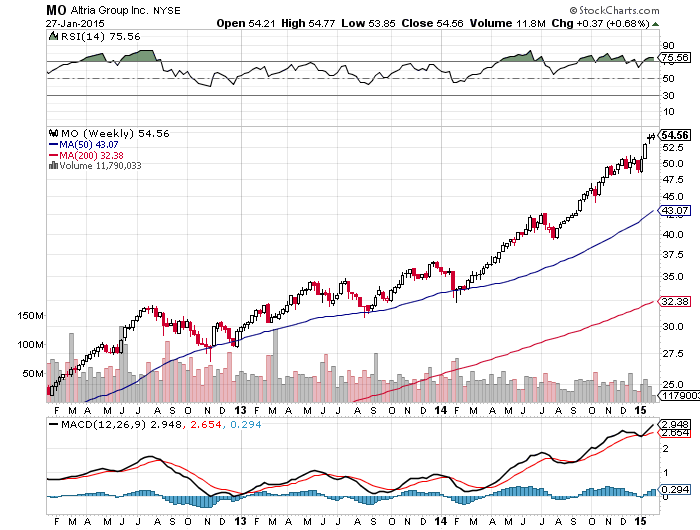
In addition to the strong financial condition of tobacco stocks, Seaburg noted that U.S. Treasury yields have been declining, with the 10-year Treasury yield dropping to around 1.8%. Altria is well-positioned to become a favorite for investors seeking stable returns, with a dividend yield of 3.8%. He believes that the long-term decline in Treasury yields will benefit Altria, which is expected to continue rising, although the pace of growth may slow, transitioning to a gradual upward trend.
Seaburg pointed out that Altria has already risen 10% this year, and momentum indicators may show signs of tapering in the coming weeks, indicating a need for consolidation in the short term. However, in the long term, it is expected to change its upward slope and become a long-term stock.
Although Altria's growth this year may not match last year's 45%, it remains a focus for funds in a volatile market. Piper Jaffray's senior technical analyst Craig Johnson stated that from a technical perspective, Altria's long-term upward trend remains intact. If you draw an upward trend line, you will find that its highs and lows are continuously rising, and the current stock price is far from the 200-day moving average.
At the same time, he believes that the consumer sector is expected to lead the market in 2015, showing stronger performance than the broader market. Typically, consumer stocks provide excess returns to investors in volatile markets, and high-quality consumer stocks with generous dividends are likely to attract global investors' attention.
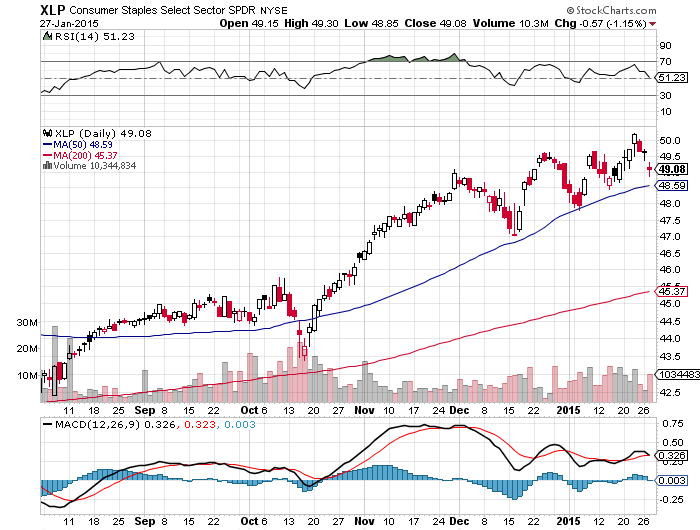
Over the past 12 months, the consumer staples sector has seen a cumulative increase of nearly 20%.


