The Place with the Highest Radiation Turns Out to Be This (Illustrated)
The story goes that a foreign guy personally explored some well-known radiation sites such as Chernobyl and Fukushima Nuclear Power Plant, and then based on the measured results, he planned to rank where the radiation is highest. Radiation refers to the phenomenon where a portion of electromagnetic energy emitted by a source escapes and propagates away from the source, and then returns to the source, with energy spreading outward in the form of electromagnetic waves or particles. All objects in nature, as long as their temperature is above absolute zero, continuously transmit heat outward in the form of electromagnetic waves and particles; this method of energy transfer is called radiation.
So, is radiation harmful to the human body?
Generally, people often turn pale at the mention of "radiation." However, in reality, only a very few types of radiation can cause irreversible damage to human health. Harmful radiation to the human body includes but is not limited to: nuclear radiation, gamma rays, ultraviolet rays, and high doses of electromagnetic radiation.
The guy used a Geiger counter for detection (the unit of radioactive measurement is microsievert, 1 sievert = 1000 millisieverts, 1 millisievert = 1000 microsieverts. A one-time exposure of the human body to 4000 millisieverts results in instant death.), and the radiation emitted by common objects in our daily lives is almost negligible.
Among the locations he tested, the radiation dose in Hiroshima, Japan, was 0.3 microsieverts per hour, the Czech uranium mine reached 1.7 microsieverts per hour, and in the core area of the Fukushima Nuclear Power Plant, the radiation dose reached 5-10 microsieverts per hour.
In Chernobyl, the guy stood near the perimeter of the generator unit that exploded back then, and at that time, the radiation dose in the air had already reached 5.16 microsieverts per hour. When he got close to the clothes left by the firefighters who participated in the rescue operation, his Geiger counter began to beep continuously, and the numbers shot up to "OVERLOAD!" It went off the charts! At that moment, the camera also started to be interfered with, and the guy's voice became muffled, it was terrifying!
According to the guy, the radiation dose we receive in our daily lives over a year is 2000#p#分页标题#e# microsieverts; a single CT scan is 7000 microsieverts; while astronauts receive 80000 microsieverts of radiation each year, but these are not the main point. The guy claims that the group of people who receive the most radiation in the world are smokers.
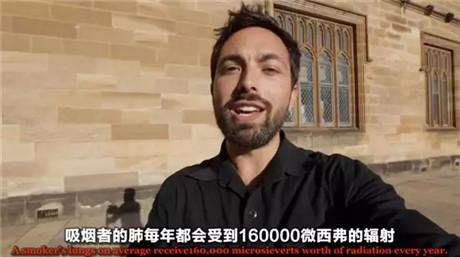
Smokers receive an annual radiation dose of 160000 microsieverts, which comes from the radioactive polonium and lead in tobacco, so not only does smoking increase the risk of lung cancer, but it also exposes people to a large amount of radiation each year.
However, electronic cigarettes produce almost negligible radiation because they do not burn tobacco, which led many netizens to comment with relief after watching the video, "Good thing I smoke e-cigarettes..."
The researchers at Jire Technology claim that they have always adhered to the concept of conveying care in product development, and every electronic cigarette produced undergoes strict quality testing, including radiation testing. Compared to traditional cigarettes, because they do not require combustion, they not only do not produce harmful secondhand smoke but also do not bring high-intensity radiation due to the combustion of radioactive elements.
In 2016, Jire Technology announced at the electronic cigarette business conference that it had become the general agent for JAI electronic cigarettes in China and recruited dream partners to jointly develop the electronic cigarette market. It is believed that in the near future, JAI electronic cigarettes will enter thousands of households and become a new generation of healthy smoking alternatives, allowing smokers to stay away from the hazards of radiation.