
Vapefly PIXIE RDA Atomizer Review
Vapefly PIXIE RDA atomizer review: many users will immediately think of the highly flexible draw adjustment and broad structural variations of the Galaxies MTL series. This time, Vapefly teamed up with Ferdinand Factor from the Philippines to launch the P
Vapefly PIXIE RDA Review: Many players will surely think of the versatile airflow adjustment and the extensive structure of the Galaxies MTL series. This time, they collaborated with Ferdinand Factor from the Philippines to launch the PIXIE RDA, a 22mm atomizer that returns to its original intention.
With a size of only 22*24mm, it offers two interchangeable single-hole and single-row internal airflow kits, and the external airflow holes can be adjusted through a smooth rotation, falling into a moderate lung hit range. Although it does not have the special airflow direction like the Horus and Core, the side airflow and short chamber still provide a smooth yet direct experience, with a balanced and not overly stirred flavor, which is my deepest impression of it.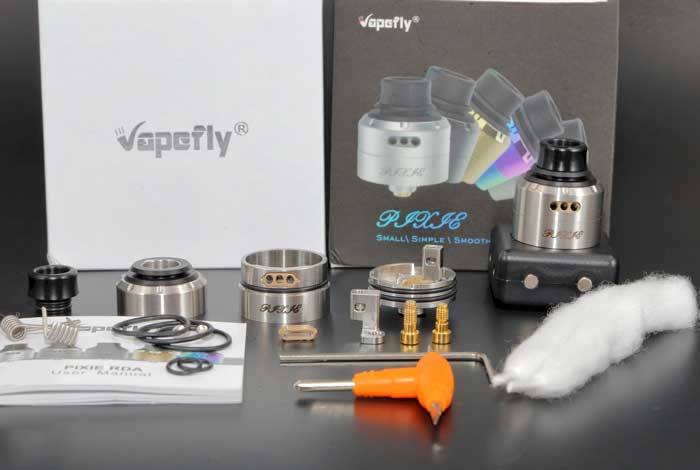 Previously, I shared my love for the Galaxies MTL series, which focuses on extreme airflow variation; the Horus or Core RTA from the same manufacturer works on airflow direction and brings charming flavor. However, the PIXIE's appeal lies solely in its simplicity and ease of use, both in structure and setup. Relatively speaking, it has fewer distinctive features, but the angled anti-leak airflow holes, heat-dissipating fins on the top cap, lip-shaped mouthpiece for better tactile feel, and the dual atomization chamber dome that enhances flavor and collects condensation, along with the side-fill bottom screws, show Vapefly's attention to detail.
The PIXIE also adopts Vapefly's common black background with blue lettering pull-out outer box, which includes: the main body, screwdriver, two pieces of 26ga*2 (KA1) + 36ga (Ni80) 3.0mm wire, screws, O-rings, and a manual with instructions in Chinese, English, Japanese, and Korean; the main body can be disassembled into: 510 drip tip, top cap, outer cover, internal airflow kit, coil deck, and regular and BF-specific positive screws.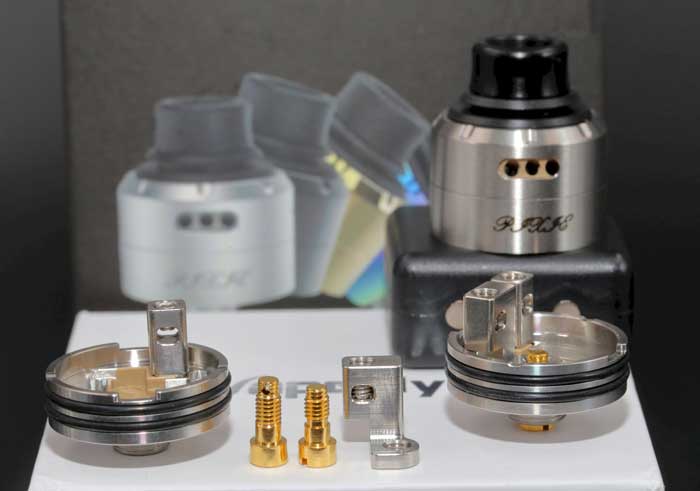 The included 510 drip tip is only about 6mm high, but the side still has a lip-shaped curve, assisting in condensation. Notably, the top cap has a fin design that aids in heat dissipation, preventing the short chamber from burning the lips, while the interior features a dome similar to a dual atomization chamber, but given its height, its main function should be to concentrate internal condensation.
The outer cover's internal airflow holes can be replaced with two airflow kits, similar to the external airflow holes, in either strip or single-hole form. The airflow kit can be easily removed by gently pushing from the small groove on the top of the outer cover, and the angle of the airflow holes is not small, so the airflow mainly blows from the upper external side downwards, acting on the lower edge of the coil, with basic anti-leak functionality.
The PIXIE uses a common dual-post coil deck, and since its main selling point is simplicity, there are holes for placing the wire-wrapping tool on both sides of the base, making it very convenient to fix the coil or determine the installation position. The distance from the locking wire hole to the outer cover is sufficient, making handling the wire legs very simple.
With a height of only 24mm including the drip tip, it is mostly used with BF devices, so the bottom-fill screw's leak holes are also set on both sides to effectively prevent oil splashes.
To match the 22*24mm PIXIE, I pulled out my long-unused mechanical box, the Hive, as both belong to a lightweight style, making them complement each other beautifully.
This time, I used the included 26ga*2 (KA1) + 36ga (Ni80) wire and a 24ga 3.0mm 5-wrap twisted wire for testing. Although the side airflow's flavor is generally not as direct as bottom airflow, due to the short airflow path and vapor channel, and since I used a mechanical box, there is still sufficient density. Excluding vapor production, this type of atomizer can produce good flavor regardless of the type of e-liquid used, but I personally prefer slightly cool complex fruity flavors, especially at 6\12NS concentration, which is direct yet smooth and balanced without being overly stirred; this is my impression of it.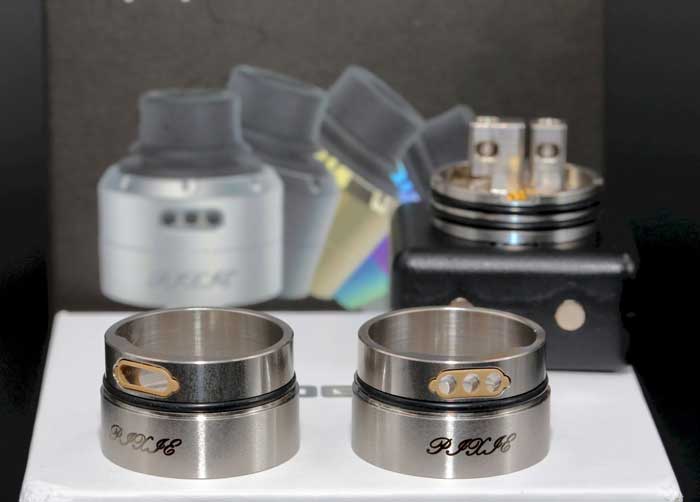 I briefly tested single-wire performance, which was within the normal range. After all, its chamber size does not pursue extreme compression ratios, making it naturally difficult to compare with my other 18mm RDAs or dedicated MTL RDAs. However, as a balanced or 22mm RDA, it is already quite good.
In summary, the characteristics are as follows:
- The airflow resistance ranges from high to low, falling within levels 3 to 5.
- The flavor profile is balanced.
- The holes for placing the wire-wrapping tool help fix the coil position and height, making coil installation easy.
- The internal airflow has an angle, making it less likely to leak.
- The fin design at the bottom of the top cap helps with heat dissipation and insulation.
- The simple and easy structure allows both new and experienced players to quickly get started.
There are also some designs that are difficult to define:
- Due to its positioning, it is relatively lacking in surprise and playability.
- The variability of the internal airflow kits is limited; if different heights with the same width strip kits could be used, it might yield more noticeable effects.
This concludes the review of the Vapefly PIXIE RDA. I hope it helps everyone understand its features, and I thank all friends for their support.
With a size of only 22*24mm, it offers two interchangeable single-hole and single-row internal airflow kits, and the external airflow holes can be adjusted through a smooth rotation, falling into a moderate lung hit range. Although it does not have the special airflow direction like the Horus and Core, the side airflow and short chamber still provide a smooth yet direct experience, with a balanced and not overly stirred flavor, which is my deepest impression of it.
Previously, I shared my love for the Galaxies MTL series, which focuses on extreme airflow variation; the Horus or Core RTA from the same manufacturer works on airflow direction and brings charming flavor. However, the PIXIE's appeal lies solely in its simplicity and ease of use, both in structure and setup. Relatively speaking, it has fewer distinctive features, but the angled anti-leak airflow holes, heat-dissipating fins on the top cap, lip-shaped mouthpiece for better tactile feel, and the dual atomization chamber dome that enhances flavor and collects condensation, along with the side-fill bottom screws, show Vapefly's attention to detail.The PIXIE also adopts Vapefly's common black background with blue lettering pull-out outer box, which includes: the main body, screwdriver, two pieces of 26ga*2 (KA1) + 36ga (Ni80) 3.0mm wire, screws, O-rings, and a manual with instructions in Chinese, English, Japanese, and Korean; the main body can be disassembled into: 510 drip tip, top cap, outer cover, internal airflow kit, coil deck, and regular and BF-specific positive screws.
The included 510 drip tip is only about 6mm high, but the side still has a lip-shaped curve, assisting in condensation. Notably, the top cap has a fin design that aids in heat dissipation, preventing the short chamber from burning the lips, while the interior features a dome similar to a dual atomization chamber, but given its height, its main function should be to concentrate internal condensation.The outer cover's internal airflow holes can be replaced with two airflow kits, similar to the external airflow holes, in either strip or single-hole form. The airflow kit can be easily removed by gently pushing from the small groove on the top of the outer cover, and the angle of the airflow holes is not small, so the airflow mainly blows from the upper external side downwards, acting on the lower edge of the coil, with basic anti-leak functionality.
The PIXIE uses a common dual-post coil deck, and since its main selling point is simplicity, there are holes for placing the wire-wrapping tool on both sides of the base, making it very convenient to fix the coil or determine the installation position. The distance from the locking wire hole to the outer cover is sufficient, making handling the wire legs very simple.
With a height of only 24mm including the drip tip, it is mostly used with BF devices, so the bottom-fill screw's leak holes are also set on both sides to effectively prevent oil splashes.
To match the 22*24mm PIXIE, I pulled out my long-unused mechanical box, the Hive, as both belong to a lightweight style, making them complement each other beautifully.
This time, I used the included 26ga*2 (KA1) + 36ga (Ni80) wire and a 24ga 3.0mm 5-wrap twisted wire for testing. Although the side airflow's flavor is generally not as direct as bottom airflow, due to the short airflow path and vapor channel, and since I used a mechanical box, there is still sufficient density. Excluding vapor production, this type of atomizer can produce good flavor regardless of the type of e-liquid used, but I personally prefer slightly cool complex fruity flavors, especially at 6\12NS concentration, which is direct yet smooth and balanced without being overly stirred; this is my impression of it.
I briefly tested single-wire performance, which was within the normal range. After all, its chamber size does not pursue extreme compression ratios, making it naturally difficult to compare with my other 18mm RDAs or dedicated MTL RDAs. However, as a balanced or 22mm RDA, it is already quite good.In summary, the characteristics are as follows:
- The airflow resistance ranges from high to low, falling within levels 3 to 5.
- The flavor profile is balanced.
- The holes for placing the wire-wrapping tool help fix the coil position and height, making coil installation easy.
- The internal airflow has an angle, making it less likely to leak.
- The fin design at the bottom of the top cap helps with heat dissipation and insulation.
- The simple and easy structure allows both new and experienced players to quickly get started.
There are also some designs that are difficult to define:
- Due to its positioning, it is relatively lacking in surprise and playability.
- The variability of the internal airflow kits is limited; if different heights with the same width strip kits could be used, it might yield more noticeable effects.
This concludes the review of the Vapefly PIXIE RDA. I hope it helps everyone understand its features, and I thank all friends for their support.


