
Before the Major Vaping Industry Reshuffle: Retail Margins Shrink as Brands Expand Offline Aggressiv
Today, I saw a hot article on the Internet. The content is about the current e-cigarette market, the topic of distribution channels between brand merchants and channel merchants. It is also the topic of most direct concern to the e-cigarette industry.
In order to expand the time, the brand side is also striving to find good channel agents, and channel merchants are constantly screening products and selecting promotion forms in order to better find sales methods and strive for profits. The content also mentions some related cooperation models and channel market status of several major brands. If you are a novice merchant who has just entered the e-cigarette industry and is ignorant of the industry, perhaps the dialogue in this article will also be useful for you; If you happen to be a channel agent who has encountered this kind of situation, you can be relieved of your current situation and continue to move forward. No matter the current public opinion or industry pressure, it will always accompany you during the development of the industry until it becomes more and more complete and develop; Of course, as the brand party said at the end of the article, there are indeed some shortcomings in the e-cigarette industry at present, but for e-cigarettes that are still in the early stages of development, they firmly believe that it can be achieved through technology."But I think there is still a long way to go." We also look forward to the e-cigarette industry working together to develop together.
In order to avoid unnecessary erroneous guidance, the specific name of the original brand in the original text has been deleted and changed into a general name. The reprinted content is as follows. The above only represent personal opinions. If there are any suggestions, professional corrections from industry professionals are welcome!
Manuscript: Time Weekly reporter Liu Weiqi partially revised
Although the e-cigarette industry is becoming more and more popular, as the attitudes of countries around the world towards e-cigarettes change and the launch date of my country's national standard approaches, nearly 4000 domestic e-cigarette companies are about to face a new situation in the industry.

"Approval is in progress". On October 14, on the website of the National Standard Information Public Service Platform, the current status of the national standard for "E-Cigarette" was displayed like this.
According to this standard formulation plan introduction issued in October 2017, the project cycle is 24 months, which means that it will be approved, approved and released by the National Standards Committee at the latest by the end of October. This news has affected nearly 4000 companies in the e-cigarette industry and may have a huge impact on their future development direction.
From the perspective of various capitals, this is indeed a huge cake. Public data shows that my country, as a major tobacco country with 350 million smokers, in 2018 alone, the tax revenue of China tobacco companies reached 1.1556 billion yuan.
According to Euromonitor statistics, the size of my country's e-cigarette market in 2018 was 5.152 billion yuan, a year-on-year increase of 28.5%, and the compound annual growth rate reached 35% in 2012 and 2018. The current penetration rate of e-cigarettes is less than 1%. If calculated based on the penetration rate of 10%, the market size will reach 100 billion.
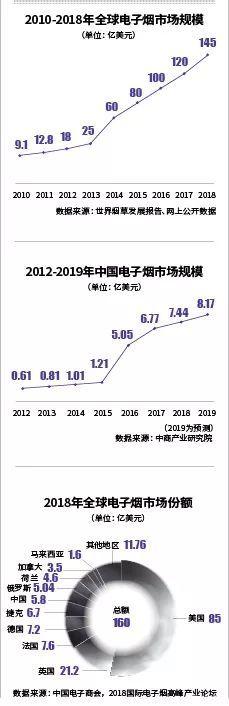
In the past two years, capital has poured into the industry crazily, and day after day, a large number of e-cigarette brands have emerged in the market.
According to data from the Prospective Industry Research Institute, there are nearly 4000 e-cigarette companies in China, and there are more than 500 in Shenzhen alone, but 80% of them are small companies with less than 50 employees.
On September 27, a person in charge of the e-cigarette brand told a reporter from Times Weekly that when the market was at its peak, the same products produced by the same OEM were sold under different brands because there were always people buying them.
From the perspective of the industry, e-cigarette supervision will inevitably become increasingly strict. The first national standard "E-Cigarette" will make it more rational, but at the same time, it will also trigger a major reshuffle in the industry.
Recently, a reporter from Times Weekly visited a number of offline retail stores and authorized specialty stores and found that during the critical period of the development of the e-cigarette industry, the market is quietly changing.
Merchants wander around #p#paginated title #e#
"I have been in this business for almost ten years, and I have stopped working since last month. The market is not good now." On October 11, Wang Xuan (pseudonym), a shop owner who has been selling e-cigarettes in Beijing for many years, said that he was "chilling" about the industry. His store is an experience store that smokers and enthusiasts often visit. According to him, this store not only sells small cigarette e-cigarettes such as the current popular models, but also sells e-cigarette products such as big smoke DIY.
Wang Xuan told a reporter from Times Weekly,"I have been working for almost ten years. I made money at the beginning, but as I went on, the more I realized that I started to need costs. Although the volume of customer orders is similar to the past, the unit price of customer orders has dropped. In the past, it used to be sold for one to two thousand yuan, two to three thousand yuan, but now a set only costs a few hundred yuan, and you can see the profit margin."
At present, many mature e-cigarette brands are actively looking for offline regional agents and expanding offline stores.
"A certain brand also came to me several times at that time because our stores were in very good locations, but considering the low profits of this brand, the price it offered was too different from my selling price, so I didn't do it. I wouldn't sell it if it wasn't 2.5 times or 2.7 times when we opened the store."
He said: "The electronic cigarettes on the market now leak more or less, which is normal." Maybe the price given by the brand is not enough profit, the profit is small and the trouble is too much. Who is willing to push it?"
On October 11, a reporter from Times Weekly contacted Zhang Ming (pseudonym), a salesperson of a certain brand. According to Zhang Ming, he was currently recruiting regional agents and franchise stores. Regional agency requirements are relatively high. Taking Beijing agency as an example, it needs to pay a deposit of 50,000 yuan and the first batch of purchase of 450,000 yuan. After three months, the monthly purchase amount will be 1 million yuan. Two stores need to be opened in the first three months. When the reporter asked when he could get back the money, Zhang Ming said that it would take 3-5 months.
Franchisees require franchisees to find a store location with a comprehensive profit of about 50%, which meets the brand's investment needs. The brand can not only provide all store decoration design and expenses, but does not require a franchise fee, but it requires a deposit of 10,000 yuan.
According to Zhang Ming, the cost of complete renovation for a site of about 10 square meters is 60,000 - 80,000 yuan, and this cost is entirely borne by the brand.
Subsequently, a reporter from Times Weekly visited an offline authorized store of an e-cigarette brand. From the bookkeeping kept by clerk Chen Hao (pseudonym), it was seen that on October 11 alone, there were nearly 30 orders. According to Chen Hao's products, the current combination of a smoking set and two cigarette bombs is estimated at 99 yuan, and the daily flow on weekdays is about 3000 yuan. For people who want to enter the industry, Chen Hao said that if they don't know much about it, try not to enter because he has seen many stores close down.
During the visit, a clerk at an offline e-cigarette store told Times Weekly that the store owner had been open for six years, but he was not making money. The boss also revealed to him that the industry was depressed and he wanted to cut his salary. He is already preparing to leave his post that month.
Offline expansion crazily
Offline stores of e-cigarettes are regarded by brand owners as the key to shipment.
"In the early stage, everyone was still studying how to sell e-cigarettes online, but now they find that online is not the main shipping channel for e-cigarettes. Its main focus is still offline." The brand party introduced it to the Times Weekly reporter.
According to the brand, the current channel expansion is divided according to different product positioning. At present, the mainstream products include disposable products and replacement products. Disposable products are more inclined to retail terminal channels, such as convenience stores, retail stores, etc.; replacement channels are relatively abundant, including brand direct stores, and brand authorized franchises, and some 3C channels.
"The most important thing in channel promotion is to find the right people and the right team." The brand said that sales and channel personnel account for a large proportion.
On October 9, a reporter from Times Weekly learned from a brand that based on the brand's current team size of nearly 1,000 people, in addition to the product and R & D team, the largest team is the channel department."The number of channel employees currently accounts for more than half of the company."# p#pagination title #e#
Times Weekly reporters learned from several e-cigarette companies they visited that they attach great importance to offline promotion and are all investing manpower and material resources to expand market share.
According to the brand, we are currently expanding at a growth rate of tens of thousands of stores every month, and we expect to have hundreds of thousands of retail outlets by the end of this year. The expansion of offline channels is not as easy as imagined. Another brand leader explained to a reporter from Times Weekly based on his past experience in the retail market: "There are now 7 million offline channel retail terminals in China, and chains may account for less than 10%, most of which are scattered small shops one by one. If you want to get through it one by one, it will be very difficult to cover it all."
Times Weekly reporters also randomly visited several offline stores. Taking Beijing as an example, a certain number of convenience stores have placed disposable e-cigarettes in prominent positions. The brands are very diverse, with well-known and many unknown ones. The reporter randomly asked several convenience store employees about the current sales situation of e-cigarettes. They generally said that the sales were not bad, and people would come to buy them every day.
In terms of specialty stores, the reporter searched through APP such as Public Dianping and found that there are currently many offline authorized stores for e-cigarettes on the market.
Later, the reporter contacted a Beijing channel salesman of an e-cigarette brand. According to the salesman, they only started recruiting agents in Beijing in July this year, so far, only 4 stores have been opened in Beijing.
Game theory of electronic cigarettes
"Who do you sell your products to? This is an industry boundary issue that we have mentioned before." A person in charge of the e-cigarette brand said.
The heads of several e-cigarette brands interviewed by Times Weekly reporters unanimously stated that they do not want their products to become the first cigarette of young people, and the target audience is still smokers. Offline stores, each e-cigarette brand is also marked in a prominent position and is prohibited for minors.
From the outside world, this kind of measure is like an Internet cafe stating that minors are not allowed to enter.
On October 11, a reporter from Times Weekly met a 23-year-old girl Li Xin (pseudonym) in an offline e-cigarette store. The frequency of her buying e-cigarettes is about once every two weeks, with an average of two to three hundred yuan per month. According to Li Xin's observation, there are not many people around her who smoke e-cigarettes, and there are fewer boys than girls.
When Times Weekly reporters visited online stores, they also observed that most of the customers were young women aged 20-30, with relatively few male customers. At present, the general consensus in the industry on e-cigarettes is that e-cigarettes are a highly repurchased consumer product and can continue to bring profits.
However, Wang Xuan, who has been selling e-cigarettes for ten years, does not agree with this: "Some people buy again and stop buying them. After ten years of making e-cigarettes, I found that none of the old smokers around me abandoned cigarettes because of e-cigarettes. Many people who smoke e-cigarettes carry a pack of traditional cigarettes with them. The fundamental problem is that e-cigarettes cannot achieve the effect of traditional cigarettes."
"The problem here is that to replace real tobacco, you need to taste very similar to real tobacco, which is what everyone calls solving addiction. If I were a smoker, and if you gave me e-cigarettes now, I wouldn't have enjoyed smoking at all. That would definitely not work. This involves the reduction degree of e-cigarettes." A brand official replied that if you reach out to non-smokers because the product cannot attract smokers, it will be out of line, and we oppose this practice.
At the same time, the person in charge of the brand also admitted that there are indeed some shortcomings in the current e-cigarette industry, but for e-cigarettes that are still in the early stages of development, they firmly believe that it can be achieved through technology."But I think there is still a long way to go."


