
Shenzhen Lawmakers Propose Revising Smoking Control Regulations to Regulate E-Cigarettes
Today's latest news from the official Weibo: [28 representatives suggest: Ban e-cigarettes in smoke-free areas] A survey report shows that among middle and primary school students in Shenzhen, the proportions of those who have heard of, seen, or used e-cigarettes are 54%, 33.9%, and 3.8%, respectively, all higher than the results of the 2014 Shenzhen adult tobacco survey. Therefore, at this year's Shenzhen Two Sessions, 28 representatives jointly suggested that Shenzhen should timely initiate the revision of the "Smoking Control Regulations" to include e-cigarettes in the smoking ban category. (Read the original Weibo post at the end of the article!)
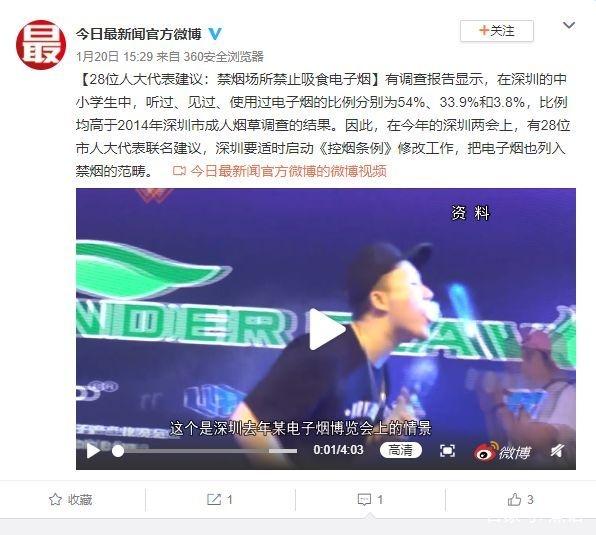
According to Yangcheng Evening News: The "Shenzhen Special Economic Zone Smoking Control Regulations" have been implemented since March 2014, with a comprehensive indoor smoking ban in Shenzhen, but there is a regulatory gap regarding e-cigarettes. This year, many representatives at the Shenzhen Two Sessions noticed this phenomenon and jointly submitted a proposal to legislate the regulation of e-cigarettes, suggesting that the Shenzhen Health and Family Planning Commission take the lead in conducting legislative research on e-cigarettes.
Shenzhen representative Zhuang Chuangyu pointed out that e-cigarettes have been labeled as "helpful for quitting smoking" since their emergence in 2003. Data shows that in 2016, China's e-cigarette production reached 1.21 billion sticks, and compared to the penetration rates in Europe and America, the domestic market still has room for development, with an estimated production of 4.75 billion sticks by 2022. It is worth noting that "90% of the world's e-cigarettes are produced in China."
However, e-cigarettes are not without risks to the environment. Research shows that the harm of e-cigarettes is 95% lower than that of traditional cigarettes, but they still contain addictive nicotine, and many e-cigarette products currently sold on the market do not accurately label their nicotine content according to standards.
For minors, accidental exposure could affect brain development. Although a notice was issued last August by the State Administration for Market Regulation and the National Tobacco Monopoly Administration prohibiting the sale of e-cigarettes to minors, other related standards have not yet been introduced.
Therefore, representatives suggest that the Shenzhen Health and Family Planning Commission take the lead in conducting legislative research on e-cigarettes, with participation from the Shenzhen Municipal People's Congress and the Market Supervision Administration. By amending Shenzhen's smoking control regulations, e-cigarettes can be treated equally with traditional cigarettes, strengthening control and enforcement in advertising, sales, and smoking areas; on the other hand, a Shenzhen version of e-cigarette standards should be introduced as soon as possible to make this regulatory work more scientific.
(Source: Yangcheng Evening News, Sina Weibo official latest news, the article only represents the author's views and does not represent the position of this site)


