
Vuse Becomes the First to Pass the U.S. PMTA, Sales Authorization May Come Soon
These final rules are an important part of the FDA's comprehensive approach to tobacco product regulation, which includes premarket application review, scientific use of product standards authority, and priority compliance and enforcement actions.
This week has been a positive week for the e-cigarette industry. First of all, the FDA finally opened its door to e-cigarettes. The world's first e-cigarette brand to pass the U.S. PMTA was born. On October 15, the World Health Organization (WHO) suddenly became uncharacteristic on the issue of e-cigarette supervision.
When providing advice on e-cigarette supervision, the WHO stated that e-cigarette products are rapidly iterating, and different regulatory plans should be formulated for different products. For example, only the sale of e-cigarettes whose users can control device functions and cigarette oil components is banned, and the sale of current market is not banned. Mainstream closed e-cigarettes, etc. This is significantly different from its previous practice of vaguely stating that e-cigarettes are harmful and should be strengthened.
Domestically, some netizens said that his local Tobacco Bureau has begun to intervene in physical e-cigarette shops, requiring tobacco business licenses, and will join forces with the public security organs to crack down on unlicensed businesses and online sales. According to him, personnel from the Tobacco Administration informed that the e-cigarette policy will be introduced soon, from the end of November to mid-December.
Key news this week
The world's first e-cigarette brand to pass the US PMTA was born #p#pagination title #e#
After rejecting more than 1 million e-cigarette related products, on October 13, the U.S. Food and Drug Administration, which is known for its strictness, announced that it had authorized the first e-cigarette: Vuse Solo manufactured by R.J. Reynolds Vapor Company, a subsidiary of British American Tobacco. The agency allowed the company's tobacco-flavored electronic liquid cartridges to market, but rejected various other cartridges.
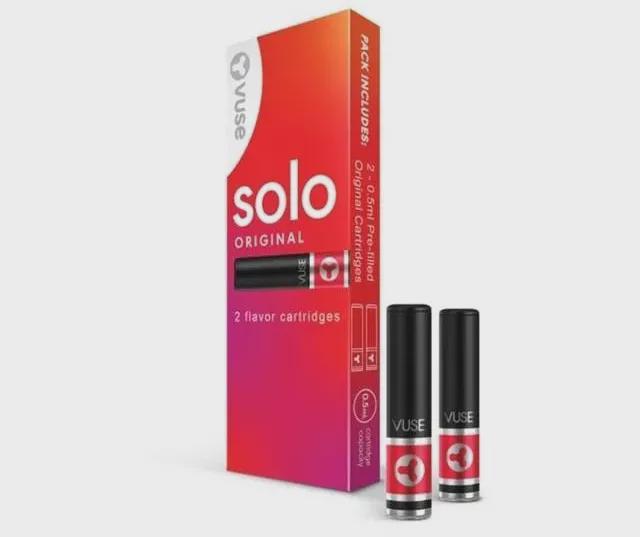
More than a month has passed since the Food and Drug Administration's deadline for review of smoky and e-cigarettes. During this period, companies were allowed to continue selling their products, although agency rules said any new tobacco product would require authorization to be sold. Now, any product sold without authorization is illegal.
WHO recognizes the safety of closed e-cigarettes
#p#Pagination Title #e#
On October 15, it was reported that the World Health Organization (WHO) suddenly became abnormal on the issue of e-cigarette regulation.
Recently, when providing e-cigarette regulatory advice, the WHO stated that e-cigarette products are rapidly iterating, and different regulatory plans should be formulated for different products. For example, only banning the sale of e-cigarettes whose users can control equipment functions and cigarette oil components, and not banning sales. Currently mainstream closed e-cigarettes on the market. This is significantly different from its previous practice of vaguely stating that e-cigarettes are harmful and should be strengthened.
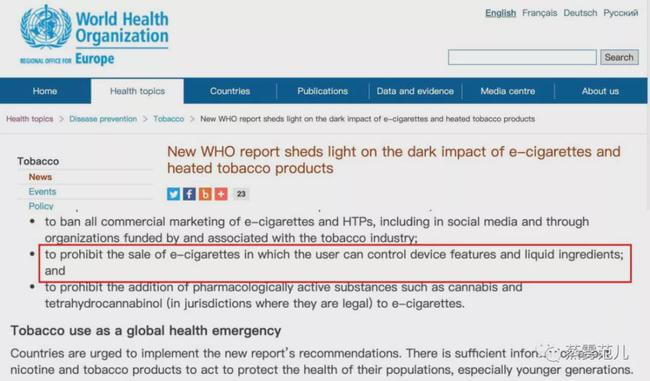
The WHO says the sale of e-cigarettes whose users can control the functions of the device and the composition of the tobacco oil should be banned (i.e. open e-cigarettes)
According to foreign media reports, the WHO wanted to urge countries to adopt the same strict regulatory measures on e-cigarettes as cigarettes at the Ninth Conference of the Parties to the World Health Organization Framework Convention on Tobacco Control (WHO FCTC). However, due to criticism from many parties and strong opposition from some member states, WHO postponed the key issue-"Discussion on New Tobacco Products"-to 2023.
FDA Acting Commissioner Janet Woodcock, M.D., said: The FDA is committed to protecting Americans from tobacco-related disease and death by ensuring that new tobacco products undergo appropriate regulatory review to determine whether they meet public health standards stipulated by law. If new tobacco products do not meet the standards of these pathways, they cannot be sold or sold in the United States.# p#pagination title #e#
Lixun Electronics holds hands with Weipeng (WEAPON electronic cigarette)
On October 10, 2021, Weipeng (Shenzhen) Technology (WEAPON) and Lixun Electronic Technology (Enshi) jointly signed a strategic cooperation agreement. The two parties formally formed a deep strategic partnership to carry out all-round cooperation in the electronic atomization industry.
Mr. Chen Zhiying, founder, CEO and chief designer of Weipeng (Shenzhen) Technology, Feng Yong, executive director and general manager of Lixun Electronic Technology (Enshi) and general manager of Suining Lixun Precision, completed the signing on behalf of both parties. Secretary-General of the Electronic Cigarette Industry Committee of China Electronics Chamber of Commerce Ao Weinuo was invited to attend. In addition, major players in the e-cigarette industry gathered at the signing site, and everyone witnessed this important moment.
New Zealand supports e-cigarettes across the country and has been approved as a smoking cessation assistant!
#p#Pagination Title #e#
The fundamental reason why New Zealand promotes e-cigarettes is that,They want to be smoke-free by 2025。
The government has put forward a series of recommendations, such as gradually raising the minimum legal age for smoking, leading to a comprehensive ban on cigarette sales, while considering significantly reducing the allowed nicotine content in tobacco products, banning the use of filters, setting a minimum selling price for tobacco, and restricting the point of sale of cigarettes and their raw materials.
Media reports say that one in four people in New Zealand dies of cancer, with tobacco poisoning being the main culprit. About 500,000 people in New Zealand smoke every day.
When announcing these reform measures, Aisha Verrol, Deputy Minister of Health of New Zealand, said that about 4500 people die from tobacco every year in New Zealand and that the pace must be accelerated to achieve the smoke-free goal, so new methods are needed.
E-cigarettes have become one of the important new methods
New Zealand has approved the use of e-cigarettes as a smoking cessation assistant, and has also officially affirmed the status of e-cigarettes at the national level.
#p#Pagination Title #e#Let's take a look at what New Zealand officials do.
According to the website of the National Ministry of Health of New Zealand, we can understand that the New Zealand government's attitude towards e-cigarettes includes the following aspects:
1. E-cigarettes are not suitable for children or minors.
2. E-cigarettes are not suitable for non-smokers.
3. E-cigarettes are not harmless, but they are much less harmful than smoking.
Electronic cigarettes can help some people quit smoking.
If the State Tobacco Administration intervenes, it may usher in an e-cigarette license!
#p#Pagination Title #e#
A few days ago, some netizens said that his local Tobacco Bureau has begun to intervene in physical e-cigarette shops, requiring tobacco business licenses, and will join forces with the public security organs to crack down on unlicensed merchants and online sales. According to him, personnel from the Tobacco Administration informed that the e-cigarette policy will be introduced soon, from the end of November to mid-December.

Coincidentally, Blue Hole's new consumption news shows that according to feedback from e-cigarette shop owners in several cities, e-cigarette shops have recently received requests from relevant departments to fill in the channel sales survey form and the e-cigarette brand survey form on sale. At present, shop owners in Chengdu and Dazhou in Sichuan, Zhengzhou in Henan, Xilinhot in Inner Mongolia, Anshun in Guizhou, and Changchun in Jilin have reported that they have received similar surveys.
Shopkeepers speculated that it may be a unified survey of offline e-cigarette channels and brands by relevant departments, which may mean that the standardization of offline channels will soon come.
So, what new policy will the State Tobacco Administration come up with?
How profitable are e-cigarettes? This is not the case!# p#pagination title #e#
Recently, some media released content about e-cigarettes in the form of long pictures. "How profitable are e-cigarettes? According to Simmore International's prospectus, in 2019, the average selling price of electronic atomization equipment was 8.7 yuan, and the average selling price of electronic atomization components was 7.5 yuan, with the overall total no more than 20 yuan. On the market, the sales of a set of rechargeable e-cigarettes can reach 200 yuan, which is a huge profit." What do you think?
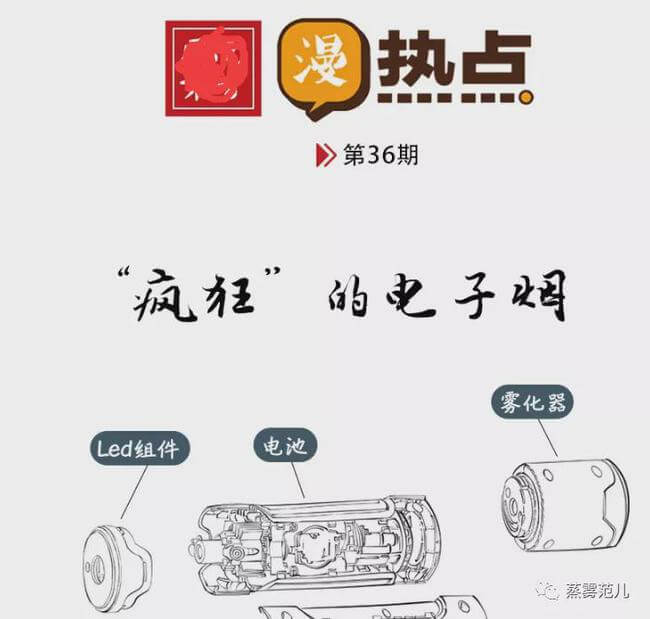
First of all, the author first expresses his opinion: If there are real huge profits, the industry will not be in a downturn. All companies are tightening their belts and preparing for the arrival of a cold wave of e-cigarettes! Some e-cigarette shop owners even liquidate their stores directly.
Oxford University: Potential benefits of e-cigarettes are ignored
Who can we turn to for honest comments when it comes to credible information about e-cigarette smoking? Maybe Jamie Hartmann-Boyce, a senior researcher, departmental lecturer and director of the Doctoral Program for Evidence-Based Medicine at the University of Oxford University's Center for Evidence-Based Medicine (CEBM).# p#pagination title #e#

She recently commented on misinformation surrounding tobacco harm reduction products: "There are many reasons why misunderstandings about the safety of e-cigarettes persist, and much discussion about e-cigarettes focuses on the risks to young non-smokers.The potential benefits of e-cigarettes for smokers and those around them are often ignored."
She published a paper titled "Balancing the risks and benefits of e-cigarettes." It considers randomized controlled trials and population studies that look at the actual risks to teenagers and the unintended consequences for adult smokers if the use of e-cigarettes is restricted or banned.
The authors pointed out that although there is evidence that e-cigarettes are currently increasing smoking cessation rates,The impact could be even greater if the public health community paid serious attention to the potential of e-cigarettes to help adult smokers, smokers received accurate information about the relative risks of e-cigarettes and smoking, and the potential impact on smokers was taken into account when designing policies.But that didn't happen."


