
RELX biggest promotion is here: 1 device + 11 cartridges for only 398
RELX has once again stepped up the intensity of its promotion. GeWu Consumer has just obtained the latest overview of RELX’s current campaign, “Enjoy Spring, Four Great Gifts.” The campaign officially began on April 1 and is open to exclusive stores nationwide through a registration-based format:
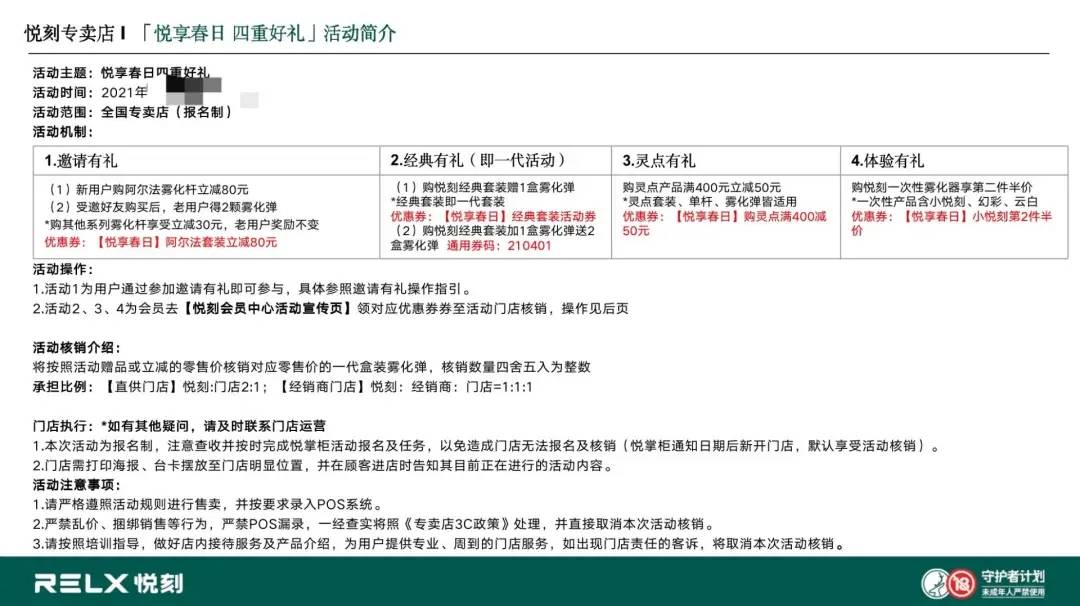
Specifically, the four offers are:
Invitation Gift: New users get an instant 80 RMB discount when purchasing the 2nd-generation Alpha. If they invite a friend to buy, the existing user receives 2 pods.
Classic Gift: Buy a 1st-generation kit and get 1 box of pods free (equivalent to 299 RMB for 1 device + 5 pods); buy a 1st-generation kit + 1 box of pods and get 2 more boxes of pods free (equivalent to 398 RMB for 1 device + 11 pods).
Lingdian Gift: Buy the 3rd-generation Lingdian and get 50 RMB off when spending 400 RMB or more, applicable to kits, single devices, and pods.
Trial Gift: For the three products in the disposable series (Xiao RELX, Huancai, and Yunbai), the second item is half price.
Even for industry insiders familiar with RELX, this campaign is still likely to spark controversy, as its strength is basically unprecedented.
Previously, RELX’s standard referral offer was that when an existing user invited a friend, the friend received a 30 RMB instant discount coupon pack, while the existing user received only 1 pod. As for the “Classic Gift,” it is an upgraded version of RELX’s “Enjoy Spring, Double Gifts” campaign that began on February 26. At that time, the offer was only 1 free box of 1st-generation pods with the purchase of a 1st-generation kit. This time, buying the kit is essentially equivalent to directly getting the right to buy pods at roughly 33% of the usual price.
The scale of the promotion is one thing, but another notable point is how the cost is shared: [Direct-supply stores] RELX:store = 2:1; [Distributor stores] RELX:distributor:store = 1:1:1.
Put simply and directly: for directly operated supply stores, the RELX manufacturer bears about 66% and the store about 33%; for franchised stores, the RELX manufacturer bears about 33%, the primary distributor about 33%, and the store about 33%.
It is not hard to see that direct-supply stores enjoy a clear advantage in terms of promotional support; distributor stores, on the other hand, are more about leveraging the same level of promotion at lower cost by shifting part of the promotional expense onto distributors. As we understand it, this 2:1 cost-sharing ratio is uncommon in brand campaigns, as most brands typically use a 1:1 model.
Beyond the campaign document itself, there is another layer that deserves more thought.
As with previous promotions, this campaign still requires verification through RELX’s system. Users collect coupons and benefit from the offers, stores redeem them and gain traffic, and RELX further consolidates user operations in its own hands—which in itself is nothing unusual. However, this campaign differs from past offers that involved only discount vouchers worth a few dozen yuan. In particular, the 1st-generation promotion is so aggressive that, after conversion, the price per pod drops to just 11 RMB.
What does 11 RMB per pod mean? It is far below the wholesale price for exclusive stores, and even lower than most compliant generic-compatible products. Direct-supply stores and franchised stores may still be able to barely absorb this; but for authorized stores, because they cannot redeem this promotion, it means that even if they want to follow suit, let alone official pods, they would have to subsidize out of pocket even to do it with compatible products.
As far as we know, quite a few authorized store owners are already preparing to switch their stores to other brands because of this extremely aggressive promotion. It is also worth recalling that not long ago media reported that a store in Linyi, Shandong, was fined 40,000 RMB and had goods confiscated for infringing RELX’s registered trademark because it could not provide supplier qualifications. This campaign will inevitably place a large number of unqualified stores in a passive position as well.
In fact, the impact of this campaign is not limited to RELX itself. Take RELX’s previous promotion of giving away 1 box of 1st-generation pods with the purchase of a 1st-generation kit as an example: it was initially released as a limited-time offer, but later the campaign period was revised and extended.
In other words, adjusting prices through “limited-time” promotions gives RELX plenty of room to advance or retreat as it wishes. Given RELX’s market influence, every price move it makes sends shockwaves through the entire upstream and downstream chain. For example, gray-market traders who rely on RELX immediately face sharply increased risks.
Should other brands follow? If they do, they cannot outspend RELX, which is already listed on the secondary market; even if they match the same price level, they still lag behind in brand power. If they do not follow, given the market education RELX has already done, it is hard to ensure that consumers will not vote with their feet and choose better value for money. #p#Page Title#e#
If we look at it from the product level, haven’t quite a few brands launched 9.9 RMB and 8.8 RMB devices positioned as traffic-driving products? In comparison, RELX Qingfeng previously looked rather weak. But once this promotion went live, the effect changed.
Take YOOZ’s 9.9 RMB device as an example: 1 device + 11 pods comes to 394.9 RMB; with MOTI, 8.8 RMB plus 11 pods comes to around 391.05 RMB. By comparison, RELX 1st-generation still has obvious advantages in device color options and the variety of stickers and lanyards, which makes things quite awkward for competitors.
In short, before brands even talk about whether they can keep up with RELX in promotional intensity, if they cannot speed up the operation of their membership systems, they are very likely to face this kind of problem more and more frequently and be pushed into a passive position.


