
2020 E-Cigarette Brand Technology Strength Rankings
BlueHole New Consumption reported on February 22 that the new media BlueHole, in collaboration with the brand reputation big data research institution Digital Brand List (DBRank), has released the 2020 Technology Competitiveness Ranking of Electronic Vapor Brands in China. This ranking reflects the overall performance of all participating companies since their establishment, up to December 31, 2020.
Both parties promise that this ranking is based on original and authentic data, without any manual intervention or commercialization.
Don't get it wrong, this is a technology strength ranking, not a brand perception ranking; the brand perception ranking will be released later this week.
This is a new ranking launched jointly after the brand perception ranking, aiming to comprehensively showcase the technological capabilities and R&D reserves of Chinese electronic vapor brands from the perspective of technology research and development.
The previous perception rankings reflected the attention brands received on external social networks, while this technology strength ranking demonstrates the R&D strength of brands internally, showcasing both the internal and external capabilities of the brands.
The launch of the technology strength ranking facilitates brands in understanding their competitors' R&D reserves and hopes to clarify that the domestic electronic vapor industry is not merely a low-barrier competition.
The technology strength ranking will still tell you who the strongest players in the industry are, who is swimming naked, who is a white label, and who is a junior player.
Like the perception ranking, the data for the technology strength ranking comes from publicly available data, and the original data is not provided by the brands but is based on publicly available intellectual property big data.
This ranking only counts small cigarette brands; large cigarettes and supply chains are temporarily excluded from the list.
Data Sources and Analysis Explanation
Data Explanation: This ranking is generated based on publicly available intellectual property big data statistics for each brand, covering three major statistical dimensions: patent rights, copyright, and trademark rights, to explore the status of brand intellectual property acquisition and calculate the brand's technology strength.
The observation window for this report is from the date of brand establishment to December 31, 2020.
Indicator Explanation: We have broken down the intellectual property authorization situation into multiple dimensions and assigned different weights to calculate the brand's technology strength PCT model:
Patent Rights (Patent) — an indicator measuring the brand's true R&D strength, where invention patents are the most difficult and account for the highest proportion, followed by utility model patents, and design patents have the lowest weight;
Copyright (Copyright) — an indicator measuring the brand's mid-platform R&D strength;
Trademark Rights (Trademark) — an indicator measuring the brand's protection of its own brand, with the lowest weight due to the ease of application.
Therefore, the brand's technology strength is derived from the comprehensive data of "the proportion of invention patents, utility model patents, copyrights, and trademark rights," analyzed according to different weights.
Based on intellectual property, we conduct a comprehensive comparison of different brands to obtain the brand's technology strength share, making the R&D strength of enterprises measurable and allowing the outside world to see the technical reserve capabilities of each enterprise more realistically.
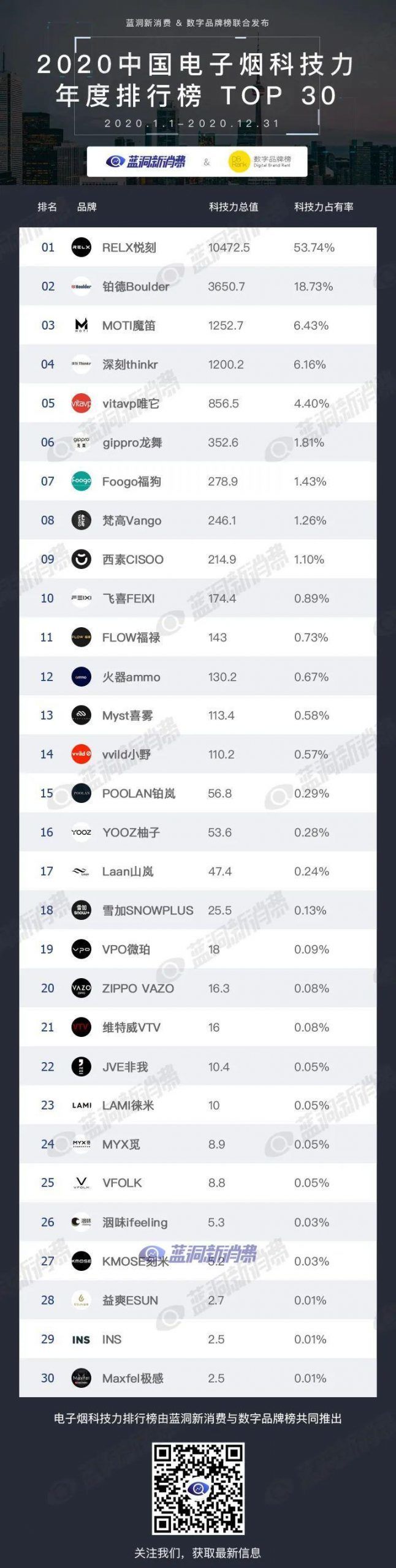
The 2020 Technology Strength Ranking of Electronic Vapor Brands in China is as follows:
BlueHole Comments:
1. The technology strength ranking and the perception ranking are like two sides of a coin; the front reflects user reviews of the product, while the back reflects the company's technological strength. Together, they provide a more comprehensive feedback on the brand's overall strength.
2. RELX is undoubtedly the top brand on both lists, consistently ranking first in perception and now leading in technology strength, capturing a significant market share and far ahead of other brands.
3. BOE ranks second in technology strength, being one of the earlier Chinese brands to apply for PMTA in the U.S.
4. MOTI ranks third, proving that its advocacy of "product strength driving" is not just empty talk.
5. We found that many of the top ten companies in the perception rankings are based in Beijing, while this time, many of the top ten in technology strength are located in Shenzhen, indicating that Beijing companies excel in user communication, while Shenzhen companies prefer to work quietly, and the technology strength ranking is a reward for the diligent workers in Shenzhen.
6. Compared to previous perception rankings, RELX, MOTI, BOE, and YOOZ are the only brands in the top ten that can manage to achieve "both virtue and art"; some brands are quite specialized.
7. Brands like Deep, Longwu, Fugou, Van Gogh, Xisu, and Feixi, which were specialized in perception rankings, have made it into the top ten of the technology strength ranking this time, indicating that some brands are quietly building their R&D reserves, and if they can bridge the gap in perception rankings, their strength should not be underestimated.
8. The technology strength ranking will be released quarterly, based on the final authorization and public disclosure stages of the enterprises, not based on submissions.
9. If you believe that your company's data is incorrect or that your company has not been included in the ranking, please feel free to contact the assistant at the end of this article.
10. This ranking is for reference only and does not accept any commercial sponsorship.
Preview: BlueHole will release the fourth quarter perception ranking of Chinese electronic vapor brands tomorrow, stay tuned.
BlueHole is holding a formal exhibition of well-known electronic vapor brands.
BlueHole previously stated at the annual summit that generic and low-quality products will never enter the scope of BlueHole's reporting and will not be included in any ranking research.
For operators of offline electronic vapor channels, choosing to represent reputable brands ensures reliable and stable products and quality. If you choose generic or low-quality products, it not only harms users but also affects the credibility of the channel, ultimately leading users to complain and report to the store.
Therefore, the final responsibility for product defects cannot be avoided by offline channel operators.
The quality of electronic vapor products will affect user choices; generic and low-quality products that pose infringement risks will damage industry development and marketing user experience.
BlueHole's upcoming exhibitions in Chengdu and Changsha have rejected numerous requests from generic brands to participate; we have publicly stated that generic brands will never enter the scope of BlueHole's reporting.
At the same time, we would like to advise some inexperienced brands:
If you are a legitimate brand and wish to engage in long-term brand building, but you always appear alongside generic brands, users will think you are also a generic brand.
As the saying goes, "You are judged by the company you keep."
As a CEO of a legitimate brand, don't you feel embarrassed to be seen at a generic brand event?
Some people are taking advantage of local store owners and users who are still unfamiliar with domestic vapor brands to package generic low-quality products as well-known brands, which is sending some legitimate brands into the hands of generic brands.
As the saying goes, to go further, it depends on who you walk with.
We firmly believe that for the industry to develop healthily, every brand must respect intellectual property and call on the entire industry to refuse to give generic brands any space to survive.


