
Chinese Vaping Giant RLX Technology Surges More Than 17% Intraday
(Original title: Breaking! Another milestone event in the 300 billion "profit" track welcomes huge benefits? How significant is the first authorization for legal sales in the U.S.?)
The 300 billion profit track is full of imagination?

The U.S. has suddenly opened the green light for e-cigarettes, which is very rare. On October 12, local time, the U.S. Food and Drug Administration (FDA) approved the PMTA review of three products from British American Tobacco's Vuse e-cigarette solo series, marking the first time e-cigarette products have been authorized for legal sale in the U.S. market.
This news directly ignited the e-cigarette industry. On the same day, the U.S. stock market opened, and Chinese e-cigarette giant RLX Technology surged, with an intraday increase of over 17%. By the close, RLX Technology had risen significantly by 14.8%. The market expects that leading e-cigarette brands such as NJOY, Logic, and JUUL are likely to accelerate their approvals, which may further stimulate e-cigarette sales in the U.S.
Globally, the e-cigarette sector continues to grow. Data shows that in 2020, the global e-cigarette industry market sales reached $42.4 billion, a year-on-year increase of 15.6%. It is expected that sales will reach $52.2 billion (approximately 330 billion RMB) in 2021 and may reach $82 billion by 2023.
The world's first! The first e-cigarette has received FDA authorization.
Is the long-suppressed e-cigarette industry about to see the dawn?
On October 12, local time, the FDA approved the PMTA review of Vuse e-cigarette solo series from RJ Reynolds, a subsidiary of British American Tobacco, marking the first set of Electronic Nicotine Delivery System (ENDS) products to receive FDA authorization for legal sale in the U.S. market.
Data shows that VuseSolo is a small stick-shaped e-cigarette that uses a pre-filled disposable atomizer. The product resembles a cigarette, with a tobacco flavor, a silver battery, and a black cartridge that provides a nicotine strength of 4.8% (48mg/ml).
In fact, as early as October 2019, RJ Reynolds had submitted a tobacco application (PMTA) to the FDA for VuseSolo and various flavored refill cartridges.
This news directly ignited the e-cigarette industry and is the first substantial positive news since the industry faced continuous suppression. On the evening of October 13, the U.S. stock market opened, and RLX Technology surged again, with an intraday increase of over 17%. By the close, RLX Technology had risen significantly by 14.8%.
Moreover, British American Tobacco, the company behind the FDA-authorized e-cigarette VuseSolo, also has great development prospects. Data shows that British American Tobacco is the second-largest publicly traded tobacco company in the world, operating in over 180 markets. It has more than 80 factories in 64 countries and over 200 tobacco brands on the market. In 2020, revenue was nearly 230 billion RMB, with a net profit of up to 56.9 billion RMB. The latest total market value is $79.2 billion (approximately 510.2 billion RMB), which also rose by more than 2% last night.
In September of this year, British American Tobacco announced that its e-cigarette brand Vuse has become the largest e-cigarette brand in the world based on market share. Market analysts believe that the three e-cigarettes of the Vuse brand that have now received FDA authorization will undoubtedly provide substantial benefits for its promotion and sales, and its market share in the U.S. may further increase in the future.
Mitch Zeller, director of the FDA, stated that the authorization of the above products for legal sale in the U.S. was due to data submitted by RJ Reynolds proving that the marketing of these products is appropriate to protect public health.
Additionally, this authorization is an important step to ensure that all new tobacco products undergo the FDA's robust and scientific pre-market evaluation. Manufacturer data shows that their tobacco-flavored products can help adult smokers reduce their addiction by minimizing exposure to harmful chemicals, whether they quit smoking completely or reduce the frequency of smoking.
In fact, the FDA's audit of e-cigarettes remains very strict. Although three products from Vuse were authorized this time, the flavored e-cigarette products submitted by Vuse received 10 marketing denial orders, and the company's application for menthol products is still under evaluation.
Furthermore, the FDA has issued marketing denial orders for over 1 million flavored e-cigarette products, rejecting those that lack sufficient evidence to demonstrate public health issues associated with the use of flavored products.
The 300 billion profit track.
From boom to silence, the development of the e-cigarette industry over the past two years has been like a roller coaster, with many industry giants encountering Waterloo.
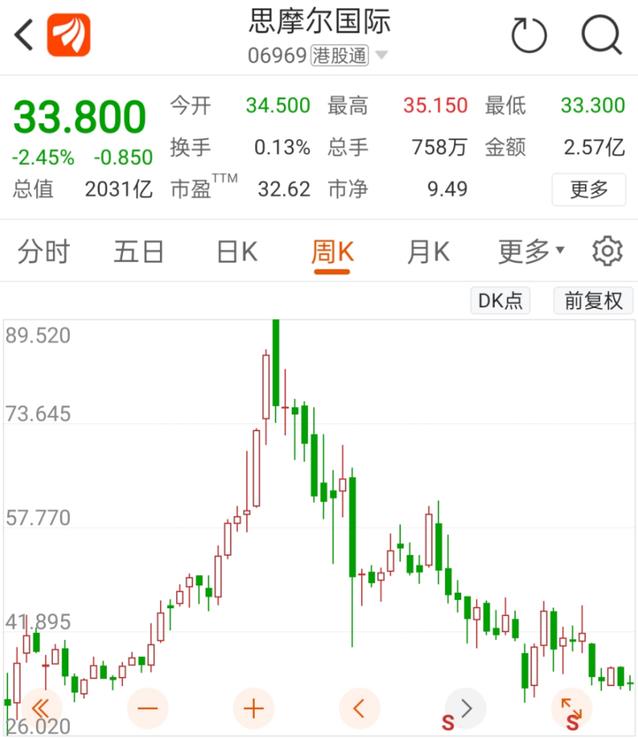
Take RLX Technology as an example. At the beginning of its listing, its total market value once reached 350 billion RMB. Subsequently, it faced a regulatory storm, and its stock price plummeted. The maximum decline during this period was nearly 90%, and the latest total market value is only $6.2 billion (approximately 39.9 billion RMB); additionally, Smoore International (06969.HK), which is listed on the Hong Kong stock market, has experienced a similar situation, with a cumulative decline of nearly 60% since the beginning of this year, evaporating nearly 300 billion HKD in total market value.
However, globally, the e-cigarette sector continues to grow. According to iiMedia Consulting data, the global e-cigarette industry market sales continued to rise in 2020, reaching $42.4 billion, a year-on-year increase of 15.6%. It is expected that sales will reach $52.2 billion (approximately 336.3 billion RMB) in 2021 and may reach $82 billion by 2023.
From a global perspective, China accounts for 90% of global e-cigarette production, while the U.S. accounts for 57% of consumption, making it the largest e-cigarette consumer country in the world. Currently, the U.S. market is almost monopolized by British American Tobacco's Vuse (33.6%), Imperial's Blu (23.6%), Japan Tobacco's Logic (14.5%), and Philip Morris International's MarkTen (5.9%), occupying 78% of the market share.
Now that the FDA has granted PMTA to three e-cigarette products from British American Tobacco, they can be legally sold in the U.S. market, which may further stimulate e-cigarette sales in the U.S. Zhejiang Merchants Securities stated that the FDA's authorization is the first strong official recognition of vapor products in the U.S. market, which will stimulate consumer demand to return to growth and has reference value for the regulatory attitudes and policies of e-cigarettes in other countries. Leading e-cigarette brands such as NJOY, Logic, and JUUL are expected to accelerate their approvals and optimize the competitive landscape of the U.S. e-cigarette market.
Zhejiang Merchants Securities emphasized that the U.S. e-cigarette industry has welcomed a milestone event. As a core supplier of major e-cigarettes, Smoore International will directly benefit.
Data shows that Smoore International is the world's largest manufacturer of electronic vaporization devices, accounting for 16.5% of the global market share. Currently, Smoore International is a global e-cigarette giant that researches, designs, and manufactures closed electronic vaporization devices and electronic vaporization components (such as Japan Tobacco, British American Tobacco, Reynolds Asia-Pacific, RELX, and NJOY). With the explosive growth of the global e-cigarette market, Smoore International's performance has also exploded. From 2016 to 2020, its net profit grew from 106 million RMB to 2.4 billion RMB, a cumulative increase of 22 times.
However, it should be noted that the FDA-authorized e-cigarette brand VuseSolo is not OEM by Smoore International, mainly provided by Cotton Core and New Hongwei, while the brand that Smoore International OEMs for British American Tobacco is VuseAlto. Zhejiang Merchants Securities expects that British American Tobacco may submit the Alto audit application again. Since VuseSolo has passed the audit, the audit progress for VuseAlto will be faster.
Will regulatory risks still be a concern for e-cigarettes in the future?
Although the U.S. has started to open the green light for e-cigarettes, in China, the e-cigarette industry still faces very strict regulations and may even face heavy taxes in the future.
On March 22 of this year, the Ministry of Industry and Information Technology and the State Tobacco Monopoly Administration jointly drafted a "Draft for Soliciting Opinions" to solicit public opinions. It clearly stated that new tobacco products such as e-cigarettes will be subject to the relevant regulations regarding cigarettes in this regulation.
For the first time, it was clearly stated that e-cigarettes and other new tobacco products are also a type of tobacco and will be included in the management scope of the monopoly law, and must comply with the tobacco monopoly law's management, and the production and sale of tobacco must obtain relevant tobacco licenses. The Chinese e-cigarette industry will enter an era of licensed operation.
The next day, the total market value of the three domestic e-cigarette giants: RLX Technology, Smoore International, and EVE Energy shrank by more than 200 billion RMB.
Although the relevant rules have not yet been implemented, the fluctuations in the industry caused by the draft for soliciting opinions have continued to this day, and the e-cigarette industry has been on a downward trend. The market may worry that e-cigarettes are likely to be taxed similarly to cigarettes in the future. Because the tobacco industry has always been a heavily taxed industry, in 2020, China's tobacco tax revenue was about 1 trillion RMB, consistently ranking first among all industries. Tobacco taxes cover the entire industry chain of production, wholesale, retail, and import.
In addition, e-cigarettes continue to face criticism from public opinion. Previously, the National Health Commission emphasized the harm of e-cigarettes to teenagers in the "2020 Report on the Harm of Smoking in China." Using e-cigarettes may make people more prone to addiction to cigarettes, especially among teenagers.
According to the China Center for Disease Control and Prevention, the e-cigarette utilization rate among high school students in China was 3% in 2019, and 2.7% among middle school students. Although the absolute proportion is not high, there is an upward trend.
The harm of e-cigarettes to teenagers is even more serious in Western countries. In the U.S., the proportion of teenagers using e-cigarettes increased from 1.5% in 2001 to 20.8% in 2018; in Poland, the proportion of teenagers using e-cigarettes even reached 62%.


