People's Daily: Vaping Enters an Era of Clear Regulation, Industry Development Accelerates
On November 26, the Chinese government website announced that to strengthen the regulation of electronic cigarettes and other new tobacco products, the State Council decided to add a new clause to the "Implementation Regulations of the Tobacco Monopoly Law of the People's Republic of China" (hereinafter referred to as the "Regulations"): "Electronic cigarettes and other new tobacco products shall be implemented in accordance with the relevant provisions of this Regulation for cigarettes."
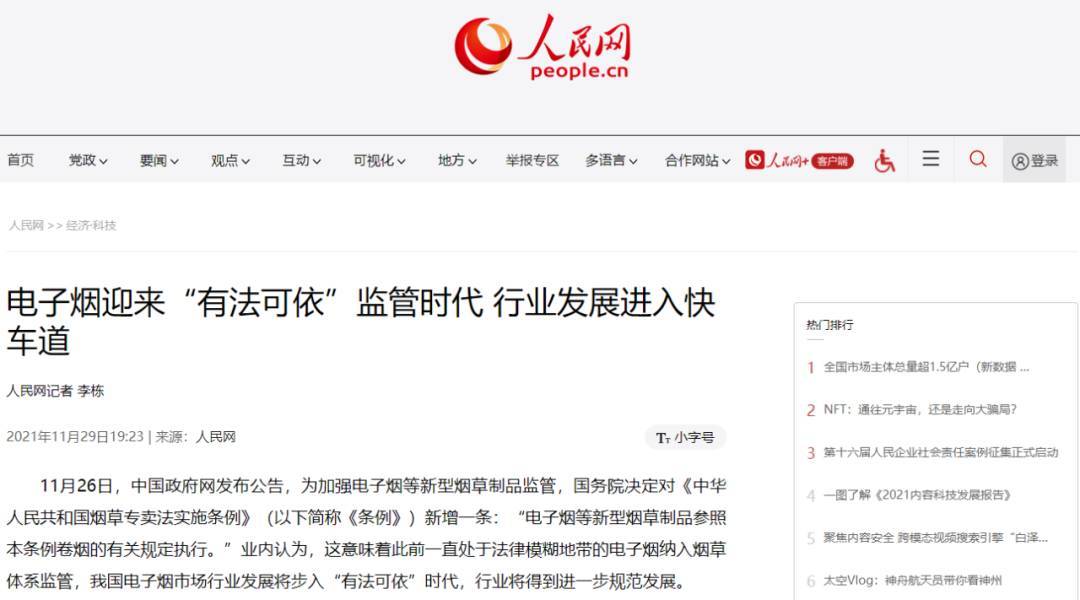
Industry insiders believe that this means that electronic cigarettes, which have long been in a legal gray area, will now be included in the tobacco regulatory system, marking the entry of China's electronic cigarette market into an era of "law-based governance," leading to further standardized development of the industry.
According to data from the Electronic Cigarette Industry Committee of the China Electronic Commerce Association, the predicted export value of electronic cigarettes in 2021 is 63.2 billion yuan, with domestic sales of 18.5 billion yuan. By 2025, the export value is expected to reach 169.7 billion yuan, and domestic sales are expected to reach 49.8 billion yuan, with a projected compound annual growth rate of 28% for both exports and domestic sales. As the global manufacturing center for electronic cigarettes, China has a complete industrial chain advantage.
Previously, electronic cigarettes were always on the edge of regulation, and relevant departments faced difficulties in law enforcement when handling complaints about electronic cigarettes. In recent years, news reports of fines issued for electronic cigarettes have become frequent, and the regulation of emerging industries has become a hot topic of discussion.
Ma Liang, a researcher at the National Development and Strategic Research Institute of Renmin University of China and a professor at the School of Public Administration, stated that the lack of a legal identity and uncertainty surrounding electronic cigarettes in the past has resulted in a lack of basic industry thresholds and product standards, leading to a chaotic development of the industry.
In Ma Liang's view, the announcement of the new "Regulations" signifies that the electronic cigarette industry is officially recognized at the legal level, gaining a legal identity. This is undoubtedly a significant milestone for the electronic cigarette industry.
According to Tianfeng Securities' research report, including electronic cigarettes and other new tobacco products under the management of the monopoly law first confirms the legal and compliant production and sales status of electronic cigarettes and other new tobacco products in the country. Additionally, the meeting held in November to solicit opinions on national standards for electronic cigarettes has preliminarily discussed issues such as the definition of electronic cigarettes, additives, and nicotine content, indicating that specific management measures and national standards for domestic vaping devices are being accelerated. The report states that the gradual implementation of electronic cigarette regulation may lead to higher industry entry barriers, benefiting compliant enterprises.
According to the requirements of the "Regulations," the regulation of electronic cigarettes and other new tobacco products must refer to the relevant provisions for cigarettes. Some opinions suggest that "referring to" does not equal "complying with," and that referring to cigarette standards allows electronic cigarettes to retain further development and innovation space while also facing strong regulatory requirements; the key still lies in the strength of enforcement.
"The announcement by the State Council regarding electronic cigarette regulation is very necessary and timely," said a relevant person from the Electronic Cigarette Industry Committee of the China Electronic Commerce Association, expressing hope that the new national mandatory standards for electronic cigarettes can be introduced and implemented as soon as possible to effectively regulate electronic cigarette production and business activities, addressing issues such as product quality and safety risks, and safeguarding consumers' legal rights.
Industry insiders believe that after the relevant regulatory details and national standards are introduced, leading domestic electronic cigarette companies such as RELX, SMOORE, and BOD will gradually move towards a regulated development track under strong supervision, with expectations for further standardization and improvement in areas such as minor protection, product quality and safety, and consumer protection, potentially releasing further innovation potential in the industry.
"This regulation can also promote the implementation and legal connection of the minor protection law," said Hu Qingyuan, director of the National Tobacco Quality Supervision and Inspection Center, noting that treating electronic cigarettes as cigarettes for regulation is beneficial in addressing some existing risks and can standardize corporate production and business activities, protecting consumer interests.