
The Dust Has Settled: E-Cigarettes Finally Have Legal Status
On November 26, news emerged that the Chinese government officially announced the modification of the "Implementation Regulations of the Tobacco Monopoly Law of the People's Republic of China," adding a new clause stating that "new tobacco products such as e-cigarettes shall be implemented in accordance with the relevant provisions regarding cigarettes in this regulation."
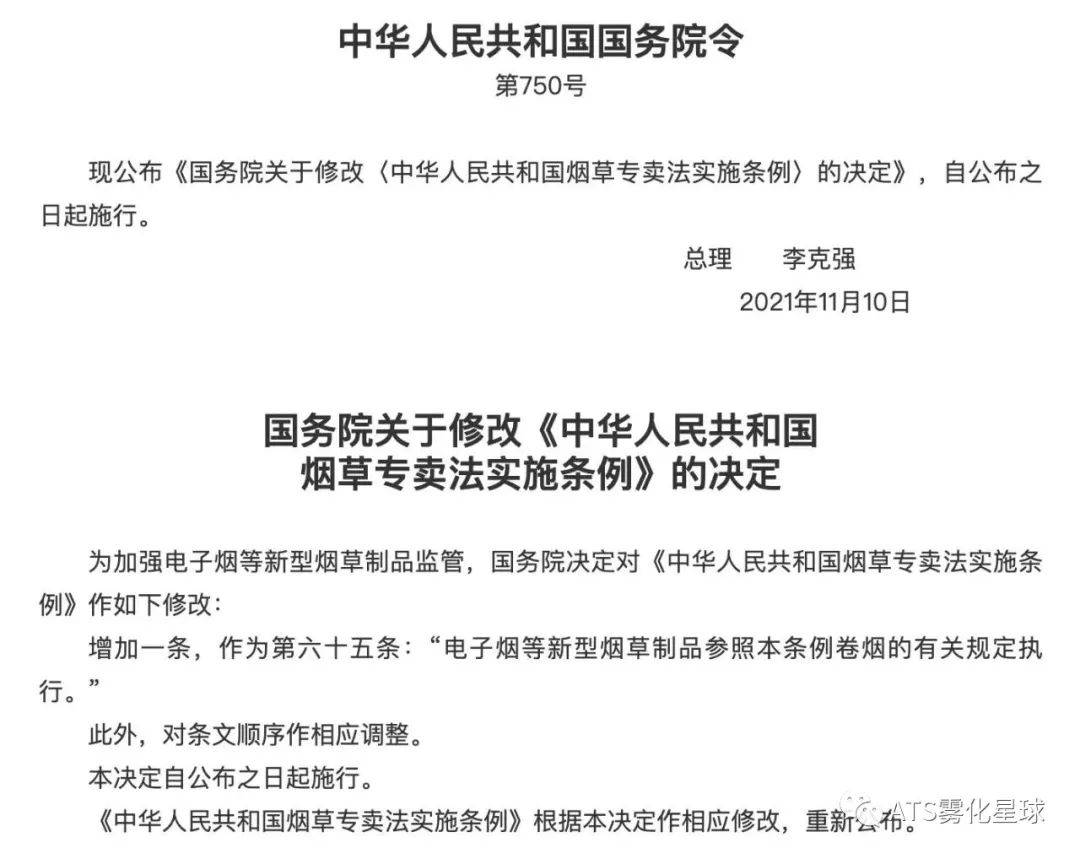
The announcement stated that in order to strengthen the regulation of new tobacco products such as e-cigarettes, the State Council decided to amend the aforementioned regulations, which will take effect from the date of publication.
This clause will be designated as Article 65, and the order of the text will be adjusted accordingly.
This is the latest development in domestic e-cigarette regulation after an 8-month hiatus, indicating that e-cigarettes now have a formal identity and will enter a phase of orderly regulation, bidding farewell to the chaotic growth stage.
On March 22, the Ministry of Industry and Information Technology released a notice stating that to strengthen the regulation of new tobacco products such as e-cigarettes, the Ministry of Industry and Information Technology and the State Tobacco Monopoly Administration drafted the "Decision on Amending the Implementation Regulations of the Tobacco Monopoly Law of the People's Republic of China (Draft for Comments)" and officially solicited public opinions, with a feedback deadline of April 22, 2021.

The draft proposed adding a clause in the appendix of the "Implementation Regulations of the Tobacco Monopoly Law of the People's Republic of China," designated as Article 65: "New tobacco products such as e-cigarettes shall be implemented in accordance with the relevant provisions regarding cigarettes in this regulation."
Today's announcement is significant, as it confirms the identity of e-cigarettes, which is a major positive for the industry.
In fact, there are two major benefits: first, the e-cigarette industry can operate legally; second, current market participants may not be directly eliminated, allowing private enterprises to continue having opportunities.
Analysis is as follows:
1. Only by clarifying what e-cigarettes are and which regulatory body is responsible can management details be refined in subsequent steps.
2. Once the management department is determined, various standards, such as national standards for e-cigarettes, production standards, sales channels, etc., can be further refined, facilitating the legal circulation of e-cigarettes.
3. After standardization, it will be easier to implement tax management. Cigarette taxes mainly include consumption tax, value-added tax, tobacco leaf tax, urban construction tax, and education surcharges; how e-cigarettes will be taxed will be a key focus moving forward.
4. For the e-cigarette industry, this is a significant positive. Each link in the industry chain now has a legal identity card, and after years of chaotic growth, the industry is experiencing a major breakthrough, with businesses becoming legitimate operations rather than being in a gray area.
5. Regarding the production side, manufacturers with higher production standards will benefit. The era of producing an e-cigarette product for 50,000 yuan, as rumored two years ago, is truly over; high production and technical standards require factories with both financial and technical reserves.
6. The impact on brands mainly depends on the relevant access mechanisms, whether they are driven by capital or resources, which requires specific analysis.
7. The impact on the channel side, if channel exclusivity is implemented, means that the currently established e-cigarette channels will undergo reshuffling, which is both a risk and an opportunity.
Overall, the confirmation of e-cigarettes' identity is good news for the industry, but for each link in the e-cigarette industry chain, the process of survival of the fittest has just begun; everything before can only be considered a warm-up match.
Under the new management, how to solve the current issues of e-cigarette logistics, price chaos, and how to avoid youth-related problems will be key focuses moving forward.
On November 25, the State Tobacco Monopoly Administration stated in the "Implementation Plan for Deepening the Separation of Licenses and Certificates to Further Stimulate the Development Vitality of Market Entities" that it will implement inclusive and prudent regulation for new technologies, new industries, new formats, and new models, tailoring regulatory models, and will impose lighter, reduced, or exempt administrative penalties for minor violations.
From this statement, and comparing the term "refer to" rather than "according to," we expect that new tobacco products such as e-cigarettes will have relatively flexible management space.
From previously not knowing whether it was a one-size-fits-all approach to now having a formal legal regulatory identity, the e-cigarette industry has officially entered the regulatory era from the gray area.


