
VTEC 200W Box Mod Review
We previously covered the VTEC 200W box mod, but many readers are still asking about it. We also wrote an Augvape VTEC 200W box mod review before, but today we're focusing again on the VTEC vaping device. Many users have clear goals when choosing a box mo
The VTEC 200W (Honda) box mod has been reviewed before, and many friends still ask about it. I previously wrote an Augvape VTEC 200W Box Mod Review, which you can check out if you're interested. But today, I want to talk about the VTEC electronic cigarette box. Many people have clear goals for their box mod needs, but some find themselves in a dilemma, such as those who love extreme resistance but prefer box mods over tube mods. I am one of them; sometimes I prefer using a regulated box, but I tend to be clumsy and can't always keep the resistance fixed at 0.1, so my choice of box mod is primarily based on whether it supports low resistance.
AUGVAPE has always been a brand that steadily builds its reputation, and most of the atomizers it produces have a good reputation. The popular Merlin RTA was also brought to us by AUGVAPE. Today, I will share my experience with the festive edition mod from AUGVAPE, which I think is well-suited for the celebratory atmosphere of the Spring Festival with its red color scheme. Let's take a closer look at the details and my impressions of each part.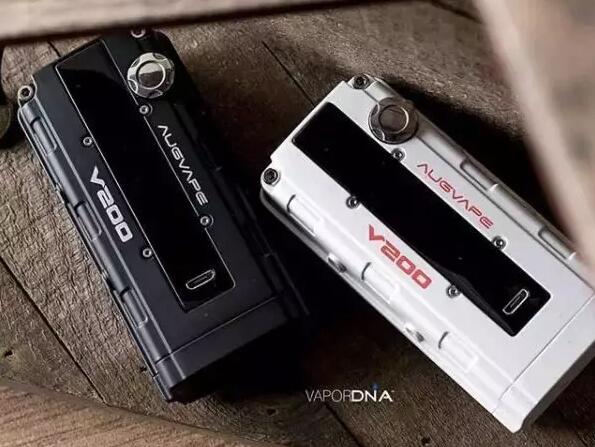 Official description:
Packaging—uses PVC environmentally friendly transparent material, with hard cardboard on the top, bottom, and sides, allowing users to appreciate the product without opening the box while ensuring the box's hardness and shock resistance. The interior uses EVA to secure the product during transport, providing all-around protection. The surface features a stylish black and red design with a silver foil logo; the overall look is fashionable and cool.
Dial—this is the simplest way to exist as a decoration, which sounds quite rogue and has no limits. After trying both the two semi-circular buttons and the dial, we ultimately decided on the most logical up-and-down dial method. This was done to facilitate structural layout without altering the dial's proportions, ensuring that the torque is transmitted through the shell to the motherboard components while maintaining comfortable damping and consistency in mass production. To ensure a good feel, the dial surface has been raised to prevent slipping from sweaty hands, which was a challenge for the engineers but ultimately completed successfully.
510 connector pattern—precision carving, polishing, electroplating, then precision carving again, and passivation; the cost of one part equals that of four parts from others, simply because of a love for the new type R wheel hub.
Buttons—many samples were made to ensure that the appearance did not affect the coordination of the red-headed engine. Whether it was the large side button, the tactile feedback above the screen, or the touch feedback with vibration, we also tried a more aggressive three-in-one button, but we had to balance appearance consistency, tactile feedback, user habits, cost, and innovation. Ultimately, we chose a hidden press structure that no one has done before to achieve the best result.
Front screen—made from injection molding, refined, and hardened with UV paint. Due to the positioning and button force transmission structure, the back could have been made with one mold, but since the back is just a flat surface, we used a harder, flatter acrylic for carving, printing, and painting.
Spray paint—the main red color went through seven versions for brightness, saturation, gloss, and wear resistance, and we are still fine-tuning it. While spraying white and black is straightforward, red requires a white base coat before applying red for better saturation, but double-layer paint can lead to tolerance issues. We have just resolved this, but there is still a slight gap from perfection.
Rejecting mediocrity and focusing on substance.
Internal structure—without increasing volume, we maximized the motherboard size. First, we arranged the chip layout for even heat dissipation, and secondly, we effectively utilized the space between the dual batteries to arrange the chips, moving the output-related parts upward to shorten the current path and configured dual inductors for boosting, allowing for longer and more stable peak power duration.
Software—on the existing chip, implementing temperature control and curve functions is completely feasible. To simplify operations, we removed all unnecessary functions and replaced the old atomizer detection with a new atomizer detection: if a new atomizer is confirmed, the power goes directly to ten watts; if it is an old atomizer, the original wattage remains unchanged, ensuring that there will be no high wattage burning out the atomizer instantly. In normal mode, the second line displays voltage; in VMODE, it shows total output joules; in BYPASS mode, it shows real-time power output. The device powers on directly after inserting the battery, with the logo displayed for less than a second before outputting, making it the fastest startup time among non-mechanical devices. In VMODE, we have shortened the firing time to 0.005 seconds, which is already at the limit of what can be compressed based on the current electronic cigarette architecture.
The VTEC mod has completely removed the temperature control mode, which has both pros and cons.
The advantage is that it simplifies the skill set required, allowing for more focus on the main power and bypass mode, as there are more players in those categories. The downside is that the few players who insist on using temperature control have completely lost that option. Forgive me for laughing a bit unkindly. The combination button functions are detailed in the manual, so I won't repeat them here.
The VTEC has three modes: Normal, Bypass, and V Mode. As mentioned earlier, I personally appreciate the VTEC's support for 0.05 resistance, as many times, when the resistance is too low, I prefer to use the box to burn the wire before putting it on a tube mod. This may not be useful for veteran players, but it feels reassuring.
In terms of burst performance, I don't have professional instruments for testing, but purely based on feel and past usage, it is instantaneous with no delay. While supporting extremely low resistance, the detection accuracy for resistance is ±0.005 ohms. The Bypass mode superficially seems to conflict with the unique VTEC mode, but in reality, it does not; the VTEC mode requires the power to reach a certain standard before it can trigger, so it does not manifest at low power. The official standard for VTEC's ignition speed is 0.005 seconds, which is indeed quite extreme.
For me, I generally can't feel the difference beyond two decimal places, and I believe most players don't have instruments and rely on daily usage experiences. Good burst, no delay, and stability will make everyone like it. I have been using the mod intermittently for over a week, and its performance remains very stable, looking good with various atomizers.
I personally feel that the VTEC mod is quite courageous; while others are adding features, it is simplifying. Although we don't often use it, the appearance of the box mod is subjective; the dominant red color is indeed a good choice with the Spring Festival approaching. Of course, there are slight shortcomings in the battery compartment cover opening method, but through excellent quality control, it has achieved almost seamlessness.
Today's protagonist, the Honda red-headed VTEC 200W, has a good size, a refreshing appearance, and simple operating modes. If you, like me, prefer a "rugged" and slightly aggressive mod and are interested in low-resistance box mods, keep an eye on this one.
#p#分页标题#e#
Official description:
Packaging—uses PVC environmentally friendly transparent material, with hard cardboard on the top, bottom, and sides, allowing users to appreciate the product without opening the box while ensuring the box's hardness and shock resistance. The interior uses EVA to secure the product during transport, providing all-around protection. The surface features a stylish black and red design with a silver foil logo; the overall look is fashionable and cool.
Dial—this is the simplest way to exist as a decoration, which sounds quite rogue and has no limits. After trying both the two semi-circular buttons and the dial, we ultimately decided on the most logical up-and-down dial method. This was done to facilitate structural layout without altering the dial's proportions, ensuring that the torque is transmitted through the shell to the motherboard components while maintaining comfortable damping and consistency in mass production. To ensure a good feel, the dial surface has been raised to prevent slipping from sweaty hands, which was a challenge for the engineers but ultimately completed successfully.
510 connector pattern—precision carving, polishing, electroplating, then precision carving again, and passivation; the cost of one part equals that of four parts from others, simply because of a love for the new type R wheel hub.
Buttons—many samples were made to ensure that the appearance did not affect the coordination of the red-headed engine. Whether it was the large side button, the tactile feedback above the screen, or the touch feedback with vibration, we also tried a more aggressive three-in-one button, but we had to balance appearance consistency, tactile feedback, user habits, cost, and innovation. Ultimately, we chose a hidden press structure that no one has done before to achieve the best result.
Front screen—made from injection molding, refined, and hardened with UV paint. Due to the positioning and button force transmission structure, the back could have been made with one mold, but since the back is just a flat surface, we used a harder, flatter acrylic for carving, printing, and painting.
Spray paint—the main red color went through seven versions for brightness, saturation, gloss, and wear resistance, and we are still fine-tuning it. While spraying white and black is straightforward, red requires a white base coat before applying red for better saturation, but double-layer paint can lead to tolerance issues. We have just resolved this, but there is still a slight gap from perfection.
Rejecting mediocrity and focusing on substance.
Internal structure—without increasing volume, we maximized the motherboard size. First, we arranged the chip layout for even heat dissipation, and secondly, we effectively utilized the space between the dual batteries to arrange the chips, moving the output-related parts upward to shorten the current path and configured dual inductors for boosting, allowing for longer and more stable peak power duration.
Software—on the existing chip, implementing temperature control and curve functions is completely feasible. To simplify operations, we removed all unnecessary functions and replaced the old atomizer detection with a new atomizer detection: if a new atomizer is confirmed, the power goes directly to ten watts; if it is an old atomizer, the original wattage remains unchanged, ensuring that there will be no high wattage burning out the atomizer instantly. In normal mode, the second line displays voltage; in VMODE, it shows total output joules; in BYPASS mode, it shows real-time power output. The device powers on directly after inserting the battery, with the logo displayed for less than a second before outputting, making it the fastest startup time among non-mechanical devices. In VMODE, we have shortened the firing time to 0.005 seconds, which is already at the limit of what can be compressed based on the current electronic cigarette architecture.
The VTEC mod has completely removed the temperature control mode, which has both pros and cons.
The advantage is that it simplifies the skill set required, allowing for more focus on the main power and bypass mode, as there are more players in those categories. The downside is that the few players who insist on using temperature control have completely lost that option. Forgive me for laughing a bit unkindly. The combination button functions are detailed in the manual, so I won't repeat them here.
The VTEC has three modes: Normal, Bypass, and V Mode. As mentioned earlier, I personally appreciate the VTEC's support for 0.05 resistance, as many times, when the resistance is too low, I prefer to use the box to burn the wire before putting it on a tube mod. This may not be useful for veteran players, but it feels reassuring.
In terms of burst performance, I don't have professional instruments for testing, but purely based on feel and past usage, it is instantaneous with no delay. While supporting extremely low resistance, the detection accuracy for resistance is ±0.005 ohms. The Bypass mode superficially seems to conflict with the unique VTEC mode, but in reality, it does not; the VTEC mode requires the power to reach a certain standard before it can trigger, so it does not manifest at low power. The official standard for VTEC's ignition speed is 0.005 seconds, which is indeed quite extreme.
For me, I generally can't feel the difference beyond two decimal places, and I believe most players don't have instruments and rely on daily usage experiences. Good burst, no delay, and stability will make everyone like it. I have been using the mod intermittently for over a week, and its performance remains very stable, looking good with various atomizers.
I personally feel that the VTEC mod is quite courageous; while others are adding features, it is simplifying. Although we don't often use it, the appearance of the box mod is subjective; the dominant red color is indeed a good choice with the Spring Festival approaching. Of course, there are slight shortcomings in the battery compartment cover opening method, but through excellent quality control, it has achieved almost seamlessness.
Today's protagonist, the Honda red-headed VTEC 200W, has a good size, a refreshing appearance, and simple operating modes. If you, like me, prefer a "rugged" and slightly aggressive mod and are interested in low-resistance box mods, keep an eye on this one.
#p#分页标题#e#


