2018 research report on the market outlook for China’s e-cigarette industry
1. Traditional smoking methods need improvement, giving rise to e-cigarettes. Traditional smoking can cause lung disease and cardiovascular disease, and easily leads to nicotine dependence, posing a threat to human physical and mental health. As people pl
1. Traditional smoking methods need improvement, and e-cigarettes have emerged as a solution.
Traditional smoking methods can lead to lung diseases and cardiovascular diseases, easily creating a "smoking addiction" that threatens human health. As people pay more attention to health, e-cigarettes have emerged as a result. E-cigarettes are electronic products that mimic traditional cigarettes, mainly consisting of a battery, atomizer, and plastic components. E-cigarettes are mainly divided into smoking cessation types and cigarette substitute types. Among them, cigarette substitute products mainly use atomization and other means to turn specially formulated e-liquids/tobacco sticks into vapor for users to inhale. They provide a smoke, taste, and sensation similar to traditional cigarettes but do not involve combustion, significantly reducing toxic substances such as tar, carbon monoxide, and nitrous oxide, and are less likely to produce secondhand smoke pollution. Therefore, they better meet consumers' demands for health and environmental protection, while also offering a novel and fashionable experience as electronic consumer products, making them a good alternative to traditional cigarettes. Modern e-cigarettes were invented by Chinese people. Earlier, in 1963, an American named Gilbert A. Herbert applied for a patent for a smoke-free, non-tobacco cigarette with the U.S. Patent Office, which was one of the earliest technologies to reform cigarettes. However, due to almost zero tobacco control at that time, the product did not receive any promotion. In 2003, Chinese pharmacist Han Li invented the modern e-cigarette in the true sense, and the following year, Han Li mass-produced this product for the first time internationally and sold it in the Chinese market. In 2005, Ru Yan Technology's e-cigarette products began to be exported overseas, and in the following years, Sanlong International, along with Ru Yan e-cigarettes, entered a fast development track, exporting to the United States and Europe. From 2008 to 2012, the U.S. FDA's ban on e-cigarettes went through ups and downs, ultimately ending in a defeat for the FDA, opening the U.S. e-cigarette market and prompting international tobacco giants to enter the field, boosting industry development. History of E-Cigarette DevelopmentSource: China Business Industry Research Institute
2. E-cigarette industry chain: manufacturing center in China, demand center in Europe and America. The e-cigarette industry chain includes upstream raw material suppliers, e-cigarette design manufacturers, and downstream sales companies. The growing demand in Europe and America, along with domestic policy regulations, has resulted in a global industry chain pattern where the manufacturing center is in China and the demand center is in Europe and America. From the upstream raw material perspective, it can be divided into battery raw material suppliers (batteries, battery cells, control circuits), atomizer raw material suppliers (plastics, glass, hardware, heating resistors), and e-liquid raw material suppliers. The midstream mainly involves the design and manufacturing of e-cigarettes, which can be divided into professional e-cigarette manufacturing companies and manufacturing departments of international tobacco giants. The market share of domestic self-owned brands is small, and domestic e-liquid companies mainly operate in an OEM/ODM model, producing for well-known foreign brands. The downstream is delivered to retailers through agents and distributors, including well-known e-cigarette brands, large supermarkets, convenience stores, and pharmacies. Currently, the e-cigarette consumption market is mainly concentrated in overseas countries such as the United States and the United Kingdom. As the market matures, the currently fragmented e-cigarette production industry is expected to move towards consolidation. In the future, companies with channel advantages are likely to lead industry consolidation by leveraging stable order resources, completing the layout of the entire e-cigarette industry chain, including battery cells, e-liquids, atomizers, etc., and shifting from B2B to B2C to strengthen control over upstream and downstream while obtaining more profits from the industry chain. E-cigarette Industry Chain
Data Source: Public Information
3. The global e-cigarette market capacity is growing rapidly, with Europe and America as the main consumer markets. Due to the rapid development of the e-cigarette industry, with tobacco giants entering the market with traditional tobacco alternatives, the market capacity is growing astonishingly. As a new product, e-cigarettes have achieved rapid development over the past decade. According to statistics, the global e-cigarette market size was approximately $416 million in 2010, expanding to $7.1 billion by 2016. In just six years, the market capacity expanded 17 times, with a compound annual growth rate of 60.5%. It is expected that the e-cigarette industry will continue to maintain a high growth momentum, with the industry scale exceeding $10 billion by 2018, during which the compound annual growth rate will be 50%. The rapid growth of e-cigarettes will inevitably lead to a replacement of traditional tobacco. Global E-Cigarette Market Size from 2010 to 2018 and Forecast
Data Source: China Business Industry Research Institute
From a regional perspective, the current major markets for e-cigarettes globally are in Europe and America. Data shows that in 2016, the top three global e-cigarette consumption markets were the United States, the United Kingdom, and Italy, accounting for 43.2%, 12.7%, and 6.9% of global e-cigarette sales, respectively. Although China produces over 90% of the world's e-cigarettes, the domestic consumption of e-cigarettes only accounts for 6% of the global market. Global E-Cigarette Industry Market Distribution in 2016
Data Source: China Business Industry Research Institute
4. Domestic e-cigarette market: primarily export-oriented, with a low consumption market base and great potential. In terms of the domestic market, although China produces over 90% of the world's e-cigarettes, the domestic consumption market remains relatively small. In terms of the export market, Europe and America account for 83.7% of the export share, while only 6% of the products are ultimately consumed domestically. Domestic E-Cigarette Export Volume Statistics from 2010 to 2018
Data Source: China Business Industry Research Institute
In terms of the consumption market, China's e-cigarette production in 2016 was 1.21 billion units, with a market consumption scale of approximately 3.2 billion yuan, of which 1.8 billion yuan was from online channels, 1.2 billion yuan from offline e-cigarette retail stores, and the remaining 200 million yuan contributed by other channels. Data from the State Tobacco Monopoly Administration shows that in 2016, the sales revenue of the cigarette industry was 1.3706 trillion yuan, based on which it is estimated that China's e-cigarette market only accounts for 0.23% of the tobacco industry. Compared to the penetration rate in Europe and America, the market still has room for development. It is expected that by 2022, e-cigarette production will reach 4.75 billion units. Statistics of China's E-Cigarette Production from 2013 to 2018
Data Source: China Business Industry Research Institute
Statistics of China's E-Cigarette Market Size from 2016 to 2022
#p#分页标题#e#
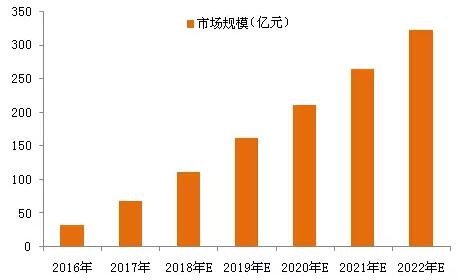 Data Source: China Business Industry Research Institute
Compared to the vast market capacity of the traditional tobacco industry, the current scale of the e-cigarette industry is still small. However, due to its inherent advantages of health, cost-effectiveness, and trendiness, the market's growth potential for the e-cigarette industry is widely recognized. 5. E-cigarette development prospects: large market capacity, promising outlook. 1. The popularization of environmental and health concepts has promoted the development of smoking cessation products. Governments and public organizations around the world are increasingly focusing on public environmental and health issues, issuing relevant laws and policies to control and ban smoking. In addition, public health awareness is gradually increasing. The global anti-smoking movement and the improvement of public health awareness are the main driving factors for the demand for e-cigarettes. The consumption pattern of tobacco will undergo significant changes, and the market capacity for smoking cessation products such as e-cigarettes will further expand. 2. Huge market capacity drives increased demand. China has approximately 350 million smokers, which is 6-7 times the number of smokers in the United States, but the current penetration rate of e-cigarettes in China is still far lower than in Europe and America, indicating great potential for domestic market development. The e-cigarette market in major smoking countries like Russia and India is still a blank slate. Even in mature markets like Europe and America, due to incomplete policy relaxation and insufficient market promotion, the current consumer group still occupies a relatively small proportion of the overall smokers, indicating that future demand for e-cigarette products is still substantial. 3. The increasing tax burden on cigarettes accelerates the transition. In recent years, raising tobacco taxes has become a common control measure adopted by various countries. The higher the tobacco tax rate, the higher the cost of cigarettes, leading to increased retail prices and heavier burdens on smokers. This makes them more likely to switch to new tobacco products. 4. E-cigarettes offer better cost-effectiveness. With governments around the world implementing strict anti-smoking measures, the price of traditional cigarettes will continue to rise. However, with technological advancements and large-scale production, the price of e-cigarettes is expected to become more affordable. The usage time of e-cigarettes is longer, as one can simply replace a disposable pod to reuse it. The usage time of a regular e-cigarette's disposable pod is equivalent to that of a pack of cigarettes, making long-term use more economical. The atomizers and battery cells of e-cigarettes can be reused.