
China’s National Standard for E-cigarettes May Really Be Coming
According to the official website of the Standardization Administration of China, the national standard for e-cigarettes has now entered the review stage. Based on the 24-month drafting cycle, it is expected to be approved by the administration within 12
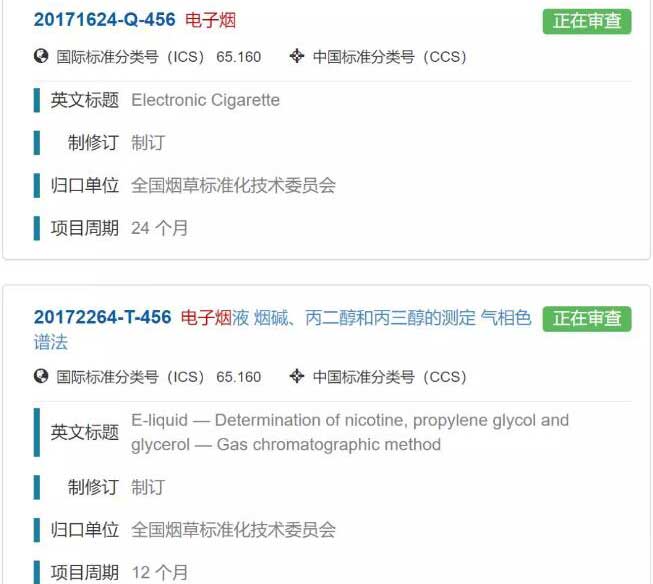
According to the official website of the National Standardization Administration, the national standard for e-cigarettes has entered the review stage. Based on the standard formulation cycle of 24 months, it is expected to be approved by the National Standard Committee within 12 months. At that time, the production and circulation of e-cigarettes in China will be executed according to national standards.
The national standard plans include "E-cigarettes" and "Determination of nicotine, propylene glycol, and glycerol in e-liquids by gas chromatography," which are reported and executed by TC144 (National Tobacco Standardization Technical Committee), with the National Tobacco Monopoly Bureau as the competent authority. It is worth noting that the "E-cigarettes" standard is a mandatory national standard, meaning it must be implemented through legal and administrative means within a certain scope, thus having legal attributes. This means that companies must strictly comply with it. Additionally, the VAPEworld public account has noted that all drafting units are tobacco system institutions.
In response to this national standard plan for e-cigarettes, VAPEworld will provide a detailed introduction.
1. National Standard Plan for "E-cigarettes"
(a) Main drafting units: Shanghai Institute of New Tobacco Products, Zhengzhou Tobacco Research Institute of China Tobacco Corporation, China Tobacco Standardization Research Center, National Tobacco Quality Supervision and Inspection Center.
(b) Scope and main technical content
Scope: This standard applies to e-cigarettes.
 Main technical content:
1. "E-cigarettes Part 1: E-liquid": Requirements for nicotine limits in e-liquids and assessment plans; technical requirements and assessment plans for e-cigarette additives; pollutant assessment plans and related technical requirements.
2. "E-cigarettes Part 2: Devices": Technical indicators and risk assessment plans for contact materials (oral, e-liquid), including analysis and research on e-cigarette materials, migration analysis, etc.; corresponding indicator requirements and assessment plans for e-cigarette devices, including mechanical structure requirements, electrical safety requirements, environmental adaptability requirements, operational safety requirements, and assessment plans.
3. "E-cigarettes Part 3: Emissions": Including studies on e-cigarette inhalation behavior and characterization of e-cigarette product stability.
4. "E-cigarettes Part 4: Packaging and Labeling": Research plans for the packaging and labeling of e-liquids and devices.
5. "E-cigarettes Part 5: Storage and Transportation": Technical requirements for the storage and transportation of e-liquids and devices.
(c) List of products involved
Pre-filled e-cigarettes, refillable e-cigarettes, e-liquids for e-cigarettes, and components of e-cigarettes (batteries, adapters, atomizer cores, connectors, mouthpieces, etc.)
(d) Main mandatory content and reasons
The entire text is mandatory.
Mandatory reasons: E-cigarettes, also known as electronic nicotine delivery systems, are designed to deliver nicotine to the lungs, similar to cigarettes or cigars, and can quickly provide consumers with sufficient nicotine to simulate the sensory experience of smoking. By placing one end of a plastic or metal tube in the mouth, inhaling draws a mixture of air and vapor from the device into the respiratory system. This includes electronic atomization systems, rechargeable batteries and chargers, electronic regulators, and replaceable pods, which may contain nicotine and other chemicals. China is the world's largest producer of e-cigarettes, and the sales volume of domestic e-cigarettes is increasing year by year. However, the current regulation of e-cigarettes is in a "three no" state: "no product standards, no quality supervision, no safety assessment." Without strict standards, e-cigarettes pose direct threats to consumer health and safety; therefore, this standard should be enforced.
2. National Standard Plan for "Determination of nicotine, propylene glycol, and glycerol in e-liquids by gas chromatography"
E-liquid – Determination of nicotine, propylene glycol, and glycerol – Gas chromatographic method
(a) Main drafting units
Zhengzhou Tobacco Research Institute of China Tobacco Corporation, Guangdong Zhongyan Industrial Co., Ltd.
(b) Scope and main technical content
Scope: This standard applies to the determination of nicotine, propylene glycol, and glycerol in e-liquids.
Main technical content:
1. Research on sample pretreatment methods for nicotine, propylene glycol, and glycerol in e-liquids, examining the effects of different extraction solvents, shaking times, and sample weights on the determination of nicotine, propylene glycol, and glycerol in e-liquids.
2. Optimization of gas chromatographic instrument analysis conditions for the determination of nicotine, propylene glycol, and glycerol in e-liquids, selecting internal standards, and examining the effects of different capillary chromatographic columns on the separation of target compounds, internal standards, and interfering substances.
3. Internal validation of the analytical method, studying the optimal linear range and correlation coefficient of the standard curve, as well as parameters such as recovery rate, detection limit, quantification limit, and precision.
4. Selection of about 200 representative e-liquid samples from domestic and foreign sources for analysis using the established method to assess the applicability of the analytical method.
5. Conducting collaborative experiments on the analytical method: organizing 10 qualified quality inspection institutions and laboratories in China to conduct collaborative experiments on the analytical method.
6. Forming a draft for public consultation on the analytical method and widely soliciting opinions from domestic quality inspection institutions and laboratories.
7. Modifying the draft based on feedback and forming a submission draft for review.
It is understood that in December last year, the Electronic Cigarette Industry Committee of the China Electronic Commerce Association released two group standards for e-cigarettes: "General Specifications for E-cigarette Atomization Devices" and "Specifications for E-cigarette Liquids," providing some reference for enterprises in production and operation. The introduction of these two national-level e-cigarette standard formulation plans will undoubtedly bring greater legitimacy to the standardized development of the e-cigarette industry. It is believed that with the attention and promotion of relevant national departments, Chinese e-cigarette companies will further strengthen their voice in the international arena.
The national standard plans include "E-cigarettes" and "Determination of nicotine, propylene glycol, and glycerol in e-liquids by gas chromatography," which are reported and executed by TC144 (National Tobacco Standardization Technical Committee), with the National Tobacco Monopoly Bureau as the competent authority. It is worth noting that the "E-cigarettes" standard is a mandatory national standard, meaning it must be implemented through legal and administrative means within a certain scope, thus having legal attributes. This means that companies must strictly comply with it. Additionally, the VAPEworld public account has noted that all drafting units are tobacco system institutions.
In response to this national standard plan for e-cigarettes, VAPEworld will provide a detailed introduction.
1. National Standard Plan for "E-cigarettes"
(a) Main drafting units: Shanghai Institute of New Tobacco Products, Zhengzhou Tobacco Research Institute of China Tobacco Corporation, China Tobacco Standardization Research Center, National Tobacco Quality Supervision and Inspection Center.
(b) Scope and main technical content
Scope: This standard applies to e-cigarettes.
Main technical content:1. "E-cigarettes Part 1: E-liquid": Requirements for nicotine limits in e-liquids and assessment plans; technical requirements and assessment plans for e-cigarette additives; pollutant assessment plans and related technical requirements.
2. "E-cigarettes Part 2: Devices": Technical indicators and risk assessment plans for contact materials (oral, e-liquid), including analysis and research on e-cigarette materials, migration analysis, etc.; corresponding indicator requirements and assessment plans for e-cigarette devices, including mechanical structure requirements, electrical safety requirements, environmental adaptability requirements, operational safety requirements, and assessment plans.
3. "E-cigarettes Part 3: Emissions": Including studies on e-cigarette inhalation behavior and characterization of e-cigarette product stability.
4. "E-cigarettes Part 4: Packaging and Labeling": Research plans for the packaging and labeling of e-liquids and devices.
5. "E-cigarettes Part 5: Storage and Transportation": Technical requirements for the storage and transportation of e-liquids and devices.
(c) List of products involved
Pre-filled e-cigarettes, refillable e-cigarettes, e-liquids for e-cigarettes, and components of e-cigarettes (batteries, adapters, atomizer cores, connectors, mouthpieces, etc.)
(d) Main mandatory content and reasons
The entire text is mandatory.
Mandatory reasons: E-cigarettes, also known as electronic nicotine delivery systems, are designed to deliver nicotine to the lungs, similar to cigarettes or cigars, and can quickly provide consumers with sufficient nicotine to simulate the sensory experience of smoking. By placing one end of a plastic or metal tube in the mouth, inhaling draws a mixture of air and vapor from the device into the respiratory system. This includes electronic atomization systems, rechargeable batteries and chargers, electronic regulators, and replaceable pods, which may contain nicotine and other chemicals. China is the world's largest producer of e-cigarettes, and the sales volume of domestic e-cigarettes is increasing year by year. However, the current regulation of e-cigarettes is in a "three no" state: "no product standards, no quality supervision, no safety assessment." Without strict standards, e-cigarettes pose direct threats to consumer health and safety; therefore, this standard should be enforced.
2. National Standard Plan for "Determination of nicotine, propylene glycol, and glycerol in e-liquids by gas chromatography"
E-liquid – Determination of nicotine, propylene glycol, and glycerol – Gas chromatographic method
(a) Main drafting units
Zhengzhou Tobacco Research Institute of China Tobacco Corporation, Guangdong Zhongyan Industrial Co., Ltd.
(b) Scope and main technical content
Scope: This standard applies to the determination of nicotine, propylene glycol, and glycerol in e-liquids.
Main technical content:
1. Research on sample pretreatment methods for nicotine, propylene glycol, and glycerol in e-liquids, examining the effects of different extraction solvents, shaking times, and sample weights on the determination of nicotine, propylene glycol, and glycerol in e-liquids.
2. Optimization of gas chromatographic instrument analysis conditions for the determination of nicotine, propylene glycol, and glycerol in e-liquids, selecting internal standards, and examining the effects of different capillary chromatographic columns on the separation of target compounds, internal standards, and interfering substances.
3. Internal validation of the analytical method, studying the optimal linear range and correlation coefficient of the standard curve, as well as parameters such as recovery rate, detection limit, quantification limit, and precision.
4. Selection of about 200 representative e-liquid samples from domestic and foreign sources for analysis using the established method to assess the applicability of the analytical method.
5. Conducting collaborative experiments on the analytical method: organizing 10 qualified quality inspection institutions and laboratories in China to conduct collaborative experiments on the analytical method.
6. Forming a draft for public consultation on the analytical method and widely soliciting opinions from domestic quality inspection institutions and laboratories.
7. Modifying the draft based on feedback and forming a submission draft for review.
It is understood that in December last year, the Electronic Cigarette Industry Committee of the China Electronic Commerce Association released two group standards for e-cigarettes: "General Specifications for E-cigarette Atomization Devices" and "Specifications for E-cigarette Liquids," providing some reference for enterprises in production and operation. The introduction of these two national-level e-cigarette standard formulation plans will undoubtedly bring greater legitimacy to the standardized development of the e-cigarette industry. It is believed that with the attention and promotion of relevant national departments, Chinese e-cigarette companies will further strengthen their voice in the international arena.


