
RING LORD RDA Tornado Atomizer Review
Every vaping enthusiast has likely experienced the awkward situation of buying an e-liquid, bringing it home, and then finding out they do not like it or that it tastes terrible. At that point, friends do not want it, reselling it seems pointless, and usi
Every vaper has experienced the awkward situation of buying e-liquid only to find they dislike it or find it hard to vape. At that moment, no one wants to take it as a gift, selling it seems worthless, and you can't bring yourself to vape it. These e-liquids are often referred to as "bad juice." Today, I want to share the RING LORD RDA Tornado Atomizer, a must-have tool that can completely end this "bad juice" dilemma. Let's take a look.
The Tornado Atomizer comes from a brand called HugVape. I haven't checked what other products they have released, so I will consider the RING LORD RDA Tornado Atomizer as their "debut work" in the domestic market.
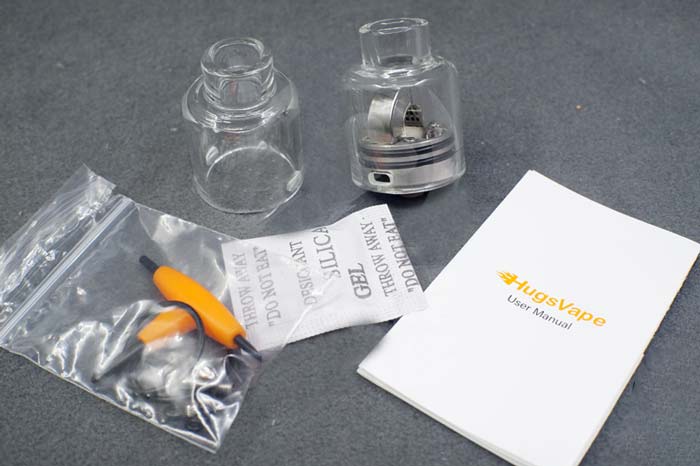
The accessories upon opening are shown in the image above.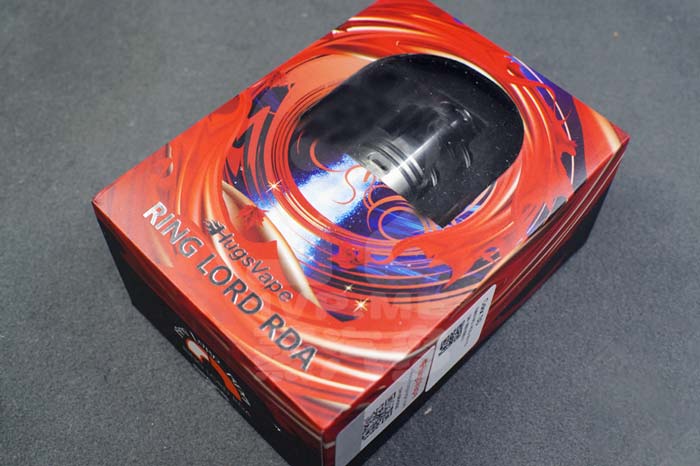
One of the most distinctive features of this atomizer is its glass cover, the internal ring airflow structure, and its "quirky" 27mm diameter. The combination of these three elements leaves a deep impression and exudes high-end vibes.
However, while enjoying its high-end feel, I found that the base and cover do not have a limiting structure, making it easy to push the base in. Even if the O-ring is not stiff, it can be quite difficult to pull it out when it is not lubricated with e-liquid.
Looking at the glass cover itself, since it is one piece, it does not support changing the drip tip. At the bottom ends, you can see the airflow holes linked to the base. Be careful during daily use, as breaking the glass cover would be troublesome.
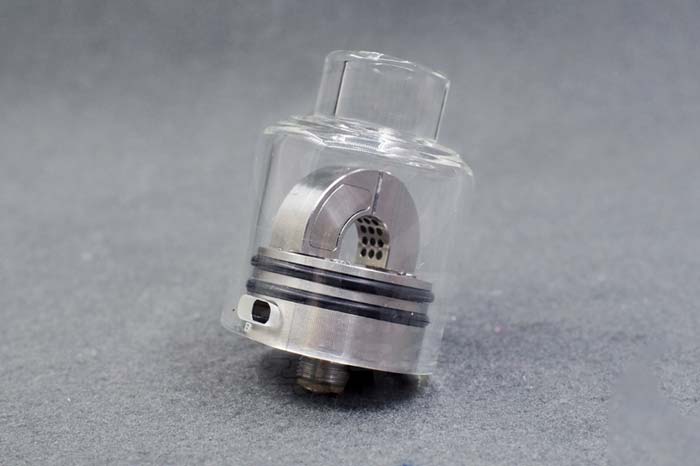
Now, regarding the base, which is the most concerning part for everyone, it appears to have a bottom airflow design. It uses two semi-circular airflow components, transforming the originally bottom airflow into a so-called surrounding airflow, which is a characteristic of the Tornado Atomizer.
These two components can also be disassembled individually, making it easier to install the heating wire without too much hassle. As seen in the image above, the inner surface of the semi-circle features honeycomb-shaped airflow holes. At first glance, this seems to be the ultimate weapon for those experienced vapers and casual users to determine "flavor," and it should be great! However, do not assume that this ring airflow combined with multiple holes will enhance the flavor of the vapor; this is merely an illusion. I will explain why shortly.
 The image above shows that the base has four wire locking holes, but due to the ring airflow kit, it can generally only accommodate a single coil.
Due to space and height limitations of the airflow kit, along with the diagonal distance of the wire holes being too long, installing the heating wire can be a bit tricky. As for the choice of heating wire, this atomizer can be said to be versatile, as I personally believe it works well with any material and specifications of wire; it is absolutely hardcore!
Since I mentioned earlier that its airflow setting is merely an illusion, we must first understand that bottom airflow means direct airflow hitting the heating wire. This way, during the vaporization process, there won't be much excess air mixing in, which is an advantage of bottom airflow. However, you can see that its ring airflow design focuses on the top after the heating wire is installed, and since it is not a traditional top airflow sealed design, it cannot effectively direct airflow straight onto the heating wire. This results in poor cooling of the vapor, especially when using complex wire structures, where you may even feel that the power is too high to use comfortably. This is just one point.
 Another point is that this airflow direction, positioned above the coil, will lead to a significant amount of air being inhaled along with the vapor. Coupled with the spacious internal space due to the 27mm diameter, which matches the single coil usage scenario, this effect is further amplified, making it a product that cannot extract the flavor of the e-liquid, regardless of the specifications, wire, or e-liquid used. However, is the Tornado Atomizer entirely without merit? Not at all, because at this point, you can completely use it to vape those "bad juices" that you can't give away, sell, or dislike. The flavors that were once hard to vape will be significantly diminished, transforming "hard to vape" into "vapeable," but only "vapeable" at best, thus greatly reducing financial waste and giving those bad juices some value.
#p#分页标题#e#
Another point is that this airflow direction, positioned above the coil, will lead to a significant amount of air being inhaled along with the vapor. Coupled with the spacious internal space due to the 27mm diameter, which matches the single coil usage scenario, this effect is further amplified, making it a product that cannot extract the flavor of the e-liquid, regardless of the specifications, wire, or e-liquid used. However, is the Tornado Atomizer entirely without merit? Not at all, because at this point, you can completely use it to vape those "bad juices" that you can't give away, sell, or dislike. The flavors that were once hard to vape will be significantly diminished, transforming "hard to vape" into "vapeable," but only "vapeable" at best, thus greatly reducing financial waste and giving those bad juices some value.
#p#分页标题#e#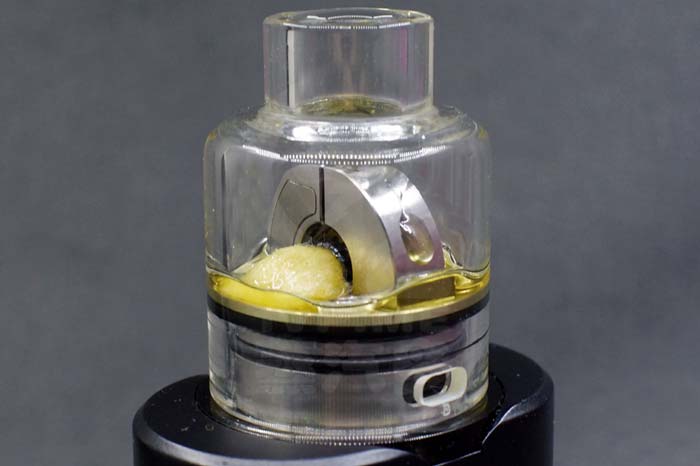 Meanwhile, if you do not use it with a bottom-fill bottle (the accessory includes a bottom-fill screw), if you want to remove the cover to refill, the airflow kit in the middle can be quite obstructive, requiring you to add e-liquid bit by bit onto the cotton. If you want to add e-liquid directly from the drip tip, this airflow kit also makes it difficult to drip directly onto the coil and cotton, as it must flow down slowly from its arched surface before being absorbed by the cotton at the edge of the base. This is not the end; due to the average sealing of its O-ring, e-liquid or condensation can easily seep out from between the base and cover onto the device. Because of this, if you want to unscrew the atomizer from the device, you will find that only the cover turns, while the base remains firmly attached to the device.
Having reviewed all of the above, I can't help but marvel at how, in today's market where atomizer designs are relatively mature, one can still find a product that fails to deliver flavor, performs poorly with any specifications, and turns various selling points into drawbacks. This is indeed a rare find.
The Tornado Atomizer comes from a brand called HugVape. I haven't checked what other products they have released, so I will consider the RING LORD RDA Tornado Atomizer as their "debut work" in the domestic market.
The accessories upon opening are shown in the image above.
One of the most distinctive features of this atomizer is its glass cover, the internal ring airflow structure, and its "quirky" 27mm diameter. The combination of these three elements leaves a deep impression and exudes high-end vibes.
However, while enjoying its high-end feel, I found that the base and cover do not have a limiting structure, making it easy to push the base in. Even if the O-ring is not stiff, it can be quite difficult to pull it out when it is not lubricated with e-liquid.
Looking at the glass cover itself, since it is one piece, it does not support changing the drip tip. At the bottom ends, you can see the airflow holes linked to the base. Be careful during daily use, as breaking the glass cover would be troublesome.
Now, regarding the base, which is the most concerning part for everyone, it appears to have a bottom airflow design. It uses two semi-circular airflow components, transforming the originally bottom airflow into a so-called surrounding airflow, which is a characteristic of the Tornado Atomizer.
These two components can also be disassembled individually, making it easier to install the heating wire without too much hassle. As seen in the image above, the inner surface of the semi-circle features honeycomb-shaped airflow holes. At first glance, this seems to be the ultimate weapon for those experienced vapers and casual users to determine "flavor," and it should be great! However, do not assume that this ring airflow combined with multiple holes will enhance the flavor of the vapor; this is merely an illusion. I will explain why shortly.
The image above shows that the base has four wire locking holes, but due to the ring airflow kit, it can generally only accommodate a single coil.Due to space and height limitations of the airflow kit, along with the diagonal distance of the wire holes being too long, installing the heating wire can be a bit tricky. As for the choice of heating wire, this atomizer can be said to be versatile, as I personally believe it works well with any material and specifications of wire; it is absolutely hardcore!
Since I mentioned earlier that its airflow setting is merely an illusion, we must first understand that bottom airflow means direct airflow hitting the heating wire. This way, during the vaporization process, there won't be much excess air mixing in, which is an advantage of bottom airflow. However, you can see that its ring airflow design focuses on the top after the heating wire is installed, and since it is not a traditional top airflow sealed design, it cannot effectively direct airflow straight onto the heating wire. This results in poor cooling of the vapor, especially when using complex wire structures, where you may even feel that the power is too high to use comfortably. This is just one point.
Another point is that this airflow direction, positioned above the coil, will lead to a significant amount of air being inhaled along with the vapor. Coupled with the spacious internal space due to the 27mm diameter, which matches the single coil usage scenario, this effect is further amplified, making it a product that cannot extract the flavor of the e-liquid, regardless of the specifications, wire, or e-liquid used. However, is the Tornado Atomizer entirely without merit? Not at all, because at this point, you can completely use it to vape those "bad juices" that you can't give away, sell, or dislike. The flavors that were once hard to vape will be significantly diminished, transforming "hard to vape" into "vapeable," but only "vapeable" at best, thus greatly reducing financial waste and giving those bad juices some value.
#p#分页标题#e#
Meanwhile, if you do not use it with a bottom-fill bottle (the accessory includes a bottom-fill screw), if you want to remove the cover to refill, the airflow kit in the middle can be quite obstructive, requiring you to add e-liquid bit by bit onto the cotton. If you want to add e-liquid directly from the drip tip, this airflow kit also makes it difficult to drip directly onto the coil and cotton, as it must flow down slowly from its arched surface before being absorbed by the cotton at the edge of the base. This is not the end; due to the average sealing of its O-ring, e-liquid or condensation can easily seep out from between the base and cover onto the device. Because of this, if you want to unscrew the atomizer from the device, you will find that only the cover turns, while the base remains firmly attached to the device.Having reviewed all of the above, I can't help but marvel at how, in today's market where atomizer designs are relatively mature, one can still find a product that fails to deliver flavor, performs poorly with any specifications, and turns various selling points into drawbacks. This is indeed a rare find.


