
Key Considerations When Choosing a Bottom-Feeding Atomizer
In the era of dripping and tank-style vaping, developing new products is undoubtedly a challenging task. With the fast pace of life and the desire for new products, the arrival of bottom-feeding devices has certainly caught everyone's attention, balancing experience and convenience, as designers strive to create new RDA gameplay—bottom filling.
As the variety of e-liquid flavors increases, many RDAs now come with a bottom-feeding screw, allowing top-drip RDA products to also be compatible with bottom filling. The emergence of bottom-feeding devices (also referred to as BF) allows for the addition of a storage bottle inside the device while also enabling dripping operations on the atomizer, making it much more convenient compared to traditional tank-style atomizers, achieving seamless switching between dripping and storage.
Traditional RDAs use direct dripping to add e-liquid to the cotton at the fastest speed, resulting in an extremely rich vaping experience due to the saturated cotton. Bottom-feeding RDAs change the traditional top-drip method to bottom seepage, where e-liquid seeps from the bottom platform and contacts the cotton legs, reaching near the coils, which involves the length of the oil delivery path.
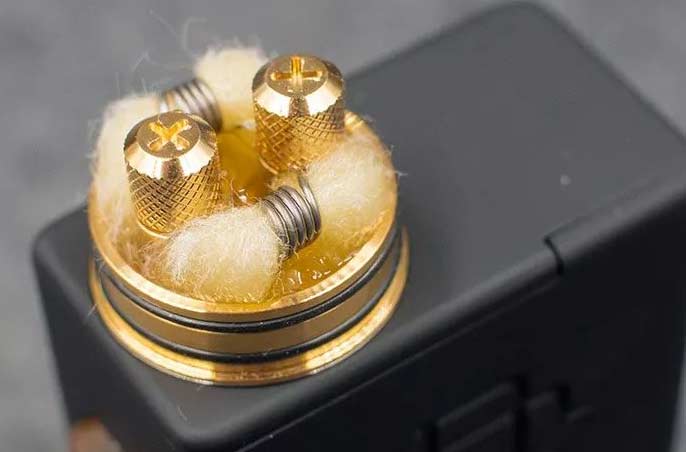
1. The length of the so-called "oil path"
The length of this oil delivery path depends on the reasonable height of the RDA coils, which in turn affects the length of the cotton legs, and this relationship is mutually restrictive. For example, the COILART DPRO RDA has a shorter oil delivery path, but care should be taken not to overfill, as its bottom platform is also shallower due to its structure.
2. Should the cotton legs fill the bottom platform?
This question is similar to the traditional top-drip method. While filling the bottom with cotton allows for more e-liquid storage and reduces the frequency of refilling, if the cotton is packed too tightly, it may cause e-liquid to backflow at the bottom. In general bottom-feeding use, as long as the cotton legs have an appropriate length and are not tightly packed, they can successfully contact the e-liquid seeping from the bottom platform and deliver it to the coils.
3. Can a regular RDA be DIY modified to become bottom-feeding?
Many RDA products now come with bottom-feeding replacement screws for users to modify themselves. In fact, even if an RDA does not come with a factory bottom-feeding screw, users can purchase compatible bottom-feeding screws from accessory stores for DIY modifications. Commonly, the best modification types are dual-post side airflow RDAs, which have been adopted by many factory bottom-feeding RDAs.
4. What flavor difference is there between bottom-feeding RDAs and RTAs?
Typically, tank-style atomizers (RTAs) are sealed atomizer chambers, with e-liquid stored outside the atomizer chamber. During use, the e-liquid may be affected by the heat from the atomizer chamber, leading to a diminished flavor experience, which is why the flavor often becomes weaker after consuming half of the e-liquid in the tank. In contrast, bottom-feeding RDAs allow for single squeezes, with e-liquid stored in a separate bottle isolated from the atomizer chamber, minimizing the impact on the e-liquid.
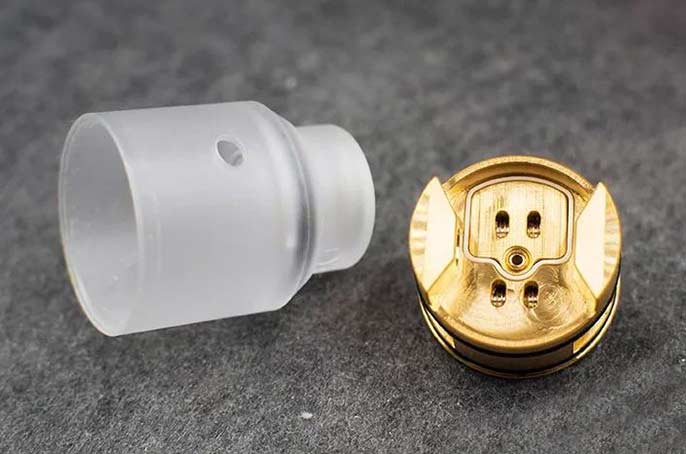
5. What experiential differences are there between bottom-feeding and traditional top-drip RDAs?
In a non-strict sense, the atomization effects between the two are the same. However, the speed of directly dripping e-liquid onto the cotton is inevitably faster than the process of the cotton absorbing from the bottom. The traditional top-drip RDA method is simpler and more straightforward. The advantage of bottom feeding is that it integrates the e-liquid bottle with the device, making it extremely compact and convenient for carrying, which is a highlight of this method. If a user is particularly fond of the rich atomization flavor of RDAs, then bottom-feeding RDA devices are undoubtedly the top choice for outings.
To accommodate the use of bottom-feeding devices, atomizers are also packaged with a new set of screws, allowing for replacement with corresponding screws for different devices. For beginners, after purchasing their device, they hope to use it quickly, so in each package, in addition to the normal spare parts, manufacturers also thoughtfully prepare a pair of pre-made coils, saving the hassle of winding coils, and the single-screw design allows users to quickly master the technique of wicking when first encountering DIY atomizers.
Of course, all this is not to prove that bottom-feeding RDAs can completely surpass RTAs or RDTAs; various electronic cigarette devices have their respective advantages, as proven by the market's development to date. The main goal is to share some of my shallow insights and analyses today to help friends who need bottom-feeding dripping provide some reference and basis when purchasing, helping electronic cigarette players avoid detours and explore the fun of DIY vaping together, which is the starting point of this article.
#p#分页标题#e# Recommended Budget Bottom-Feeding AtomizersAre bottom-feeding devices good to use? What are their advantages?
Review of the Petri Bottom-Feeding Device


