
Who should regulate vape sales near primary and secondary schools?
Who should regulate vape sales around primary and secondary schools? Recently, the Live Anyang program reported that some shops near local schools were frequently found selling vaping products. Are these products harmful to health, and who is responsible
Who should regulate the sale of e-cigarettes near primary and secondary schools? Recently, the program "Live Anyang" reported that e-cigarettes have frequently been found for sale near some schools in our city. Are e-cigarettes harmful to the human body, and who should be responsible for the environment around schools?
Citizen Mr. Yang called our hotline, stating that he saw reports indicating that some shops near primary and secondary schools in certain areas sell e-cigarettes, which poses a certain danger to students. He wanted to know if there are similar situations in Qingzhou. In response, reporters visited several stationery stores around various primary and secondary schools in the urban area and found that some stationery stores do sell e-cigarettes."I saw in some news reports that certain stationery stores near schools sell e-cigarettes. The reports mentioned that harmful substances in e-cigarettes could harm the health of elementary school students and easily provide psychological satisfaction, leading to potential psychological dependence and addiction. I want to know if there are similar situations in Qingzhou," Mr. Yang reported on the morning of the 17th. Subsequently, reporters investigated this issue, first visiting a shop near Zhengfa Street next to a school, where the shop owner stated they did not sell e-cigarettes. The reporters then went to a neighboring store and received the same response. "We don't sell e-cigarettes, only regular cigarettes, and we wouldn't sell to students if they came in to buy," the shop owner said. The reporters then went to Hengwangfu West Street, where several schools, including primary schools, middle schools, and kindergartens, are located. Various stationery stores line both sides of the street. At noon, students had already been dismissed, and many entered the stationery stores to shop. The reporters first visited two stationery stores adjacent to a school, where both owners stated they did not sell e-cigarettes. One owner mentioned, "Because my store is very close to the school, I am cautious when stocking products. Although students occasionally ask about e-cigarettes, I never sell them." The reporters then visited a slightly further stationery store, where the owner asked if the reporters wanted fruit-flavored e-cigarettes while showing them a plastic bag containing several e-cigarettes priced at 10 yuan each. The reporters then went to another stationery store, where they saw many students selecting stationery items, and under the owner's guidance, they discovered e-cigarettes for sale at 8 yuan each. They then visited another stationery store, where the owner informed them that they only had one type of refillable e-cigarette priced at over 20 yuan, which had low sales due to its higher price and limited stock.
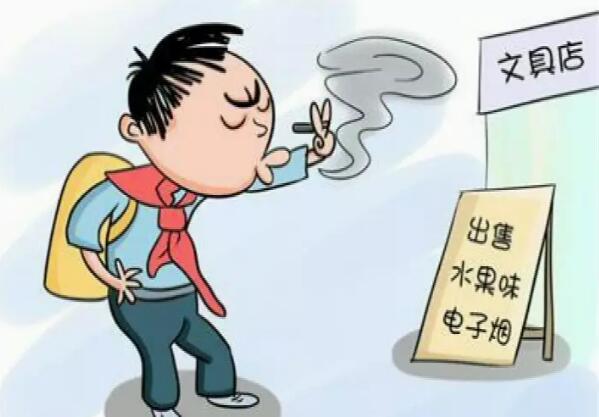 The reporters purchased an e-cigarette from one of the stores. Upon removing the packaging, they found it slightly thicker and longer than a regular cigarette. Just by holding the "mouthpiece" and inhaling, it produced vapor, with a red light glowing at the other end. Upon careful observation, the reporters noted that neither the outer packaging nor the e-cigarette itself had any Chinese manufacturer name, address, phone number, license number, product logo, production date, or Chinese product instructions, which are legally required labels, making it a "three-no" product.
Do e-cigarettes pose health risks? The reporters inquired with relevant departments at a hospital in Qingzhou, where doctors stated that due to e-cigarettes being a new phenomenon, there has been no in-depth research on their safety.
During the undercover investigation, the reporters also purchased a more than 20 yuan e-cigarette. After returning, following the shop owner's instructions, they poured colorless e-liquid into the e-cigarette and pressed the button on the device to start vaping. So, what is the principle behind e-cigarettes? The reporters learned online that e-cigarettes, also known as electronic atomization cigarettes, are devices that deliver vapor to the respiratory system through electronic heating, with the vapor produced from atomized liquid.
The reporters purchased an e-cigarette from one of the stores. Upon removing the packaging, they found it slightly thicker and longer than a regular cigarette. Just by holding the "mouthpiece" and inhaling, it produced vapor, with a red light glowing at the other end. Upon careful observation, the reporters noted that neither the outer packaging nor the e-cigarette itself had any Chinese manufacturer name, address, phone number, license number, product logo, production date, or Chinese product instructions, which are legally required labels, making it a "three-no" product.
Do e-cigarettes pose health risks? The reporters inquired with relevant departments at a hospital in Qingzhou, where doctors stated that due to e-cigarettes being a new phenomenon, there has been no in-depth research on their safety.
During the undercover investigation, the reporters also purchased a more than 20 yuan e-cigarette. After returning, following the shop owner's instructions, they poured colorless e-liquid into the e-cigarette and pressed the button on the device to start vaping. So, what is the principle behind e-cigarettes? The reporters learned online that e-cigarettes, also known as electronic atomization cigarettes, are devices that deliver vapor to the respiratory system through electronic heating, with the vapor produced from atomized liquid.Many people think that vaping seems "safer." However, research by foreign experts shows that the nicotine content in e-cigarettes is not strictly controlled and contains other harmful chemicals. Additionally, e-cigarettes may activate smoking habits, especially among teenagers. Experts indicate that if the heating speed of the e-cigarette device is too fast, it can produce a highly toxic substance called acrolein. The impact of e-cigarettes on children's physical and mental development is significant. So, should relevant departments regulate this phenomenon? The reporters first contacted the city's education department. Phone interview with the Party Office of the City Education Bureau: "I think we can inform the Beiguan District Education and Sports Bureau to strengthen student education. Secondly, I feel it should fall under the jurisdiction of the Industry and Commerce Bureau."
Reporter: "Does the Education Bureau have any enforcement departments related to this?"
Phone interview with the Party Office of the City Education Bureau: "The Education Bureau does not have enforcement powers for managing the areas around schools."
Subsequently, the reporters visited the Station Business Office of the Beiguan Branch of the City Industry and Commerce Bureau, where they met with a responsible person who stated that the management of e-cigarettes should first determine their nature.
Responsible person at the Station Business Office of the City Industry and Commerce Bureau: "If it is tobacco, then it falls under the tobacco department; if it is an electronic product, then it is another matter."
Regarding whether e-cigarettes can be sold near schools, the reporters also inquired.
Responsible person at the Station Business Office of the City Industry and Commerce Bureau: "Tobacco cannot be sold to primary and secondary school students, as there are national regulations on this."
However, regarding whether e-cigarettes can be sold, this person indicated that it should still be inquired with the tobacco department. The reporters then contacted the City Tobacco Monopoly Bureau by phone.
Phone interview with the City Tobacco Monopoly Bureau staff: "If e-cigarettes contain tobacco and nicotine, they fall under our management, and we will conduct inspections. If they are purely electronic cigarettes, we still need to coordinate with the Industry and Commerce Bureau."
The staff of the Tobacco Monopoly Bureau stated that they would promptly investigate the situation around schools and urged timely communication of any findings. In this regard, "Live Anyang" hopes that this issue can be thoroughly resolved to truly protect the physical and mental health of children.
We all know that the development of behavior habits in primary and secondary school students is crucial. The sale of e-cigarettes around schools undoubtedly impacts children's growth. The environment around schools has always been a significant concern for schools and parents. In this regard, "Live Anyang" hopes that relevant management departments can pay attention to and rectify this phenomenon, preventing harmful products from invading the pure campus.


