
How Can Vaping Devices Reproduce the Taste of Traditional Cigarettes?
Vaping devices were developed as an alternative to traditional cigarettes, with the goal of delivering a similar sensory experience while reducing some of the safety risks associated with smoking traditional tobacco. 1. The mechanism behind traditional to
E-cigarettes are products developed as alternatives to traditional cigarettes, aiming to replicate the sensory enjoyment provided by traditional tobacco while reducing the safety risks associated with smoking traditional tobacco.
1. Mechanism of Traditional Tobacco Flavor Smoking is a multi-sensory experience involving taste and smell. Each person's perception of tobacco is diverse and personal. The sensory experience provided by tobacco mainly comes from the combined experience of aroma, strength, flavor, and irritation produced during the burning and inhalation process. Only by understanding how traditional tobacco affects human senses can we develop new types of cigarettes that can adequately replace traditional tobacco. The traditional tobacco industry generally classifies tobacco quality into style characteristics and quality characteristics. The former mainly includes aroma type, aroma rhythm, and aroma state, while the latter includes aroma characteristics, smoke characteristics, and taste characteristics. In our laboratory, we use various statistical analysis methods to distinguish the taste characteristics of traditional tobacco. Using the YC/T138-1998 "Sensory Evaluation Methods for Tobacco and Tobacco Products" as a standard, we score aroma quality, aroma quantity, miscellaneous gas, strength, concentration, aftertaste, irritation, ash color, and combustibility, with each individual indicator having a maximum score of 9 points. Among them, taste characteristics include irritation and aftertaste, with a maximum score of 18 points.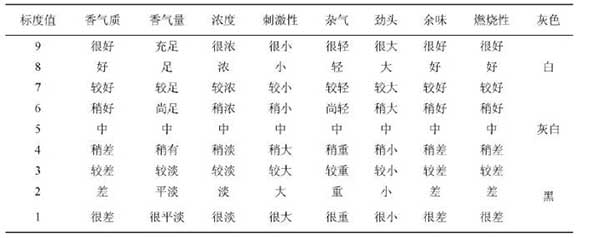 Tobacco contains various chemicals that affect its flavor during the burning and inhalation process. In the laboratory, we generally use correlation analysis to study the relationship between tobacco flavor characteristics and chemical composition indicators.
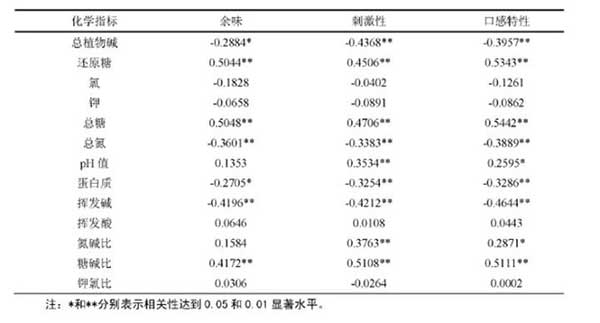
As shown in the figure below, total alkaloids, total nitrogen, protein, and volatile alkaloids show significant or highly significant negative correlations with aftertaste, irritation, and taste characteristics. Total sugars, reducing sugars, and sugar-alkali ratios show highly significant positive correlations with aftertaste, irritation, and taste characteristics; pH value and nitrogen-alkali ratios show significant or highly significant positive correlations with irritation and taste characteristics, but the relationship with aftertaste is not significant. The relationships between potassium, chlorine, volatile acids, potassium-chlorine ratios, and taste characteristics are not significant.
Tobacco contains various chemicals that affect its flavor during the burning and inhalation process. In the laboratory, we generally use correlation analysis to study the relationship between tobacco flavor characteristics and chemical composition indicators.
As shown in the figure below, total alkaloids, total nitrogen, protein, and volatile alkaloids show significant or highly significant negative correlations with aftertaste, irritation, and taste characteristics. Total sugars, reducing sugars, and sugar-alkali ratios show highly significant positive correlations with aftertaste, irritation, and taste characteristics; pH value and nitrogen-alkali ratios show significant or highly significant positive correlations with irritation and taste characteristics, but the relationship with aftertaste is not significant. The relationships between potassium, chlorine, volatile acids, potassium-chlorine ratios, and taste characteristics are not significant.
 We know that both traditional tobacco and new cigarettes use added flavoring agents for taste. The main aromatic substances in traditional tobacco can also be derived through factor analysis in the laboratory:
We then conduct correlation analysis between the taste characteristics of traditional tobacco and polyphenols and organic acids:
The conclusion is that the main compounds affecting tobacco flavor are: chlorogenic acid, rutin, palmitic acid, linoleic acid, stearic acid, oleic acid, succinic acid, myristic acid, and propionic acid, mainly consisting of higher fatty acids.
Finally, we established BP neural network models and multiple regression models in the laboratory to derive the mechanisms of interaction between various indicators in traditional tobacco.
The above data only represent the analysis of traditional tobacco raw materials and do not consider the processing steps in the tobacco industry such as rolling, baking, and flavoring. The factors causing changes in traditional tobacco flavor are complex, and replicating the flavor of tobacco is not a simple task.
2. Principles of E-Liquid Formulation
Currently, the main types of cigarettes sold in the global tobacco industry are: flue-cured and blended cigarettes. Domestic cigarettes are mostly flue-cured, while foreign cigarettes are mainly blended. The production process involves adding flavoring agents to tobacco, with the only difference being the type of tobacco and flavoring formula used.
The raw materials for e-cigarette e-liquids include: propylene glycol, glycerin, flavoring agents, and nicotine.
The taste of cigarettes: tobacco and flavoring agents release flavors through combustion.
The taste of e-cigarettes: e-liquid releases flavors through heating and atomization.
The biggest difference is that combustion is a chemical change, while heating and atomization are more physical changes.
Flavoring agents are added to traditional tobacco because the tobacco leaves undergo low tar and harm reduction processing and natural fermentation, which may have some flavor defects. To maintain the relative stability of cigarette product quality, while reasonably designing the leaf blend formula, flavoring agents are also added to overcome flavor defects, which is also an important measure to improve product quality. Similarly, this practice ensures that tobacco leaves produced under different natural climatic conditions in different years can maintain consistent taste when smoked. Just as the same brand of wine can reveal the vintage of the grapes, the same brand of cigarettes cannot distinguish the origin of the tobacco leaves based on the year of production, which is the fundamental requirement for adding flavoring agents.
E-liquid components:
Propylene glycol: dissolves nicotine and flavoring agents;
Glycerin: dissolves propylene glycol, simulates smoke, and is the main source of vapor;
Flavoring agents: for flavoring, simulating traditional tobacco taste;
Nicotine: nicotine.
3. What Needs to Be Done to Replicate Tobacco Flavor in E-Liquid
How e-liquid can achieve the flavor of tobacco is a profound research topic. To explore this from the simplest directions, a e-liquid that can satisfy users' taste needs to achieve the following:
1. Flavoring agent formulation replication
To replicate the taste characteristics of traditional tobacco, it is essential to be as consistent as possible with the aromatic components in traditional tobacco.
The flavoring agents used in traditional tobacco are tobacco flavoring agents. The regulation of tobacco flavoring agents is governed by the National Tobacco Monopoly Administration, which issued the "Interim Management Measures for the Use of Tobacco Flavoring Agents in Tobacco Product Manufacturing Enterprises" in document No. 746.
Tobacco flavoring agents are generally divided into: natural flavoring agents and synthetic flavoring agents. Natural flavoring agents are mixtures of volatile aromatic components extracted from the flowers, leaves, stems, roots, and fruits of tobacco. The most commonly used commercial varieties include tobacco extract, tobacco flower extract, and tobacco essential oil.
Currently, the industry's challenge is that tobacco planting in China is a planned economy crop, requiring contracts with the China Tobacco Group for tobacco leaf planting and purchasing. Enterprises without a tobacco background cannot access key flavoring extraction sources.
2. Component ratio
E-liquids with the same flavoring formula will have vastly different atomization effects in different solvents.
By fixing the volume and content of nicotine and water in e-cigarette e-liquids and comparing the release of nicotine in the aerosol of e-cigarettes with different volume ratios of propylene glycol (PG) and glycerin (VG), the results show that as the content of propylene glycol increases, the release of nicotine in the aerosol also increases. This is because, at the same power level, as the volume of propylene glycol (boiling point 188°C) increases, the volume of glycerin (boiling point 290°C) decreases, leading to a lower azeotropic point of the atomizing agent, which increases the nicotine release in the aerosol.
Thus, it can be concluded that propylene glycol and nicotine content are positively correlated; how to achieve a reasonable component ratio in terms of flavoring solubility, nicotine content, and vapor size is extremely important.
3. Atomization temperature
E-cigarettes are electronic products that primarily use electrical energy converted into thermal energy for operation. Considering safety factors, reasonably determining the atomization temperature can effectively enhance the flavor of e-cigarettes. (High temperatures can lead to the decomposition of glycerin, producing formaldehyde.)
The combustion temperature of traditional tobacco can reach 720°, while the safe temperature for e-liquid is only 340°. In different temperature environments, how to ensure that all aromatic factors are fully atomized is an extremely complex modulation task.
Based on our laboratory's research on the impact of combustion temperature on the flavor of traditional tobacco, the following conclusions were drawn:
At 150~400 °C, O–H, N–H, C–O, and C–N in tobacco basically disappear, with only a small amount of C O remaining, while a large number of aromatic components are generated, which are the main functional groups in charcoal; at 400 °C~580 °C, the oxidation reaction of C–H and aromatic components occurs, releasing a large amount of heat and initially generating various inorganic salts; at temperatures above 600 °C, various inorganic salts are generated and transformed, absorbing heat.
The relationship between temperature/power and the flavor of e-liquid is positively correlated, reaching a peak and then tending towards no correlation; the inhalation curve, duration of inhalation, and inhalation volume are the main factors affecting the flavor of e-liquid, while inhalation frequency has a relatively small impact on the flavor of e-liquid.
We know that both traditional tobacco and new cigarettes use added flavoring agents for taste. The main aromatic substances in traditional tobacco can also be derived through factor analysis in the laboratory:
We then conduct correlation analysis between the taste characteristics of traditional tobacco and polyphenols and organic acids:
The conclusion is that the main compounds affecting tobacco flavor are: chlorogenic acid, rutin, palmitic acid, linoleic acid, stearic acid, oleic acid, succinic acid, myristic acid, and propionic acid, mainly consisting of higher fatty acids.
Finally, we established BP neural network models and multiple regression models in the laboratory to derive the mechanisms of interaction between various indicators in traditional tobacco.
The above data only represent the analysis of traditional tobacco raw materials and do not consider the processing steps in the tobacco industry such as rolling, baking, and flavoring. The factors causing changes in traditional tobacco flavor are complex, and replicating the flavor of tobacco is not a simple task.
2. Principles of E-Liquid Formulation
Currently, the main types of cigarettes sold in the global tobacco industry are: flue-cured and blended cigarettes. Domestic cigarettes are mostly flue-cured, while foreign cigarettes are mainly blended. The production process involves adding flavoring agents to tobacco, with the only difference being the type of tobacco and flavoring formula used.
The raw materials for e-cigarette e-liquids include: propylene glycol, glycerin, flavoring agents, and nicotine.
The taste of cigarettes: tobacco and flavoring agents release flavors through combustion.
The taste of e-cigarettes: e-liquid releases flavors through heating and atomization.
The biggest difference is that combustion is a chemical change, while heating and atomization are more physical changes.
Flavoring agents are added to traditional tobacco because the tobacco leaves undergo low tar and harm reduction processing and natural fermentation, which may have some flavor defects. To maintain the relative stability of cigarette product quality, while reasonably designing the leaf blend formula, flavoring agents are also added to overcome flavor defects, which is also an important measure to improve product quality. Similarly, this practice ensures that tobacco leaves produced under different natural climatic conditions in different years can maintain consistent taste when smoked. Just as the same brand of wine can reveal the vintage of the grapes, the same brand of cigarettes cannot distinguish the origin of the tobacco leaves based on the year of production, which is the fundamental requirement for adding flavoring agents.
E-liquid components:
Propylene glycol: dissolves nicotine and flavoring agents;
Glycerin: dissolves propylene glycol, simulates smoke, and is the main source of vapor;
Flavoring agents: for flavoring, simulating traditional tobacco taste;
Nicotine: nicotine.
3. What Needs to Be Done to Replicate Tobacco Flavor in E-Liquid
How e-liquid can achieve the flavor of tobacco is a profound research topic. To explore this from the simplest directions, a e-liquid that can satisfy users' taste needs to achieve the following:
1. Flavoring agent formulation replication
To replicate the taste characteristics of traditional tobacco, it is essential to be as consistent as possible with the aromatic components in traditional tobacco.
The flavoring agents used in traditional tobacco are tobacco flavoring agents. The regulation of tobacco flavoring agents is governed by the National Tobacco Monopoly Administration, which issued the "Interim Management Measures for the Use of Tobacco Flavoring Agents in Tobacco Product Manufacturing Enterprises" in document No. 746.
Tobacco flavoring agents are generally divided into: natural flavoring agents and synthetic flavoring agents. Natural flavoring agents are mixtures of volatile aromatic components extracted from the flowers, leaves, stems, roots, and fruits of tobacco. The most commonly used commercial varieties include tobacco extract, tobacco flower extract, and tobacco essential oil.
Currently, the industry's challenge is that tobacco planting in China is a planned economy crop, requiring contracts with the China Tobacco Group for tobacco leaf planting and purchasing. Enterprises without a tobacco background cannot access key flavoring extraction sources.
2. Component ratio
E-liquids with the same flavoring formula will have vastly different atomization effects in different solvents.
By fixing the volume and content of nicotine and water in e-cigarette e-liquids and comparing the release of nicotine in the aerosol of e-cigarettes with different volume ratios of propylene glycol (PG) and glycerin (VG), the results show that as the content of propylene glycol increases, the release of nicotine in the aerosol also increases. This is because, at the same power level, as the volume of propylene glycol (boiling point 188°C) increases, the volume of glycerin (boiling point 290°C) decreases, leading to a lower azeotropic point of the atomizing agent, which increases the nicotine release in the aerosol.
Thus, it can be concluded that propylene glycol and nicotine content are positively correlated; how to achieve a reasonable component ratio in terms of flavoring solubility, nicotine content, and vapor size is extremely important.
3. Atomization temperature
E-cigarettes are electronic products that primarily use electrical energy converted into thermal energy for operation. Considering safety factors, reasonably determining the atomization temperature can effectively enhance the flavor of e-cigarettes. (High temperatures can lead to the decomposition of glycerin, producing formaldehyde.)
The combustion temperature of traditional tobacco can reach 720°, while the safe temperature for e-liquid is only 340°. In different temperature environments, how to ensure that all aromatic factors are fully atomized is an extremely complex modulation task.
Based on our laboratory's research on the impact of combustion temperature on the flavor of traditional tobacco, the following conclusions were drawn:
At 150~400 °C, O–H, N–H, C–O, and C–N in tobacco basically disappear, with only a small amount of C O remaining, while a large number of aromatic components are generated, which are the main functional groups in charcoal; at 400 °C~580 °C, the oxidation reaction of C–H and aromatic components occurs, releasing a large amount of heat and initially generating various inorganic salts; at temperatures above 600 °C, various inorganic salts are generated and transformed, absorbing heat.
The relationship between temperature/power and the flavor of e-liquid is positively correlated, reaching a peak and then tending towards no correlation; the inhalation curve, duration of inhalation, and inhalation volume are the main factors affecting the flavor of e-liquid, while inhalation frequency has a relatively small impact on the flavor of e-liquid.

