
Changing Competitive Trends Among Global Tobacco Giants in 2017 as E-Cigarettes Grow Rapidly
Recently, the 2017 World Tobacco Development Report analyzed the operating data and development strategies of major international tobacco companies in 2017. It reviewed the competitive landscape and strategic shifts of four multinational tobacco companies
Recently, the 2017 World Tobacco Development Report disclosed and analyzed the operating data and development strategies of major international companies in the tobacco business for 2017, examining the competitive landscape and strategic changes among the four major multinational tobacco companies, and providing insights into future trends. So, what changes occurred in the international tobacco landscape in 2017? Let's take a look with the editor!~
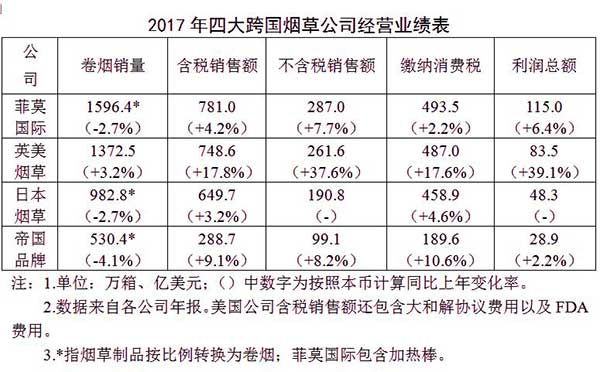 Several significant mergers and acquisitions have had a considerable impact on the scale comparison of the four major multinational tobacco companies.
In July 2017, British American Tobacco completed its acquisition of Reynolds American, which is expected to increase its sales volume by about 1.4 million cases, offering a more comprehensive product range and bringing its sales revenue close to that of Philip Morris International, with expectations to surpass it in 2018, while significantly improving profit margins.
Although Japan Tobacco has made significant strides in expanding its international market in recent years, its sales volume of 10 million cases still lags behind the first tier by a considerable margin, with sales revenue reaching only about 60% of that of Philip Morris International.
Imperial Brands remains the smallest among the four companies, with sales only one-third of Philip Morris International's, and its sales have been declining at a relatively rapid pace in recent years.
Several significant mergers and acquisitions have had a considerable impact on the scale comparison of the four major multinational tobacco companies.
In July 2017, British American Tobacco completed its acquisition of Reynolds American, which is expected to increase its sales volume by about 1.4 million cases, offering a more comprehensive product range and bringing its sales revenue close to that of Philip Morris International, with expectations to surpass it in 2018, while significantly improving profit margins.
Although Japan Tobacco has made significant strides in expanding its international market in recent years, its sales volume of 10 million cases still lags behind the first tier by a considerable margin, with sales revenue reaching only about 60% of that of Philip Morris International.
Imperial Brands remains the smallest among the four companies, with sales only one-third of Philip Morris International's, and its sales have been declining at a relatively rapid pace in recent years.
From a market distribution perspective, Philip Morris International holds an overall market share of about 25%, with a balanced market distribution, showing the most significant advantages, and occupying a clear first-mover position in emerging markets in the Asia-Pacific region. British American Tobacco has an overall market share of about 19%, with its advantages stemming from a relatively balanced global market distribution. Its highest market share is in Latin America and Oceania, while the lowest is in the Asia-Pacific and North American regions. However, after acquiring Reynolds, it became the second-largest tobacco company in the U.S. market and occupies an important position in the emerging markets of the Middle East and Africa. Japan Tobacco has an overall market share of about 14%, but its global market distribution is uneven, with a high reliance on the domestic market. In 2017, the domestic market contributed 34% of sales revenue and 40% of profits with a sales volume of 20%. However, the market capacity has significantly declined in recent years. The markets with higher market shares, such as Russia and Europe, are also experiencing substantial reductions in capacity. In recent years, it has optimized its market layout through acquisitions, having acquired tobacco companies in Iran, Ethiopia, the Philippines, and Indonesia, as well as the Dominican Republic cigar factory and the second-largest tobacco distributor in Bolivia. In 2017, sales in these regions increased by 8.4% year-on-year, accounting for 30% of total sales. Imperial Brands has an overall market share of about 7%, primarily in Western Europe and Oceania, with significant declines in sales in recent years, placing it at a clear disadvantage in market distribution. It has made little effort to explore new markets, only increasing its market share in the U.S. by acquiring some divested assets during the Reynolds acquisition in 2016, which has become an important support for its profitability.
From a brand perspective, Despite the continuous decline in total cigarette sales, the sales and market share of major brands from each company are steadily increasing. Among international cigarette brands, "Marlboro" holds an absolute advantage, not only maintaining a high-end price point but also far exceeding other brands in sales, being 2.4 times that of the second-largest brand, "Winston." However, the main contributors to Philip Morris International's sales growth are mid-range and low-end brands. In 2017, sales of high-end brands such as "Marlboro," "L&M," and "Parliament" all saw a decline of over 3%. Nevertheless, high-end brands like "Marlboro" still play a stabilizing role, with an overall increase in cigarette prices of 5.2% throughout the year. In 2017, British American Tobacco's key brand sales grew by 7.6%, and its market share increased by 1.1% (excluding Reynolds). Among its nine key brands, all but "Dunhill" and "Pall Mall" saw an increase in market share. Japan Tobacco's products are mostly mid to high-end, but low-end products have seen the highest sales growth, indicating a trend towards low-end development in recent years. Imperial Brands advocates for a full product line development strategy, meaning each brand includes various categories such as cigarettes and rolling tobacco.
From a profitability perspective, Among the four major tobacco companies, Imperial Brands has the highest profit margin, maintaining over 46% for three consecutive years, mainly due to the high proportion of other tobacco products. iQOS has significant price and tax advantages, and increasing sales will significantly boost Philip Morris International's profit margins.
Development strategy analysis Cultivating brands remains a constant theme. However, in the face of an increasingly volatile environment, the development strategies of each company have shown significant differentiation. Philip Morris International's "smokeless" strategy Philip Morris International has clearly stated its intention to replace traditional cigarettes with new tobacco products, with heated tobacco products becoming the core of resource allocation and the driving force for profit growth. In 2016, Philip Morris International's investment in iQOS reached 27% of its capital expenditures, with an additional $376 million in capital expenditures in 2017 (1 USD is approximately 6.5063 RMB), and an expected increase of $200 million in 2018. In 2017, sales of heated sticks surged to 724,000 cases, and sales of heated tobacco products jumped from $730 million to $3.64 billion, accounting for 12.7% of total sales, driving a 7.7% increase in total sales, marking the largest sales increase for Philip Morris International since separating from Altria. British American Tobacco's balanced development strategy British American Tobacco places equal emphasis on traditional cigarettes and new tobacco products. The company has proposed a slogan to transform into an innovative enterprise, investing early in the research and sales of new tobacco products. However, overall, British American Tobacco does not believe that new tobacco products will ultimately replace traditional cigarettes; instead, it treats them as a segmented product with demand and potential, while traditional cigarettes remain the focus and foundation. The company places great importance on integrating the U.S. market and maintaining brand integrity, fully incorporating the former Reynolds brand into its brand system and adjusting its performance evaluation methods from focusing on key brand sales volume to prioritizing new brand system sales revenue. Japan Tobacco's market expansion strategy Japan Tobacco is gradually shifting its focus to international business. In the face of a significant decline in domestic cigarette sales, Japan Tobacco is mainly acquiring to seize emerging markets in the Asia-Pacific region to quickly fill the gap. In 2017, it completed two significant acquisitions in the Philippines and Indonesia. One was the $936 million acquisition of the second-largest tobacco company in the Philippines, which holds a 23% market share. After the acquisition, Japan Tobacco's market share in the Philippines will increase from 6% to 26%, second only to Philip Morris International's Philippine subsidiary (65%). The other was a $677 million acquisition of the Indonesian clove cigarette company KDM and its distribution company SMN, gaining four strong brands in the mid to low-end clove cigarette market, achieving a transformation from non-existent to strong in a category that accounts for about 80% of sales, and localizing production to significantly reduce tax costs and enhance the competitiveness of its own brands. Additionally, in the heated tobacco product sector, Japan Tobacco is striving to catch up with Philip Morris International, proposing to invest 100 billion yen (1 yen is approximately 0.05871 RMB) over the next three years to achieve the goal of becoming the market leader in domestic heated tobacco products by 2020. Imperial Brands' optimization concentration strategy Unlike the other three companies, Imperial Brands has implemented a brand concentration strategy since 2012, focusing on reducing the number of brands, cultivating strong brands, and lowering operating costs. First, it gradually integrates weaker brands into stronger ones. The number of brands has decreased from 249 in 2013 to 184 in 2016, with a target of reducing to 125. Its market share increased to 8.1% in 2017, and in the 2017 fiscal year, the sales revenue of key brands accounted for 63%, with the number of inventory units reduced to 3,170 in 2017. Reducing the number of brands and inventory has improved mechanical efficiency by 10%, productivity by 5%, and capacity utilization by 15%. Secondly, additional investments have been made in key brands. In the second half of the 2017 fiscal year, brand cultivation funds were significantly increased by £310 million, leading to a noticeable improvement in operating efficiency. Thirdly, strengthening financial management to reduce costs and increase efficiency has maintained cash conversion efficiency above 90% for three consecutive years, with expected annual cost savings of £300 million starting from September 2018 and £600 million from September 2020.
Outlook on development trends Increasing efforts to seize new growth points #p#分页标题#e#
 First, seizing new products, whether they are modified new products like slim cigarettes and flavored cigarettes, or innovative new products like e-cigarettes and heated tobacco products, any new product with demand and potential could change the competitive landscape. For example, "IQOS" for Philip Morris International's expansion in the Japanese market, and slim cigarettes for the domestic tobacco industry's competitive landscape, all highlight the importance of seizing new products.
Second, seizing new markets, major multinational tobacco companies are accelerating their efforts to capture emerging markets. Philip Morris International has laid out its plans early, while Japan Tobacco has been quite aggressive in recent years, with almost every significant acquisition being fiercely contested among the major companies. Seizing new markets is crucial for stabilizing current operating performance and winning future development space. In summary, the ability to timely identify and follow new growth points within and outside the industry will become increasingly significant for company development.
Increasing efforts to promote capacity adjustments
As existing markets continue to shrink and regulatory measures evolve, companies must not only develop new products and explore new markets but also modify existing products to meet regulatory requirements while focusing on improving production efficiency and reducing production costs. This necessitates significant adjustments to existing capacities, but practical implementation can be quite challenging. Therefore, any capacity adjustment decision will attract widespread attention. In recent years, the closure of cigarette factories has mainly concentrated in Western Europe, Australia, and Malaysia, with Western European capacity shifting mainly to Eastern Europe and capacity in Australia and Malaysia moving primarily to East Asia. New capacity areas generally have significant growth potential and often serve to radiate surrounding markets.
The importance of retail terminals in cultivating cigarette brands and enhancing structure will become increasingly prominent.
First, the spread of plain packaging will make brand cultivation more challenging. With plain packaging, brand appearances are nearly indistinguishable, leading to intense price competition, which disproportionately impacts major brands and their companies. In regions where plain packaging has been implemented, there has already been a trend of high-end cigarettes shifting to mid-range.
Second, increasing taxes and prices are squeezing or even exhausting the space for structural enhancement. The pace of consumption upgrades is increasingly difficult to keep up with rising taxes, and the space for improving profitability through price increases is narrowing. Thus, tobacco companies' proactive actions are more constrained, and relying on natural growth is also fraught with difficulties. Therefore, retail terminals, as an important bridge between tobacco companies and consumers, will play an increasingly crucial role in brand cultivation and structural enhancement.
First, seizing new products, whether they are modified new products like slim cigarettes and flavored cigarettes, or innovative new products like e-cigarettes and heated tobacco products, any new product with demand and potential could change the competitive landscape. For example, "IQOS" for Philip Morris International's expansion in the Japanese market, and slim cigarettes for the domestic tobacco industry's competitive landscape, all highlight the importance of seizing new products.
Second, seizing new markets, major multinational tobacco companies are accelerating their efforts to capture emerging markets. Philip Morris International has laid out its plans early, while Japan Tobacco has been quite aggressive in recent years, with almost every significant acquisition being fiercely contested among the major companies. Seizing new markets is crucial for stabilizing current operating performance and winning future development space. In summary, the ability to timely identify and follow new growth points within and outside the industry will become increasingly significant for company development.
Increasing efforts to promote capacity adjustments
As existing markets continue to shrink and regulatory measures evolve, companies must not only develop new products and explore new markets but also modify existing products to meet regulatory requirements while focusing on improving production efficiency and reducing production costs. This necessitates significant adjustments to existing capacities, but practical implementation can be quite challenging. Therefore, any capacity adjustment decision will attract widespread attention. In recent years, the closure of cigarette factories has mainly concentrated in Western Europe, Australia, and Malaysia, with Western European capacity shifting mainly to Eastern Europe and capacity in Australia and Malaysia moving primarily to East Asia. New capacity areas generally have significant growth potential and often serve to radiate surrounding markets.
The importance of retail terminals in cultivating cigarette brands and enhancing structure will become increasingly prominent.
First, the spread of plain packaging will make brand cultivation more challenging. With plain packaging, brand appearances are nearly indistinguishable, leading to intense price competition, which disproportionately impacts major brands and their companies. In regions where plain packaging has been implemented, there has already been a trend of high-end cigarettes shifting to mid-range.
Second, increasing taxes and prices are squeezing or even exhausting the space for structural enhancement. The pace of consumption upgrades is increasingly difficult to keep up with rising taxes, and the space for improving profitability through price increases is narrowing. Thus, tobacco companies' proactive actions are more constrained, and relying on natural growth is also fraught with difficulties. Therefore, retail terminals, as an important bridge between tobacco companies and consumers, will play an increasingly crucial role in brand cultivation and structural enhancement.

