
Tongdao Dashu and Luo Yonghao are entering vaping—how long can this trend stay hot?
There are few so-called air vents like e-cigarettes that are collectively criticized by the media as soon as they appear, and they continue to be criticized. Since the signs appeared in the middle of last year, the trend of public opinion and the enthusiasm of entrepreneurs have deviated significantly.
Counting how many people were involved, first Luo Yonghao announced Zhu Xiaomu's flow fortune; then, Tongdao Uncle founder Cai Yuedong and Huang Taiji founder He Chang launched YOOZ grapefruit; then behind Lingxi LINX, which was widely spread in the circle of friends, were five self-media people, including Tongdao Uncle Chairman and Visual Zhi CEO.
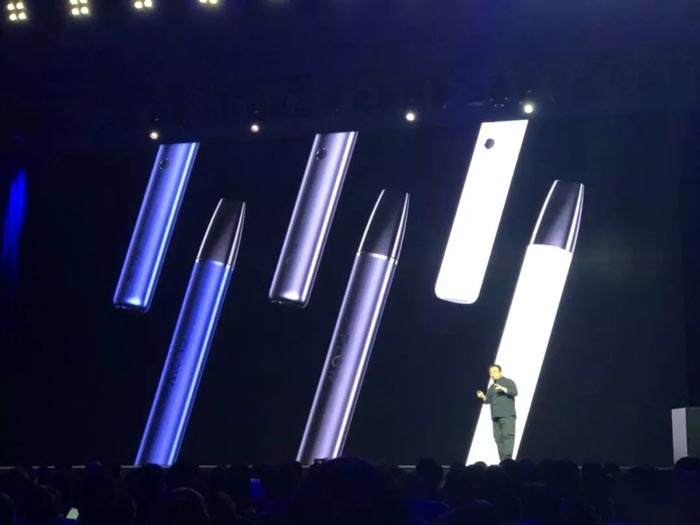
Fellow uncle Cai Yuedong's yooz e-cigarette circle of friends sold 5 million in sales a day
Marked by these three waves of re-entrepreneurs with their own traffic, at the beginning of 2019, if a fire finally emerged on the frozen lake, it would be an e-cigarette. At this time, people realized that in 2018, more than a dozen e-cigarette companies received financing, and there were even front-line institutions such as IDG and Zhenge Fund behind them. More people posed possible risks on the e-cigarette track and poured cold water on this outlet.
Compared with verbal criticism, we are more concerned about what kind of mentality changes are behind the competition among star entrepreneurs to flock to the thorns. If you invest or not, what are investment institutions thinking?
Low-bar sexy business
The earliest mass production of e-cigarettes appeared in China.
In 2003, China pharmacist Han Li designed and invented the first nicotine-based e-cigarette product, named Ruyan. Within one year from 2005 to 2006, Ruyan's sales were close to 1 billion yuan. However, as CCTV exposed Ruyan's smoking cessation effect was fake and the State Tobacco Monopoly Administration requested control, Ruyan had to withdraw from the domestic market.
China failed to become the largest e-cigarette market, but became the largest OEM. More than 90% of the world's e-cigarette equipment is produced in Shenzhen. At the same time, the global e-cigarette market is growing rapidly, and e-cigarettes have become a trend culture overseas. In 2014, vape, also known as e-cigarettes, was selected as the word of the year by the British Oxford Dictionary. In December 2018, Marlboro manufacturer Altria spent US$12.8 billion to acquire a 35% stake in U.S. e-cigarette company, with a valuation of US$38 billion, surpassing SpaceX and Airbnb.
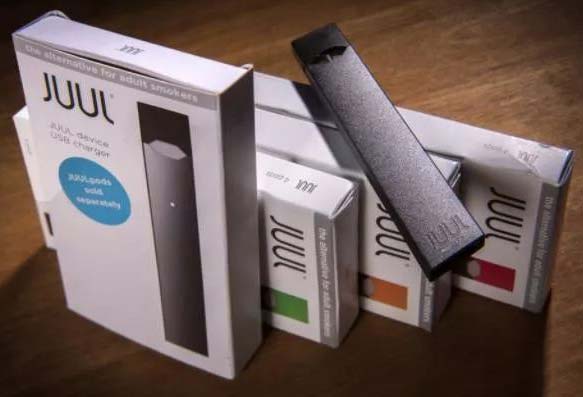
Juul e-cigarettes
This is of course a landmark event in the e-cigarette industry, and the core is the wealth effect of overseas pioneers. With the benchmarking case, this trend immediately blew back to China. But compared with the tracks favored by VCs in the past, e-cigarettes are not an area with a reasonable threshold.
There are more than 600 e-cigarette manufacturers in China, and representative companies listed on the New Third Board include Avips, McWeir, and Five-Wheel Electronics. Most emerging e-cigarette brands are supplied by OEM factories such as McWare, printed with LOGO, and shipped through their own channels, agents and distributors.
The production of e-cigarette atomizers, batteries, etc. is not difficult, but the most important thing is the factory that produces cigarette bombs. According to Tencent Technology, there are no more than 10 domestic companies with R & D capabilities in artificially synthesizing nicotine salts, and the pricing power and profit point of cigarette bombs are basically in the hands of these R & D factories.
“You spend a few months to half a year contacting suppliers, stocking up, and designing. The rest is that you don't need to do anything else. There is almost no hard investment. It is essentially a very light business." rdquo; Early investor Fu Qiang told Entrepreneurship News. Restrictions on raw materials and suppliers also lead to limited room for product differentiation.
Despite this, there are still many entrepreneurs flocking to e-cigarettes. A key factor is the high gross profit of the industry. Divide e-cigarettes into two parts: cigarettes and cigarettes. Cigarettes can have a gross profit of 80%, and cigarettes can also have a gross profit of 20 to 30%. The average gross profit is close to 50%, even after intensified competition drops to 20%, if the volume is increased, the profit will be considerable, Fu Qiang believes.
In addition to high gross profit driving, another attraction of the e-cigarette industry lies in its potential market space. Li Kanglin, partner of Tiantu Capital, told reporters that the current craze for e-cigarette entrepreneurship is mainly due to the huge market space for this new category. Data from China Industrial Research Institute shows that the number of smokers in my country has doubled that of the United States, but the penetration rate of e-cigarettes is only 1%, compared with 13% in the United States.
Low threshold, high gross profit, and huge market space. Can it be regarded as a sexy business?
Business models and risks
Li Kanglin has been paying attention to e-cigarettes since the second half of last year. After studying all the companies on the market, he felt that there were still opportunities in this market, and some relatively clear targets had emerged." ldquo; We still need to wait for the company's data, structure and other aspects to become clearer before we take action. The entire market should not develop for too long. After the capital structure is formed, the next step will be to compete and seize market share. rdquo;#p#pagination title #e#
Since technical and product barriers are flat, the key to competition undoubtedly lies in brand marketing and channels.
JUUL's victory in the U.S. market also benefits from excellent brand marketing. One of its founders graduated from Stanford with a degree in design and worked in Apple's design department. JUUL is also very good at pleasing young people. Its smoke bombs usually come in multiple colors and flavors, such as cucumber, mango, and cream pudding. In the end, it won the first place in the United States in market share, mainly relying on marketing promotion from 2017 to 2018. They pay special attention to the frequent use of social media by teenagers, such as Instagram.
Li Kanglin believes that the core of e-cigarette entrepreneurship is that the team must understand the brand, but the industry background is not so important. In Li Kanglin's view, e-cigarettes are not tobacco in nature, but a fast-moving consumer product similar to casual snacks. ldquo; Consumer goods themselves do not have much product innovation. From the perspective of product differentiation, most people cannot taste the difference between Pepsi and Coca-Cola." rdquo;
Fu Qiang also recognized that if a company can create a brand, establish strong channels, have high repurchase, and have considerable gross profit, it is certainly a good business. But he is still not very sure about the e-cigarette business model with only brands and channels.& ldquo; Only the sales parts such as brands and channels, I still feel quite worried." rdquo;
The greater uncertainty comes from the particularity of e-cigarettes and the unclear public opinion and policies surrounding it.
At present, China's supervision of the e-cigarette industry is in a blank period, but some local governments have already incorporated it into supervision and management. Following the ban on the use of e-cigarettes in public places in Hangzhou and Nanning, Shenzhen also introduced a ban on e-cigarettes in early 2019. The ban expands the concept of smoking to include the use of e-cigarettes or possession of other lit tobacco products, thereby adding e-cigarettes to the tobacco control blacklist.
As we learn from the past, the state's supervision of tobacco is a root cause risk issue. In addition, since e-cigarettes currently rely heavily on online channel sales, the regulatory attitude of the "E-commerce Law" towards micro-businesses will also directly affect the spread and sales of e-cigarettes.
Marketing targeting young people will also face public opinion risks. Compared with traditional cigarettes, e-cigarettes are less harmful, but they are still harmful. Younger marketing will inevitably lead a group of young people who are not addicted to smoking to develop the habit of smoking. Since 2018, JUUL has caused many legal lawsuits in the United States. The U.S. FDA even required it to take 60 days to prove that minors cannot obtain its e-cigarette products, otherwise these products will not be sold on the market.
Of course, before everything is clear, risk judgment is a subjective thing. In Li Kanglin's view, the so-called risks mainly depend on whose interests are touched. After experiencing several e-cigarette products, he made the judgment that the current e-cigarette products do not have much functionality, and their core users are not old smokers, so they are not enough to pose a threat to traditional tobacco manufacturers.
“E-cigarettes belong to the kind of fashionable consumer goods that typical young people like and are an incremental market. The iron law of consumer goods is that people are only willing to spend more money on products that have little functionality. rdquo; Li Kanglin believes.
Is Internet celebrities bringing goods the essence of business?
In this wave of e-cigarette entrepreneurship, the ones that have attracted the most public attention are Cai Yuedong, founder of Tongdao Uncle, and Zhu Xiaomu, former hammer technology executive. Their mentality of starting a business again is also worth pondering.
After Meisheng Holdings spent more than 200 million yuan to acquire Tongtong Culture, Cai Yuedong cashed in about 178 million yuan. In August last year, Cai Yuedong personally funded the establishment of the Black Swan Factory to invest and incubate early Short Video projects. I'm afraid it's because of the Short Video that it's not easy to get ashore this time. Although he did not have an official name in hand, the personal appeal of the same uncle still remained. Through the circle of friends, he sold 5 million yuan in sales in one day.
Cai Yuedong, founder of Tongdao Uncle
Coincidentally, Zhang Jinyuan, who took over as CEO of the same company, also turned to e-cigarettes. As Cai Yuedong's Tsinghua junior brother and former investor, Zhang Jinyuan once described a more ambitious blueprint for Tongtong Culture-Oriental Disney-after taking over as CEO.
But Oriental Disney 's vision may still be too ambitious. After all, in recent years, both the entertainment industry and the real estate industry have liked to flaunt themselves as Disney. Wang Jianlin, the former richest man, said that he would make Shanghai Disney unable to make profits within 20 years and still slapped him in the face. It's easy for a self-media company to make Disney.# p#pagination title #e#
Magnifying into the entire media industry, since last year, regulatory authorities have exercised unprecedented control. The Cyberspace Administration has successively interviewed Tencent, Weibo, Today's Headline and other platforms, and launched a centralized cleanup operation on a series of problems existing in self-media. At the capital level, several cases of listed companies acquiring self-media were stopped due to inquiries from the exchange.
It seems that there is not much growth in the self-media industry that relies on advertising for monetization. Although e-cigarettes are risky, it is still worth taking a risk. No one will admit that they want to make quick money, but it is human nature to seek benefits and avoid disadvantages. E-cigarettes are a business with a completely different reputation on the table.
“Internet celebrities bring goods to support many companies in Hangzhou. If you go there, you will find that many Internet celebrities drive Ferraris. The industry's gross profit reaches 25%. However, Internet celebrities neither control the production of clothing nor raw materials. If you sell well, I will place an order and ask the factory to produce it for me, and use the traffic of the celebrity to sell the goods. Isn't the same way to sell e-cigarettes?& rdquo; An investor bluntly said.
Like Lingxi LINX, the circulation of traffic in the private domain through the combination of head self-media matrices is indeed one of the competitive advantages of self-media entry. According to a closed-door meeting of the e-cigarette industry media steam, there are more than seven domestic media companies that have set up teams to prepare for cross-border e-cigarettes.

Self-media's big V may not have much aura of idealism, but the turn of Zhu Xiaomu, employee of Hammer 001, still makes some people who don't like to talk about business truly sigh.
The message of entrepreneurship comes very ambiguous. In December last year, Zhu Xiaomu also refuted rumors on Weibo that he had not left his job. Next month, Luo Yonghao announced his venture at the Chattreasure press conference. Given that Zhu's current Weibo certification is also the vice president of Hammer Technology's User Experience Center, and Luo Yonghao was also revealed to have visited the e-cigarette industry chain in Shenzhen last year, the possibility that this project was incubated internally by Hammer cannot be ruled out.
Zhu Xiaomu said on Weibo that regarding the brand name, there is a huge conflict between the English name FLOW and the Chinese name Fulu. This confrontation makes people laugh and cry. The comparison between the two entrepreneurial projects he himself has gone through before and after is also a little sad.
In the six years since the establishment of Hammer Technology, the Matthew effect in the mobile phone industry has become increasingly obvious. Once upon a time, Luo Yonghao stood on stage and told the people below that you are in a mediocre era that is not ideal today. But after experiencing challenges such as ticket skipping, insufficient production capacity and capital chain crisis, Luo Yonghao has become less paranoid.
Rather than ambitiously redefining the industry, Luo Yonghao has obviously begun to obey business rules, cycles, trends, and markets. From embracing proving himself, facing difficulties, and entering the most difficult mobile phone hardware business to now clenching his fists and bowing his head to sell chat treasures and e-cigarettes, Luo Yonghao's story can be called a model for the times to change lives.
This is by no means a change for one person. In 2019, as the dividends of the mobile Internet subsided, the word entrepreneurship experienced disenchantment. Perhaps for a long time in the future, there will be fewer and fewer entrepreneurs like Luo Yonghao who are obsessed with transforming mediocrity, proving themselves, and having obsessions, such as e-cigarettes. Projects with a clear monetization model will be more popular, even if they can only race against the time of regulatory failure with cash flow.


