
Zhengzhou Tobacco Research Institute of CNTC Makes Progress in E-Cigarette Aerosol Research
The Zhengzhou Tobacco Research Institute of China Tobacco Corporation has recently made some progress in the research on e-cigarette aerosols. The purpose is to provide reference and technical support for the research and development of e-cigarette products in my country's tobacco industry.
E-cigarettes belong to one of the electronic nicotine delivery systems. Electronic nicotine delivery systems are used to deliver nicotine to the respiratory system. The term covers products that contain substances derived from tobacco, but do not necessarily use tobacco. They're battery-powered devices that deliver vaporization of propylene glycol/ Nicotine mixture allows people to inhale varying doses of nicotine. Electronic nicotine delivery systems are sold under different brands and names, with the most popular name being e-cigarettes.

In recent years, withWHOWith the in-depth implementation of the Framework Convention on Tobacco Control, the growing global anti-smoking movement and the gradual increase in consumer health awareness, the sales of e-cigarettes as a smoking cessation product or smoking substitute in foreign markets have increased rapidly. Some multinational tobacco companies have Actively develop and promote e-cigarettes from a strategic perspective.
At present, my country's tobacco industry has regarded e-cigarettes as an important direction for the development of new tobacco products. The development and research of e-cigarettes is still in its infancy, and there is a lack of basic research work. The smoke properties and release of harmful components of e-cigarette aerosols are not yet fully understood. There have been some literature reports on the analysis and research of e-cigarette aerosols abroad; no domestic research in this regard has been reported, and there is a lack of reference documents for systematic analysis and research of e-cigarette aerosols. Therefore, the institute is close to10The domestic and foreign literature on e-cigarette aerosol research over the past few years has been systematically and comprehensively summarized to grasp the current status and key topics of e-cigarette aerosol research, and provide technical support and decision-making reference for the research and development of e-cigarette products in my country's tobacco industry.
1Comparison of chemical compositions between e-cigarette aerosols and traditional cigarette smoke
Related research shows that the release of many harmful components in e-cigarette aerosols is much lower than the release of them in mainstream smoke of traditional cigarettes. Representative documents are as follows:2012 Year,Lauterbach Use a standard analytical smoking machine and smoke per puff55 mL, Suction per puff #p#pagination title #e#3 s, Suction interval is30s Compare the conditions for smoking e-cigarettes and cigarettes1 The release of chemical components from aerosols from mainstream e-cigarettes and cigarettes. Study results (Table1) shows that under the smoking scheme adopted, the nicotine release in e-cigarette aerosol is only that of the nicotine release in traditional cigarette mainstream smoke.2.5%, many other harmful ingredients are released less than traditional cigarettes98%。At the same time, e-cigarettesCO、B[a]P, benzene,1,3- ding
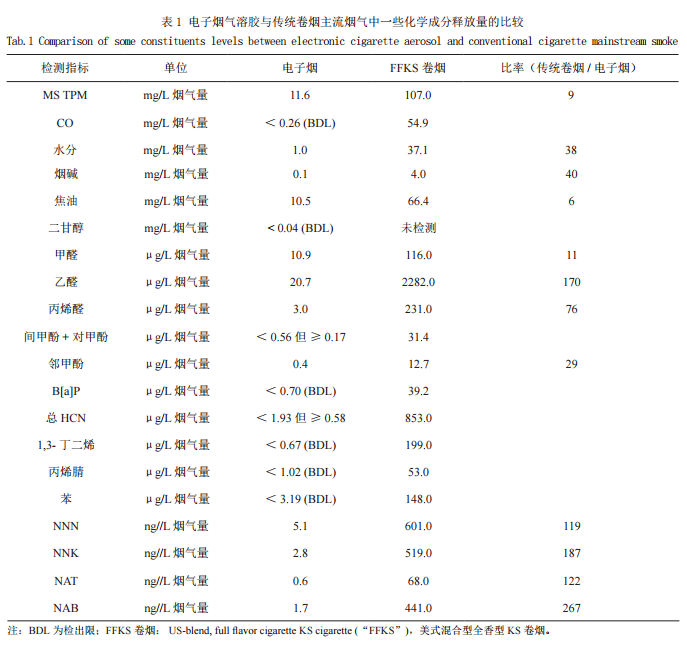
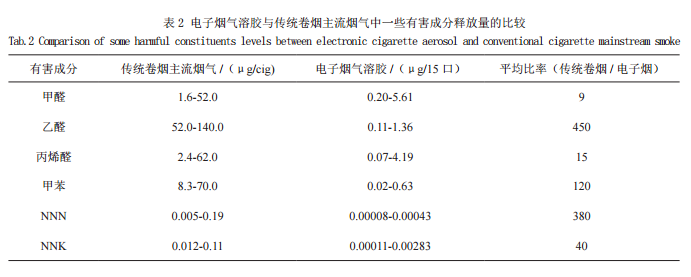
2013 Year,Goniewicz et al. compared some harmful components in traditional cigarette mainstream smoke and e-cigarette aerosols (see table2), Studies have shown that e-cigarette aerosols can release some harmful components that appear in traditional cigarettes, but the amount they release in e-cigarette aerosols is only that released in mainstream smoke of traditional cigarettes.1/450~1/9, that is0.2%~11.1%。
2Environmental smoke from e-cigarette aerosols #p#Page title #e#
E-cigarettes do not burn tobacco and have no sidestream smoke. However, the aerosol exhaled by e-cigarette smokers will have some impact on the environmental space. At present, there are few studies on e-cigarette aerosol environmental smoke.
2012Year,Mcauley et al. compared the volatile organic compounds (volatile organiccompounds,VOCs), carbonyl compounds,PAHs, nicotine,TSNAs The results showed that compared with traditional cigarettes, e-cigarettes produce very small pollutant exposure, and the environmental smoke of e-cigarette aerosols is not significant to human health.
2014 Year,Czogala Other reports, smokers smoke e-cigarettes1 h After, in the ambient smokePM2.5an average concentration of151.7±86.8 μg/m3,COThe concentration of volatile organic compounds such as toluene did not increase, and the average concentration of nicotine was3.32±2.49 ug/m3; while smokers smoke traditional cigarettes1 h After,#p#pagination title #e#in ambient smokePM2.5 an average concentration of819.3±228.6 μg/m3, the average concentration of nicotine is31.60±6.91 ug/m3,CO, toluene, ethylbenzene and xylene have increased.

3In vitro toxicological evaluation of e-cigarette aerosols
At present, there are few literature evaluating the in vitro toxicology of e-cigarette aerosols, but research in relevant literature shows that e-cigarette aerosols have no obvious toxic effects compared with traditional burning cigarettes.
Misra The toxicity evaluation results of e-cigarette liquid and e-cigarette aerosol condensate showed that at the tested dose, there was no obvious toxic effect compared with burning cigarettes, and the presence of nicotine and flavor components in e-cigarette liquid did not cause any cytotoxicity and genotoxicity, while traditional cigarettes showed obvious in vitro toxic effects under comparable exposure conditions.
Cervellati et al. using submicroscopic morphology observation, Trypan blue exclusion test and lactate dehydrogenase- The results of in vitro toxicity studies on human keratinocytes and lung epithelial cells such as cytotoxicity detection and analysis kits show that the cytotoxicity of e-cigarette aerosols is much less than that of traditional cigarette smoke.
NeilsonThe results of three-dimensional cell culture experiments on human trachea and bronchial epithelial cells using the neutral red blood cell toxicity test method showed that the cytotoxicity of e-cigarette aerosols was significantly lower than that of traditional cigarettes. Zhang Liang and others studied the cytotoxicity of mainstream smoke from different e-cigarettes under different smoking methods. The results of neutral red blood cell toxicity showed that the cytotoxicity of mainstream smoke from e-cigarettes was significantly less than that of #p#Page title #e#3R4F Reference cigarettes.
FarsalinosResearch found that some e-cigarette liquids containing aroma components are toxic, but the cytotoxicity of all e-cigarette aerosols is significantly lower than that of traditional cigarette smoke.Giorgio Research by et al. also proved that the in vitro cytotoxicity of e-cigarette aerosols is significantly lower than that of traditional cigarette smoke.
A review of the previous literature on electronic cigarette aerosols shows that the physical and chemical properties and toxicological evaluation of electronic cigarette aerosols are significantly different from those of traditional cigarettes. HOFFMANNS The detection rate of harmful components in the list is low in e-cigarette aerosols. The release of some harmful components in e-cigarette aerosols is much lower than their release in mainstream smoke of traditional cigarettes. The toxicity of e-cigarette aerosols is significantly lower than that of traditional cigarette smoke. As a new type of tobacco product, e-cigarettes can reduce the risk of smokers 'exposure to some harmful components of smoke and are worthy of in-depth research and development.


