
Can Vapes Help You Quit Smoking? Research Shows Limited Effectiveness
From kits costing a few dozen yuan to those priced over ten thousand, with flavors like cigar and mint... In recent years, the online sale of e-cigarettes has surged, and it is not uncommon to see users of e-cigarette products. What exactly are e-cigarettes, can they help with quitting smoking, and are there any dangers? The reporter conducted interviews on this topic.
The reporter searched online and found that major e-commerce platforms are selling e-cigarettes and related products. On one shopping platform, the reporter entered "e-cigarette" for queries and found over 100 related brands, with prices ranging from a dozen yuan for a single unit to over ten thousand for a complete set, while the top-selling product recorded monthly sales of 15,000 units.
Can e-cigarettes help with quitting smoking? Research shows limited effectiveness.
E-cigarettes are a smoking method that vaporizes nicotine and other substances for users to inhale. They do not burn to produce smoke, have no solid particles, and contain no tar. Compared to the thousands of chemicals found in cigarette smoke, e-cigarettes are often considered safer.
The reporter found that some e-cigarettes claim in their product descriptions to be "quit smoking artifacts," while others assert they can "clean the lungs." Some e-cigarette users also believe that using e-cigarettes helps with quitting smoking.
Wu Yiqun, deputy director of the New Exploration Health Research Center, told the reporter that the amount of nicotine in e-cigarettes sold on the market is not fixed and varies greatly, which is significantly different from the nicotine replacement therapy advocated by the World Health Organization.
Yang Jie, a researcher at the Tobacco Control Office of the Chinese Center for Disease Control and Prevention, stated that there is currently no scientific evidence proving that smokers achieve quitting goals by using e-cigarettes, nor has any authoritative organization evaluated the quitting effectiveness of e-cigarettes.
Moreover, e-cigarettes have led to dual usage of traditional cigarettes and e-cigarettes among smokers. Experts analyze that for many heavy smokers, e-cigarettes only reduce cigarette use but simultaneously exacerbate nicotine dependence, making quitting even more difficult.
Dr. Gan Quan from the International Union Against Tuberculosis and Lung Disease introduced that a study in New Zealand showed that the quitting rate of smokers who intended to quit did not change significantly after using e-cigarettes.
A new study in the United States found that for teenagers, e-cigarettes, seen as alternatives to traditional cigarettes, not only do not help them quit smoking but may also make them more susceptible to nicotine addiction.
Experts say e-cigarettes produce secondhand smoke, and risks still exist.
In interviews, several e-cigarette users told the reporter that e-cigarettes do not contain tobacco and do not produce secondhand smoke, so they can be used in public places. However, in recent years, all domestic airlines have said "no" to e-cigarettes, prohibiting passengers from using e-cigarettes on planes.
In response, Yang Jie explained that e-cigarettes do not only produce "water vapor"; they also emit inhalable liquid fine particles, ultrafine particles, and nicotine, which means they cannot completely eliminate the health impact of secondhand smoke on non-smokers.
Wu Yiqun told the reporter that based on current research, it is still unclear whether exposure to toxic substances and particles in e-cigarette vapor, like exposure to tobacco smoke, increases the risk of disease and death for secondhand smoke inhalers. However, from the perspective of protecting public health, exposure to secondhand smoke should be avoided.
Experts generally believe that since the safety of e-cigarettes has not been fully scientifically validated, the zero tolerance policy for secondhand smoke from traditional cigarettes should also apply to e-cigarettes.
The nicotine in e-cigarettes is highly addictive, and the dangers remain unclear.
The reporter learned that some e-cigarette products claim in their advertising to have "the taste of real cigarettes" and "no tar or harmful substances." So, how do e-cigarettes specifically meet the needs of smokers?
Zeng Fanyu, director of the office of the China Tobacco Control Association, explained that e-cigarettes generally consist of three parts: a lithium battery, an atomizer, and a cartridge. The cartridge uses propylene glycol and glycerin as main blending agents, adding nicotine and other flavoring components. The atomizer is used to heat the e-liquid into vapor.
So, are e-cigarettes safe?
Yang Jie said that e-cigarette aerosol typically contains some carcinogenic compounds and other toxic substances found in tobacco smoke, but the average content is 1-2 orders of magnitude lower than that in tobacco smoke, so it can be considered that the toxin levels in e-cigarettes are lower. However, he told the reporter that nicotine is the addictive component of tobacco and may also act as a "tumor initiator."#p#分页标题#e#
Wu Yiqun said that the nicotine in e-cigarettes is not synthetic but extracted from tobacco. Nicotine is an addictive substance and a toxin. Some e-cigarette products contain high levels of nicotine, which can even cause direct harm to the human body, so it should not be simply considered safe.
For "three no" e-cigarettes, experts recommend conducting safety assessments and strengthening regulation.
The World Health Organization's official website shows that e-cigarettes are already sold in over 50 countries and regions. In 2013, global e-cigarette sales reached approximately $3 billion. Due to the inability to verify the safety of e-cigarettes, governments around the world have differing attitudes and policies towards e-cigarettes, with some countries, including Brazil, Norway, and Singapore, beginning to restrict or completely ban the sale of e-cigarettes.
On August 26, the World Health Organization released a report in Geneva stating that e-cigarettes also produce toxic substances and harm health, and governments should take measures to prohibit the sale of e-cigarettes to minors.
Gan Quan suggested that the production, marketing, and sale of e-cigarettes should be regulated, treating e-cigarettes as pharmaceuticals. At the same time, a complete ban on advertising, promotion, and sponsorship of e-cigarettes should be implemented, prohibiting the promotion of e-cigarettes as a quitting method and their use in public places, workplaces, and public transport.
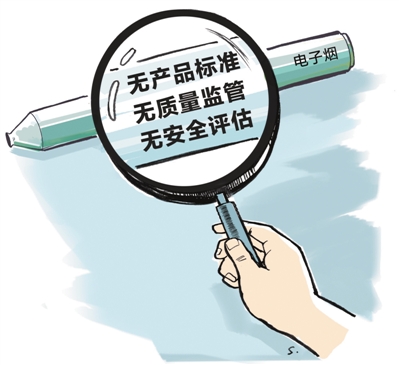
Experts noted that although production is massive, e-cigarettes in China still fall under the "three no" category: no product standards, no quality regulation, and no safety assessment. Due to the current lack of clear classification and definition of e-cigarettes, it is difficult to designate them as specific regulatory objects, leading to disorder in production and a lack of regulation.
Given that the main component of e-cigarettes is nicotine, which is an addictive and highly toxic substance, Zeng Fanyu suggested that the National Medical Products Administration should regulate them as pharmaceuticals.
Experts recommend that national health and drug administration departments should specifically fund projects, organize professionals, allocate research funds to scientifically evaluate the safety of e-cigarettes, and propose scientifically sound policies to be responsible for the health of smokers and those around them.


