
Beginner-Friendly the Viper RTA Review
A single-coil setup means easier operation, purer flavor, and better coil compatibility. WOTOFO has long excelled in the development of single-coil RTA atomizers, and this time we are looking at its latest release: the Viper RTA. Many users have had the e
Single coil means simpler operation, purer taste, and better coil compatibility. WOTOFO is a leader in the development of single-coil RTA atomizers (such as the Serpent, Alto, etc.), and today I bring you WOTOFO's latest single-coil RTA, the Viper.
Many of you may have experienced this: you just got a pair of great fancy coils and eagerly installed them in your atomizer, but no matter how you adjust, you can't get both coils to heat up simultaneously. This is usually due to the electrode post structure of the atomizer (excluding issues with coil production or lead lengths), which can be quite embarrassing.
At this point, a single-coil atomizer can solve your problem, helping you rescue those coils that can no longer be used in a dual-coil atomizer (isn't that great?). The newly added oil path locking design can completely eliminate the hassle of leaking oil.
Alright, after all that, let's start the official review!
RTA Packaging<\/strong>
 <\/strong>
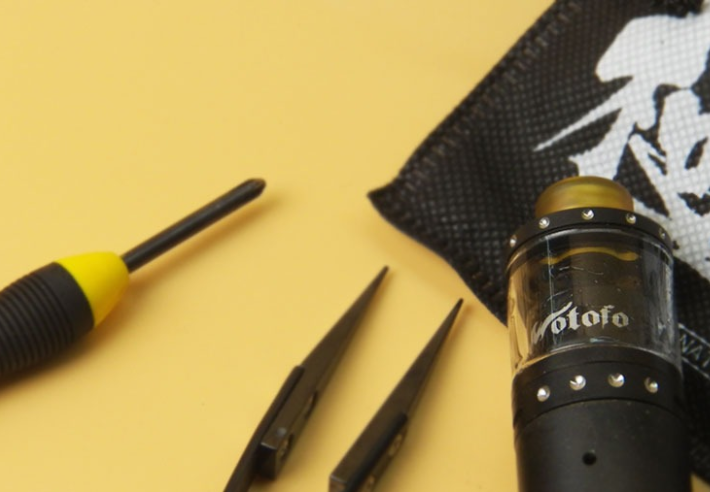
Wotofo's traditional drawer-style packaging features two layers: the upper layer contains the atomizer body and a spare oil tank, while the lower layer includes Wotofo's magical little bag, which contains two pre-made coils (dual-core Clapton), a pack of cotton, a T-shaped screwdriver, and a set of O-rings and screws.
RTA Appearance<\/strong>
 <\/strong>
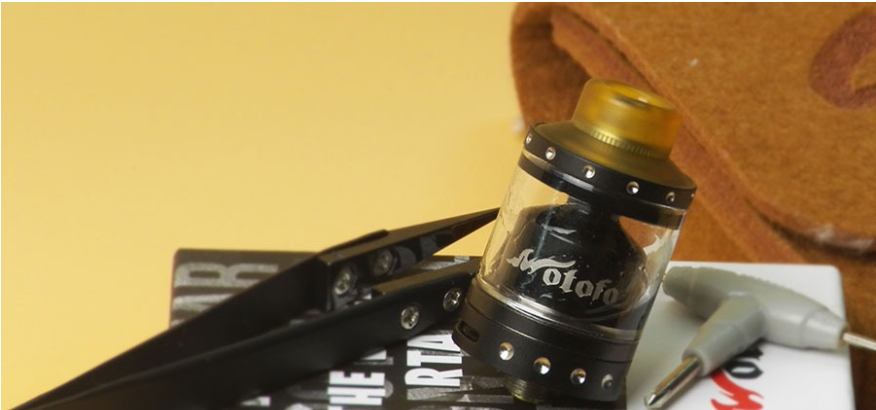
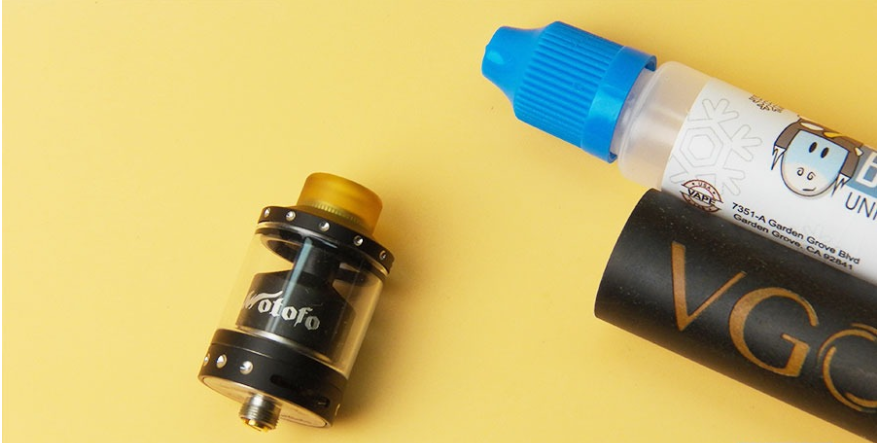
The all-black base paired with a yellow PEI drip tip and metallic-colored dots on the top and bottom gives it a stylish look without being too dark. The Wotofo logo on the atomization chamber adds a touch of coolness (though beauty is subjective, and everyone has different tastes).
RTA Disassembly Structure<\/strong>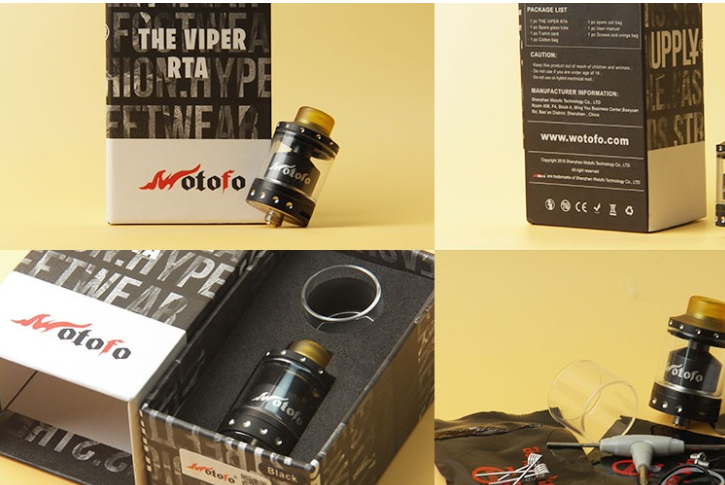
The atomizer structure is relatively simple, consisting of five parts: the drip tip (integrated with the top cap), the atomization chamber with a filling ring, the glass oil tank, the electrode base, and the airflow adjustment ring. All parts fit tightly, preventing oil leakage due to tolerances, and the threads of each component fit well, making disassembly and cleaning relatively easy.
RTA Classification Details<\/strong>
The drip tip has many optimized details for a better experience. First, the hat-shaped PEI drip tip ensures heat insulation and protects the lips from the heat conducted from the atomization chamber. The metal threads ensure it won't strip due to misalignment (and have high durability). The top of the vapor channel is recessed, and the internal multi-level steps provide excellent resistance to condensation (completely avoiding condensation entry issues).

The sealing O-rings at the filling ring are positioned low to avoid high pressure when closing the oil tank, and the extensive use of conical slopes, combined with the kidney-shaped filling holes, makes the filling process more convenient. The smooth and flowing dome curvature inside the atomization chamber enhances the compression effect on the vapor, meaning the taste will be richer. The circular decoration on the outer edge of the filling ring also increases friction.
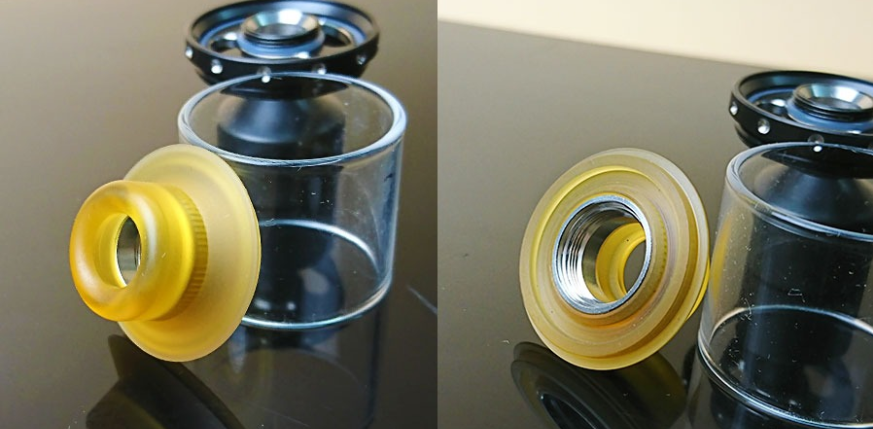
The oil tank's edges are rounded, with high transparency and excellent craftsmanship. The overall oil capacity after installation is around 3ml, which is sufficient for a single-coil setup.
The electrode base includes a very practical feature: the oil path lock (no more worries about leaking atomizers!). In the image, 1 shows the oil path open mode, and 2 shows the closed mode. The single-sided dual-post design with dual holes can accommodate most complex fancy heating wires on the market, and the spacing between the electrode posts is suitable for the width of current complex fancy heating wire coils. The low-positioned oil guide groove allows this atomizer to extract the last drop of e-liquid from the tank.
The bottom electrode screws are protruding, allowing safe use with mechanical devices. Other than that, there is nothing particularly special, just the atomizer's name and manufacturer's logo printed on it. #p#Pagination Title#e#
RTA Operation Demonstration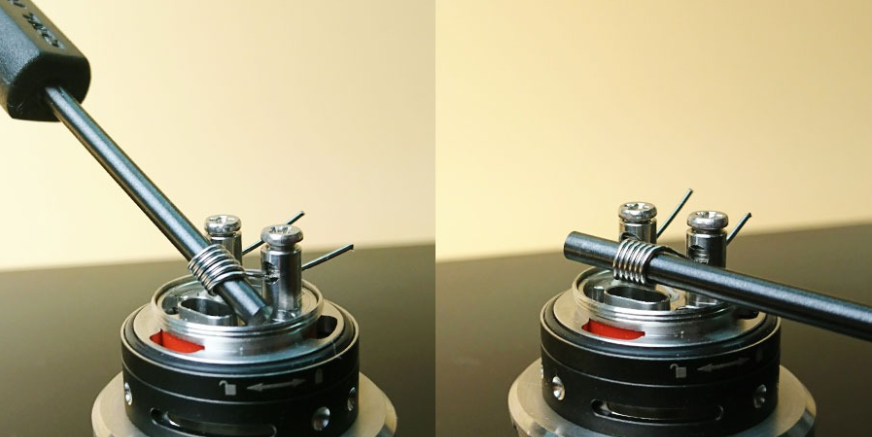
Installing a standard coil is not complicated; simply insert the coil into the electrode post, ensuring it is positioned directly above the airflow hole, then tighten the screws. After that, use a winding rod to straighten the coil and trim any excess leads, and we can start burning the wire.
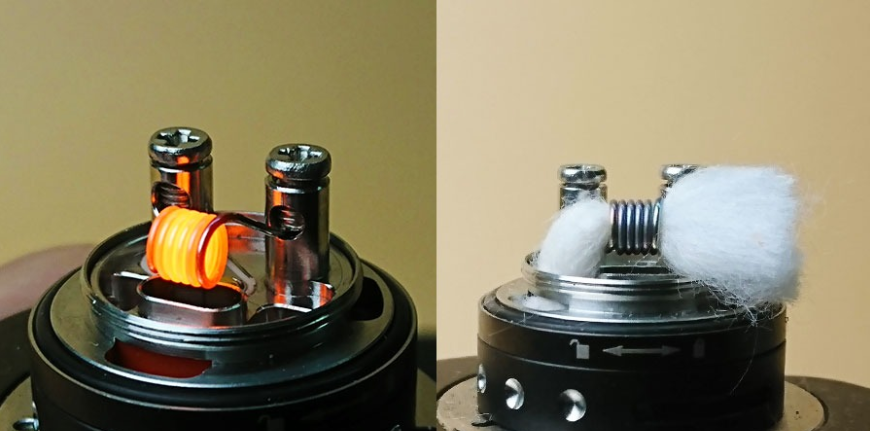
Since this is a single-coil atomizer, there is no need to worry about getting both coils to heat up simultaneously, making the wire burning process exceptionally simple. The length of the cotton should match the outer edge of the base. Since the oil guide line is compressed in the middle, when making the oil guide cotton, it is advisable to thin the cotton tips to avoid insufficient oil delivery.
After installing the oil guide cotton, the display of the oil path's open and closed states shows that after installing the oil tank, simply twisting the tank can open and close the oil path, which is very simple and convenient.
Issues and Advantages Found During RTA Use
The oil delivery effect after thinning the cotton is commendable, but when using complex fancy heating wires, the oil delivery speed still seems slightly insufficient, and continuous deep lung inhales may cause a burnt wick issue; avoiding prolonged inhalation can prevent this problem.
The layering and e-liquid authenticity are quite good, but when using standard coils, the flavor richness is not high. Partially closing the airflow can help mitigate this issue.
The design of the drip tip and top cap is very clever, completely eliminating concerns about burning the lips and condensation entry issues. Of course, the inability to replace the drip tip is a pain point for some users.
The combination of the oil path lock and oil tank structure allows users to rescue e-liquid in case of leaks (caused by poorly made oil guide cotton). Simply close the oil path, invert the atomizer, remove the base, redo the oil guide cotton, and reassemble the base.
The circular grooves on the top and bottom of the atomizer can easily accumulate dirt, making cleaning a bit challenging, but rinsing with water can resolve this issue.
One thing to note when closing the top cap is that since the direction to open the oil path is the same as the direction to close the top cap, you need to hold the oil tank to keep the oil path fixed, avoiding the simultaneous opening of the oil path when closing the top cap.
RTA Performance Testing
Still using a 4-point comparison system, with four points being the maximum score.
General data (0.6 Kanthal A1 heating wire, 3.0 diameter, 6 wraps, 0.4Ω) flavor performance under 3.7V: authenticity 3, fullness 2, layering 2, richness 3.
Under general data, the vapor effect shows that the vapor volume is quite considerable.
(0.32 wire diameter Kanthal A1 heating wire, 3.0 diameter, and 6 wraps, 0.64Ω resistance) flavor performance under 3.7V: authenticity 4, fullness 4, layering 4, richness 1 (closing 1/2 airflow can reach 3 points).
Under 0.32 dual data, the vapor effect shows that the vapor volume is relatively thin, but still at a high vapor level.
The Rhino finished dual-core Clapton wire flavor performance under 3.7V: authenticity 3, fullness 2, layering 3, richness 3.
The Rhino finished dual-core Clapton wire single-coil vapor effect shows that the vapor volume is not large, only comparable to the dual 0.32 wire.
The Alien Clapton wire flavor performance under 3.7V: authenticity 4, fullness 2, layering 3, richness 4 (continuous deep inhales may cause burning).
Although some issues arose during the actual experience, these problems are not likely to occur during daily use (such as prolonged deep lung inhales). This atomizer is very suitable for beginners to use, as it does not require high cotton amounts (it can be said that the thinner, the better, but not too thin), and the difficulty of resetting the coil is extremely low, with the oil path locking mechanism (leaking oil? Not a chance!).
The only concern is the compatibility of the data; this atomizer does not work well with standard coils, meaning you need to use dual or other methods to make coils for better flavor performance, or use fancy heating wires.
Overall, this atomizer is very suitable for beginners entering the DIY world, as it won't discourage them from trying e-cigarettes due to various issues, and they can confidently experiment with different data (low learning curve). #p#Pagination Title#e#
Many of you may have experienced this: you just got a pair of great fancy coils and eagerly installed them in your atomizer, but no matter how you adjust, you can't get both coils to heat up simultaneously. This is usually due to the electrode post structure of the atomizer (excluding issues with coil production or lead lengths), which can be quite embarrassing.
At this point, a single-coil atomizer can solve your problem, helping you rescue those coils that can no longer be used in a dual-coil atomizer (isn't that great?). The newly added oil path locking design can completely eliminate the hassle of leaking oil.
Alright, after all that, let's start the official review!
RTA Packaging<\/strong>
<\/strong>
Wotofo's traditional drawer-style packaging features two layers: the upper layer contains the atomizer body and a spare oil tank, while the lower layer includes Wotofo's magical little bag, which contains two pre-made coils (dual-core Clapton), a pack of cotton, a T-shaped screwdriver, and a set of O-rings and screws.
RTA Appearance<\/strong>
<\/strong>
The all-black base paired with a yellow PEI drip tip and metallic-colored dots on the top and bottom gives it a stylish look without being too dark. The Wotofo logo on the atomization chamber adds a touch of coolness (though beauty is subjective, and everyone has different tastes).
RTA Disassembly Structure<\/strong>
The atomizer structure is relatively simple, consisting of five parts: the drip tip (integrated with the top cap), the atomization chamber with a filling ring, the glass oil tank, the electrode base, and the airflow adjustment ring. All parts fit tightly, preventing oil leakage due to tolerances, and the threads of each component fit well, making disassembly and cleaning relatively easy.
RTA Classification Details<\/strong>
The drip tip has many optimized details for a better experience. First, the hat-shaped PEI drip tip ensures heat insulation and protects the lips from the heat conducted from the atomization chamber. The metal threads ensure it won't strip due to misalignment (and have high durability). The top of the vapor channel is recessed, and the internal multi-level steps provide excellent resistance to condensation (completely avoiding condensation entry issues).
The sealing O-rings at the filling ring are positioned low to avoid high pressure when closing the oil tank, and the extensive use of conical slopes, combined with the kidney-shaped filling holes, makes the filling process more convenient. The smooth and flowing dome curvature inside the atomization chamber enhances the compression effect on the vapor, meaning the taste will be richer. The circular decoration on the outer edge of the filling ring also increases friction.
The oil tank's edges are rounded, with high transparency and excellent craftsmanship. The overall oil capacity after installation is around 3ml, which is sufficient for a single-coil setup.
The electrode base includes a very practical feature: the oil path lock (no more worries about leaking atomizers!). In the image, 1 shows the oil path open mode, and 2 shows the closed mode. The single-sided dual-post design with dual holes can accommodate most complex fancy heating wires on the market, and the spacing between the electrode posts is suitable for the width of current complex fancy heating wire coils. The low-positioned oil guide groove allows this atomizer to extract the last drop of e-liquid from the tank.
The bottom electrode screws are protruding, allowing safe use with mechanical devices. Other than that, there is nothing particularly special, just the atomizer's name and manufacturer's logo printed on it. #p#Pagination Title#e#
RTA Operation Demonstration
Installing a standard coil is not complicated; simply insert the coil into the electrode post, ensuring it is positioned directly above the airflow hole, then tighten the screws. After that, use a winding rod to straighten the coil and trim any excess leads, and we can start burning the wire.
Since this is a single-coil atomizer, there is no need to worry about getting both coils to heat up simultaneously, making the wire burning process exceptionally simple. The length of the cotton should match the outer edge of the base. Since the oil guide line is compressed in the middle, when making the oil guide cotton, it is advisable to thin the cotton tips to avoid insufficient oil delivery.
After installing the oil guide cotton, the display of the oil path's open and closed states shows that after installing the oil tank, simply twisting the tank can open and close the oil path, which is very simple and convenient.
Issues and Advantages Found During RTA Use
The oil delivery effect after thinning the cotton is commendable, but when using complex fancy heating wires, the oil delivery speed still seems slightly insufficient, and continuous deep lung inhales may cause a burnt wick issue; avoiding prolonged inhalation can prevent this problem.
The layering and e-liquid authenticity are quite good, but when using standard coils, the flavor richness is not high. Partially closing the airflow can help mitigate this issue.
The design of the drip tip and top cap is very clever, completely eliminating concerns about burning the lips and condensation entry issues. Of course, the inability to replace the drip tip is a pain point for some users.
The combination of the oil path lock and oil tank structure allows users to rescue e-liquid in case of leaks (caused by poorly made oil guide cotton). Simply close the oil path, invert the atomizer, remove the base, redo the oil guide cotton, and reassemble the base.
The circular grooves on the top and bottom of the atomizer can easily accumulate dirt, making cleaning a bit challenging, but rinsing with water can resolve this issue.
One thing to note when closing the top cap is that since the direction to open the oil path is the same as the direction to close the top cap, you need to hold the oil tank to keep the oil path fixed, avoiding the simultaneous opening of the oil path when closing the top cap.
RTA Performance Testing
Still using a 4-point comparison system, with four points being the maximum score.
General data (0.6 Kanthal A1 heating wire, 3.0 diameter, 6 wraps, 0.4Ω) flavor performance under 3.7V: authenticity 3, fullness 2, layering 2, richness 3.
Under general data, the vapor effect shows that the vapor volume is quite considerable.
(0.32 wire diameter Kanthal A1 heating wire, 3.0 diameter, and 6 wraps, 0.64Ω resistance) flavor performance under 3.7V: authenticity 4, fullness 4, layering 4, richness 1 (closing 1/2 airflow can reach 3 points).
Under 0.32 dual data, the vapor effect shows that the vapor volume is relatively thin, but still at a high vapor level.
The Rhino finished dual-core Clapton wire flavor performance under 3.7V: authenticity 3, fullness 2, layering 3, richness 3.
The Rhino finished dual-core Clapton wire single-coil vapor effect shows that the vapor volume is not large, only comparable to the dual 0.32 wire.
The Alien Clapton wire flavor performance under 3.7V: authenticity 4, fullness 2, layering 3, richness 4 (continuous deep inhales may cause burning).
Although some issues arose during the actual experience, these problems are not likely to occur during daily use (such as prolonged deep lung inhales). This atomizer is very suitable for beginners to use, as it does not require high cotton amounts (it can be said that the thinner, the better, but not too thin), and the difficulty of resetting the coil is extremely low, with the oil path locking mechanism (leaking oil? Not a chance!).
The only concern is the compatibility of the data; this atomizer does not work well with standard coils, meaning you need to use dual or other methods to make coils for better flavor performance, or use fancy heating wires.
Overall, this atomizer is very suitable for beginners entering the DIY world, as it won't discourage them from trying e-cigarettes due to various issues, and they can confidently experiment with different data (low learning curve). #p#Pagination Title#e#


